
One of the beautiful things you will sometimes see in Israel is a car driving by that’s all decorated for a bride and groom. It’s always a wonderful feeling, because another Jewish home is being built.
But then you realize that there’s another car driving toward the very same wedding: the mother and father of the bride. And another car carrying the groom’s parents.
Their cars aren’t decorated—their vehicle might be driving literally right next to you, but because there’s no sign on it, you have no idea that the person sitting inside is about to walk their child down to the chuppah. They might not be as visibly ecstatic as the bride or groom, but there is an incredible sense of happiness inside them. You’re looking at the person, and you have no idea about the emotions happening inside.
To a certain degree, I find myself experiencing a similar feeling on certain days of the Jewish year. One of those days is coming up this week: Jerusalem Day, Yom Yerushalayim.
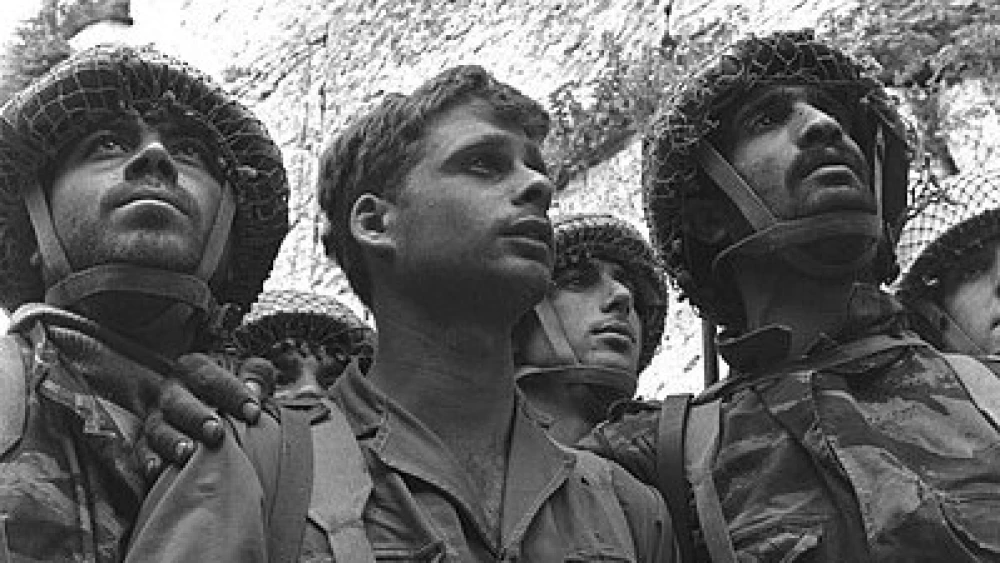
I was not born in 1967. I was born only nine years later. But every year on Yom Yerushalayim, and for that matter whenever I go to the Old City, I try to think about the emotions that Israeli Col. Mordechai (“Motta”) Gur and members of the 55th Paratrooper Brigade were experiencing when they broke through the Lions’ Gate, came into the Old City on June 7, placed an Israeli flag on the Temple Mount and said the words: Har HaBayit beyadeinu—“The Temple Mount is in our hands.”
They are some of the most powerful words in modern Jewish history.
Every year, I ask myself: What were the emotions running through Gur’s heart and mind, as well as the other paratroopers there, when they said it? How can we try to relive those emotions, that feeling, that excitement?
Sadly, I feel the Jewish people do not embrace this day as much as they should. Yes, the streets of Jerusalem on Yom Yerushalayim fill up with hundreds of thousands of people coming from all over the country. (This year, much of the celebration will take place the night before since it falls on Friday.)
But unfortunately, when you find yourself talking to people outside of the city, outside of specific circles in the State of Israel, and especially outside of Israel, you don’t always have the feeling that you’re talking to somebody who understands and appreciates the day and its meaning.
Jerusalem is at the root of our religious identities. There’s the famous song that we all know, the one we’ve sung in NCSY and every other youth group and yeshivah for decades: “Bilvavi Mishkan Evneh.” Ultimately, it captures the idea that there’s a piece of Yerushalayim inside the heart of every single Jew in the world. There is no other city about which every Jew can say, “There is a piece of me that is connected to this place.”
There are wonderful cities across Eretz Yisrael: Hebron, Tiberias, Safed and many other great ones. But you cannot tell me that every Jew in the world has a connection to any of those cities as they do to Jerusalem.
Every synagogue around the world faces Jerusalem. Every davening that the Jewish people have is focused on Jerusalem. Vetechezenah eineinu beshuvcha leTziyon, “Let our eyes see the return to Yerushalayim.” These are tefillot that we say every single day, three times a day, again and again and again. It is ultimately what every Jew around the world is yearning for.
I remember as a kid growing up in Staten Island, N.Y. I went to school at RJJ. There was a choir called Tzlil V’Zemer that came out with a song, “The Little Bird Is Calling,” about a little bird that wishes to return.
And where is home? “The nest is Yerushalayim, where we yearn to be once more.”
I remember singing it as a young child and really yearning to be there—really feeling that I was that little bird longing to come home. And we were able to make it back to Yerushalayim. On our first day in Israel, my family made sure to go to Yerushalayim, to live and feel what this incredible city is all about.
But we take it for granted. I take it for granted, because I wasn’t there when Motta Gur announced those immortal words. I wasn’t there when suddenly we were able to walk to all sides of the city. I was born into a Jerusalem that was already unified, already ours. It is difficult to imagine a reality without it. But we all must recognize what it is we have and not allow ourselves the luxury of taking it for granted.
This is why, even though it is 59 years after reunification, if we continue celebrating Yom Yerushalayim and continue to give thanks for this miracle called Jerusalem, again and again and again, then we won’t take it for granted, and we’ll be able to truly rejoice in it.
Whether we choose to sit at home in Beit Shemesh or Ma’ale Adumim and watch the beautiful ceremony held each year at Yeshivat Merkaz HaRav, come to the “March of Flags” (Rikud Degalim) in Jerusalem, or decorate our homes with pictures of Jerusalem on Yom Yerushalayim, let us make sure that this city is never something we take for granted.
After 2,000 years of exile, we have returned here. Let us show our deep appreciation for this precious gem of a city that every Jew should feel connected to and carry within them.
There is no stronger statement we can make to our children, neighbors, friends and communities than to celebrate Yom Yerushalayim openly, proudly and with gratitude.
At the OU, together with the Yerushalayim Municipality, we gather each year on the Tayelet in Armon Hanatziv for a moving prayer overlooking the city itself, reminding us that Jerusalem is not something to be taken for granted, but a gift to cherish, protect and celebrate.