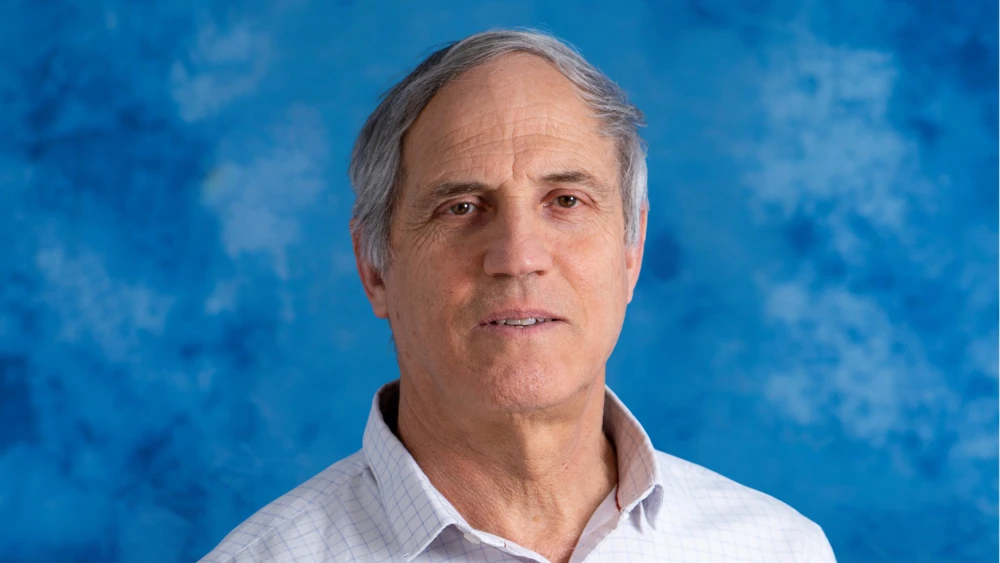
One year into his presidency at the Jerusalem College of Technology (JCT), Avi Domb, Ph.D., finds himself leading at a moment when institutional transformation and national reality are inseparable.
This has not been a year of incremental change. It has been a year of acceleration—of rethinking academic programs, expanding into critical fields like healthcare and engineering and embedding artificial intelligence across disciplines. At the same time, many students have spent months not in classrooms, but in uniform.
In this conversation, Domb reflects not only on achievements, but on the deeper question facing JCT: What does it mean to educate—and to lead—when the ground itself is shifting?
Q: Looking back on your first year, what stands out as your most significant accomplishments and where do you still see major challenges ahead?
Domb: This past year has been about renewal with purpose. Not cosmetic change, but a deliberate effort to align everything we teach with the realities our graduates will face.
We are expanding into areas where demand is both immediate and structural. In healthcare, we are working toward establishing a pharmacy program and developing programs in medical imaging, which is rapidly becoming central to modern medicine.
In engineering, we are advancing plans for mechanical and civil engineering programs—core disciplines that are essential for Israel’s infrastructure and long-term development.
At the same time, we are integrating artificial intelligence across all departments. Not just in computer science, but in every engineering field. AI is no longer a specialization—it is part of the professional language of the future.
We are also rethinking existing programs. For example, our nursing program is being redesigned—shorter, more focused and better aligned with healthcare system needs.
But there are constraints. We operate within the framework of the Council for Higher Education. If it were entirely up to us, we would move even faster—even toward establishing a medical school, which is clearly needed, especially for communities seeking high-level education within a values-based framework.
At JCT, students carry a heavy load—academically and personally. They deserve not only excellence, but a sense of belonging and support.
Q: Israel is once again facing a complex regional reality. How has this affected JCT in practice?
Domb: Beyond all of this, there is something just as important: our students’ experience. The impact is immediate and very real.
A significant portion of our students serve in the IDF reserves, many in combat roles. There are times when entire classes are missing because students are on active duty.
This creates a profound challenge—not only logistically, but also socially. You have students sitting side by side—some returning from intense operational environments, others experiencing a very different reality.
Maintaining a coherent academic framework under these conditions is not simple, but it is essential.
Q: In such a context, what is the role of JCT in strengthening Israeli resilience?
Domb: At its core, our mission is clear: to educate professionals who contribute immediately and meaningfully to society.
That is our direct contribution to resilience—engineers, technologists and healthcare professionals entering the workforce at a high level. But our role extends beyond that. JCT also plays a role in integrating populations—particularly within the haredi community—into higher education and the workforce.
We are helping create a pathway from potential to participation, from limited opportunity to full engagement in Israel’s economy. We also offer shorter professional programs, enabling faster entry into meaningful careers. This is not only an academic mission—it is a societal one.
Q: JCT alumni have contributed to major defense systems like Iron Beam. How do you view the institution’s impact in this area?
Domb: It reflects something very fundamental about JCT. We have always emphasized engineering excellence, especially in fields like electro-optics and electronics—areas that are directly connected to advanced defense technologies.
The fact that dozens of our graduates have received the Israel Defense Prize is not incidental. It reflects a long-standing culture of applied, high-impact engineering education that dates back to our founder, Ze’ev Lev, a pioneer in electro-optics. That tradition remains central today.
Our faculty also bring deep experience from the defense and technology sectors, and they pass that knowledge on to the next generation.
Q: How have students responded this past year and how are you supporting them?
Domb: Many of our students have served hundreds of days in reserve duty. Their academic journey is happening in parallel with something much more demanding.
The challenge is twofold: First, ensuring they can complete their studies at a high level. Second, supporting their transition back to civilian and academic life.
We have built a comprehensive support system—academic accommodations, personal mentoring and significantly expanded mental health services. But it is important to understand that this is not just about missed classes. Students are returning from very different realities—often from combat—and need to re-enter routine, family life and intellectual work, a transition that requires real support and has become one of our central responsibilities.
At the end of his first year, Domb’s leadership reflects a dual awareness: that universities must evolve rapidly and that they must also remain anchors of stability. At JCT, those two roles are not in tension. They are increasingly the same mission.