Newsletter
Newsletter Support JNS

Iran reveals details of underground military drone base

Iranian state TV says 100 drones are housed at the base, including some that can fire their own missiles.

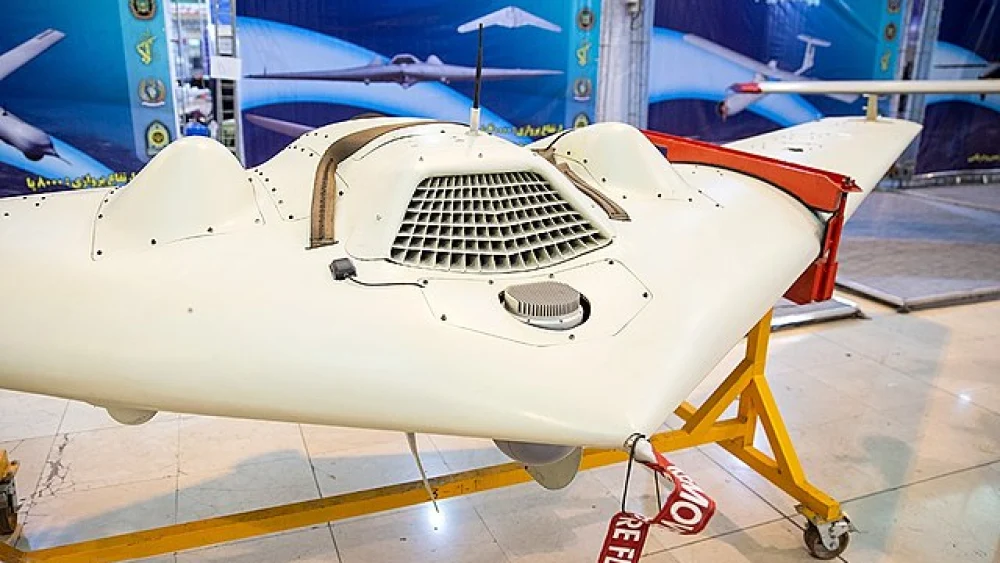
An Iranian Saegheh-2 drone on display at the Eqtedar 40 defense exhibition in Tehran, Feb. 5, 2019. Photo by Hossein Mersadi via Wikimedia Commons.

Iranian state media have released details regarding an underground military base housing unmanned aerial vehicles, Israeli media reported on Saturday.

According to the report, the base is located in the heart of the Zagros mountains in western Iran, though its precise location was kept secret.

An Iranian state television report said 100 UAVs are kept in the base, including some, like the Ababil-5 system, that are capable of launching air-to-ground missiles.

“[The] Iranian state TV correspondent said he made the 45-minute helicopter flight on Thursday from Kermanshah in western Iran to a secret underground drone site. He was allowed to take his blindfold off only upon arrival at the base,” said the report.

In March, the Israel Defense Forces revealed that it had used F-35 stealth fighters to shoot down two Iranian drones in foreign countries in 2021.

The Iranian UAVs were identified as Shahad 197-type systems, which have a flight range of some 2,000 kilometers (1,240 miles) and a flight time of 20 hours.

One Iranian UAV was approaching Israeli airspace from the east and the other from the south. At least one of the UAVs had handguns on board, representing an attempt to breach Israeli airspace and drop off firearms to Hamas in Gaza and likely to Hamas or Palestinian Islamic Jihad in the West Bank, according to the officials.

The Islamic Republic forced Washington to “retreat both on the battlefield and at the negotiating table,” said Mohammad Bagher Ghalibaf.
The Iran-U.S. Memorandum of Understanding underscored Tehran’s ongoing support for the terror group, Abbas Araghchi told Basem Naim.
The launch pads were established under the cover of the ceasefire with Hamas, according to the Israeli military.
An all-women panel at the JNS International Policy Summit highlighted the voices of ordinary Iranians.
Ilana Gritzewsky, a former Hamas captive, told the U.N. Human Rights Council she is “living proof” of sexual violence, challenging rapporteur Reem Alsalem.
“There is an understanding here that Israel has a problem with Hezbollah and that something needs to be done about it,” said the Dutch defense chief.
Benny Gantz, JNS editor-in-chief Jonathan S. Tobin, Gilad Erdan, Mosab Hassan Yousef, Nissim Black and leading voices in security, diplomacy, media, law and Jewish communal affairs headline the summit’s third day in Jerusalem.