


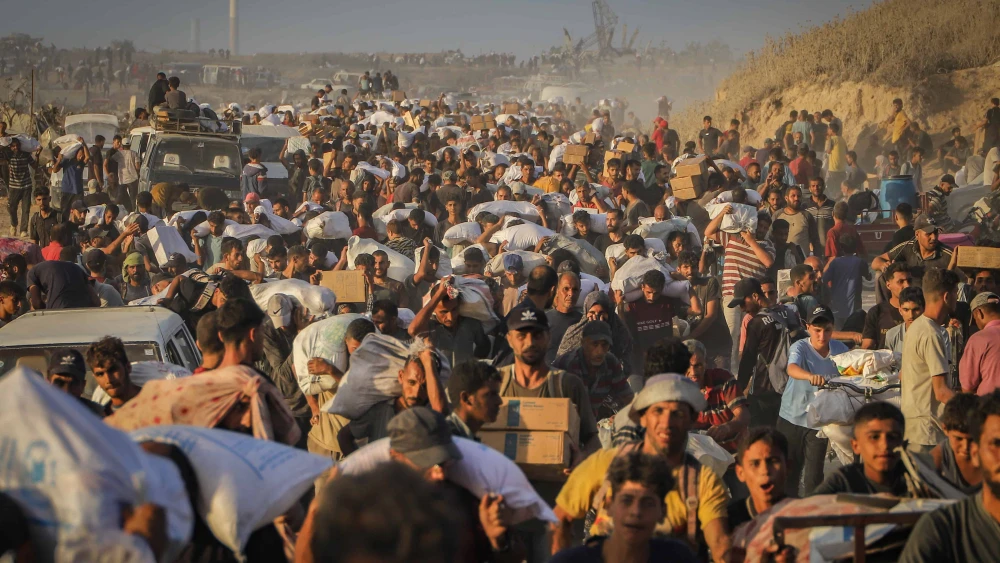
British famine expert Alex de Waal, executive director of the World Peace Foundation at Tufts University’s Fletcher School of Law and Diplomacy, blames the Hamas terror organization for the Oct. 7 attacks.
“Hamas is guilty of many crimes. It is guilty of starving the hostages. When Hamas says ‘everyone is hungry, so the hostages are hungry too,’ that’s false,” de Waal told JNS. “Hamas leaders have shown reckless and callous disregard for the Gazan people, willing to risk or sacrifice them for its political goals.”
But although he thinks that the United Nations and the agency that it relies on for food security analysis are using incomplete data in their determination that “famine” is occurring in Gaza, de Waal told JNS that it would be in the Jewish state’s best interest to allow for better access to data on what is happening in Gaza and that despite its best efforts, the U.S.-funded Gaza Humanitarian Foundation may be inadvertently feeding the very people from whom it wants to keep aid away.
“One of the striking things about the Gaza Humanitarian Foundation is that it can’t tell you who’s consuming—or selling or hoarding—their food,” de Waal told JNS.
“It’s a ‘survival of the fittest’ distribution. Who are those young men grabbing most of the food? People in need? Members of armed gangs? Hamas?” he said. “No professional humanitarian would have designed a system without a decent targeting and monitoring process.”
De Waal, who is the author of the 2018 book Mass Starvation: The History and Future of Famine, told JNS that Israeli soldiers are in a difficult position when they guard checkpoints leading up to foundation distribution sites in Gaza.
“If I were an IDF soldier and I saw a crowd of 10,000 young men rushing down the road towards my checkpoint, I would be scared,” de Waal said. “Are they heading for the GHF site? Or are they about to attack? If you have no means of communicating with them except firing live ammunition—into the ground, over their heads, whatever. It’s a recipe for a massacre.”
The scholar told JNS that whoever designed the Gaza Humanitarian Foundation system is guilty of “sheer lethal incompetence.”
The foundation told JNS that not a single one of its trucks has been looted, even as 90% of the aid from other groups is looted or diverted. The foundation “is willing to help other humanitarian groups deliver their aid securely and safely into Gaza and directly to those in need, including up in northern Gaza,” the foundation told JNS.
Israeli policy around the foundation distribution sites in Gaza may also be providing the independent International Criminal Court and the International Court of Justice, the principal U.N. judicial arm in The Hague, “with evidence for their charges of the war crime of starvation and even genocidal starvation,” de Waal warned.
Instead, to de Waal, Israel ought to replicate the sort of successful two-round polio vaccination campaign in Gaza last year, which it led with the World Health Organization and the U.N. Children’s Fund.
“That showed what was possible,” de Waal told JNS. “It can be done again.”
‘Soft’ data but reasonable conclusion
Even setting aside the question—which divides supporters and critics of the Jewish state—of who is to blame for the plight of civilians in Gaza, deciding if the dire situation has reached the threshold of “famine” is a complicated endeavor, which requires wading through an enormous amount of inside-baseball terms and technical statistics.
The Integrated Food Security Phase Classification, a tool backed in part by several U.N. agencies, stated on Friday that there is “reasonable evidence” of “famine” in Gaza. The announcement drew extensive reports in the international press and condemnations from Israel and others. The Jewish state said that it drew on “outdated figures, while downplaying or disregarding newer information that directly undermined the famine classification.”
A key problem for the report’s critics is the absence of corpses displaying evidence of malnourishment.
De Waal told JNS that the classification is using reasonable and tried-and-true methodology in its analysis of the death rate in and around Gaza City.
“Even if the IPC figures for mortality rates turn out to be somewhat soft, we’re still seeing a big increase in excess deaths from hunger and disease,” he said.
Ethiopia and Sudan have also accused the IPC of “bias and exaggeration,” although “none of those got the same publicity,” de Waal told JNS.
The IPC used the metric of “excess mortality,” which means the difference between the actual and expected number of deaths recorded in a particular place at a given time, drawing upon historical trends or data about a similar population elsewhere, according to de Waal. Data about deaths, which physicians diagnose as being from malnutrition, “are always a tiny fraction of total excess deaths,” he told JNS.
Varying thresholds
Critics have said that the classification’s announcement on Friday and a concurring report from its famine review committee lack statistics on deaths related to malnutrition, which must include either two such deaths per 10,000 people daily, or such deaths of four children younger than 5 years old daily per 10,000 to meet the criteria which the IPC has published for “famine.”
De Waal told JNS that U.N. statistics record a baseline mortality rate of 0.096 Gazans per 10,000 daily in 2019, compared to a rate of closer to 0.3 people per 10,000 daily in Somalia and South Sudan. Since the IPC uses an absolute threshold level, rather than a standard that is a multiple of the typical rate, “that means that many more people need to die from hunger and disease in Gaza than in, say, South Sudan to qualify as famine,” de Waal told JNS.
“So death rates need to rise seven times in South Sudan to qualify as ‘famine,’” he said. “In Gaza, they have to rise 20 times.”
The classification states that it used other indicators, which, taken together, tend to correlate with famine to make its determination. “Non-trauma mortality in the Gaza Strip is likely underreported due to collapsed monitoring systems,” it stated. “Convergence of widespread malnutrition, micronutrient deficiencies, lack of access to health care, deteriorating water, sanitation and hygiene conditions, and surging child diseases mirrors the established combination of factors that lead to death in famine conditions.”
“Against this backdrop, mortality among the population in Gaza governorate is assessed to have reached the famine threshold,” the IPC said. “Deir al-Balah and Khan Yunis are projected to reach similarly critical levels by late September.”
The IPC Famine Review Committee’s report includes similar reasoning and stated that it provided further analysis since the IPC “could not conclude on mortality evidence.”
De Waal told JNS that the IPC modeled the “excess mortality rate from the pre-escalation period” of malnutrition, up to around this May, using a “convergence of evidence” approach. It projected that forward to the period it assessed in its report.
That model isn’t one-size-fits-all but “requires adaptation for the specific demographic and epidemiological profile of the Gazan population,” de Waal told JNS.
A different group of experts might look at the same evidence and arrive at a different conclusion, according to de Waal. “It’s a bit like going to see your doctor, but he can’t send the bloodwork off to the lab for testing,” he said. “So he or she will use expert judgment to make the diagnosis based on the symptoms presented.”
Even before the “escalation,” de Waal said his “back-of-the-envelope calculations” suggest that non-trauma Gazan death rates “were pushing the ‘famine’ thresholds.”
“I would infer that the escalation pushed them through that barrier,” he told JNS.
‘Throw out inconvenient half’
Some critics, including Avi Bitterman, a dermatopathologist and analyst who has been tracking Gaza-related data during the war, say that the standards of mortality rates are in place for a reason and interpreting them more widely leads to bias.
“We can agree the non-traumatic mortality rate is undercounted while doubting it has reached famine thresholds,” he wrote. “We need more to conclude the latter part.”
Reports from the Gaza health ministry, which Hamas controls, suggest that at least 273 people, including 112 children, are known to have died from starvation as of Friday. When the IPC issued its last report, on July 29, the Hamas-controlled ministry had said that there were about 100 fewer deaths.
The IPC has determined that it is reasonable to assume that an area of the Gaza governorate with a population of about 937,600 is experiencing famine. By the IPC’s criteria, there would need to be about 188 daily, malnutrition-related deaths in the area to determine “famine.”
U.N. data suggests an average of 119 daily deaths due to all causes in all of Gaza during the month of July, including at least 28 children daily. It does not break the data down by region. That death rate is the highest it has recorded since January 2024.
August figures are lower, though, with less than 85 daily deaths from all causes in the entire Strip. Again, the U.N. data doesn’t separate August figures by region.
JNS asked Jean-Martin Bauer, director of food security and nutrition analysis service at the U.N. World Food Programme, how the IPC and the United Nations could say that there is sufficient evidence to show famine in Gaza when the available data suggests much fewer deaths than the threshold.
“No liberties were taken with any data here,” Bauer told JNS. “There’s evidence of collapsing health systems and treated illnesses, a surge in child disease, and all that is combined with widespread malnutrition.”
Due to those factors and “exponential increase in child malnutrition in Gaza governorate and specifically in Gaza City,” the report “concludes that the famine thresholds have been exceeded in the case of Gaza City,” Bauer said.
“The prevalence of malnutrition amongst children has tripled between May and July. When you have that exponential increase, it means that there’s also an exponential increase in mortality risk,” he told JNS.
JNS asked Bauer how the United Nations and IPC went from mortality risks to determining that there had actually been a famine.
“The indicator we use for nutrition is mid-upper arm circumference, and it is very clear that there is a tight correlation between mid-upper arm circumference and mortality,” he said. “That is indisputable. It’s peer reviewed.”
“That’s why we feel confident that’s a good indication of the problems taking place in Gaza,” Bauer said.
The World Food Programme official said that the determination went beyond a single indicator.
“There’s also a collapse in the health system. There’s much more frequent incidence of untreated diseases, upper respiratory illnesses, diarrhea, things that can cause children who are malnourished to die,” he said. “There’s a surge in child disease, there’s issues with water, sanitation and hygiene. So all these pathways lead a vulnerable population like children under five to death.”
The Famine Review Committee also cited a disputed study published in June that covered a time frame outside the window of the committee’s current review. The study stated that Hamas vastly underreported overall deaths in the first 16 months of the war.
An expert told JNS in June that the study’s “math is intentionally confusing to cover the partiality of the authors.”
That study is a “baseline” with which the committee validated its claims that malnutrition-related deaths are currently underreported. (The primary author of that study, a scholar at the London School of Hygiene and Tropical Medicine, is listed as a new member of the Famine Review Committee and contributed to the report.)
Mark Zlochin, a former artificial intelligence researcher and self-described “incorrigible data analysis geek,” who has spent months poring over data from Gaza, wrote of the Friday IPC announcement.
“What do you do when the actual data contradicts the narrative you’re desperately trying to promote?” he stated. “If you’re an IPC ‘expert,’ you just throw out the inconvenient half and spotlight the rest.”



