


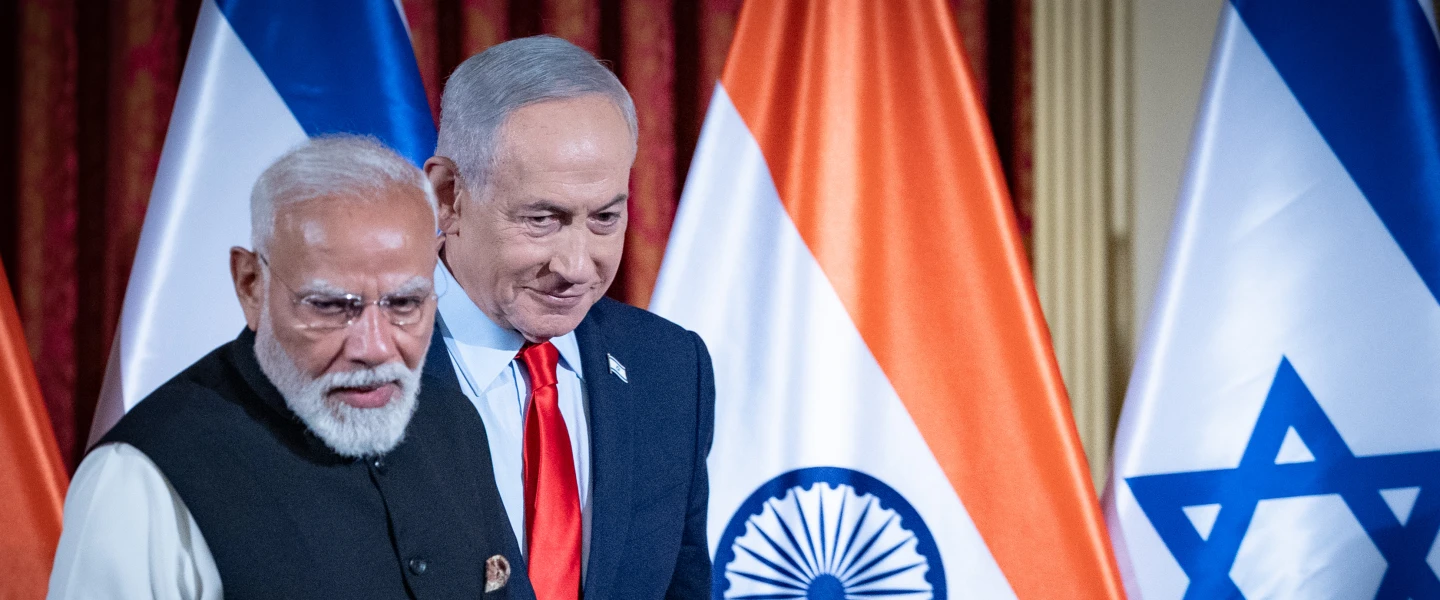
India is emerging as one of Israel’s most important strategic partners, Israeli Ambassador to India Reuven Azar told JNS on Thursday.
He pointed to a pivotal moment following the Hamas-led Oct. 7, 2023, massacre, when Indian Prime Minister Narendra Modi became the first world leader to call Jerusalem, expressing solidarity with the Jewish state and affirming its right to self-defense.
“India is becoming one of our main strategic partners. We have the United States, which is our major ally, Germany, with whom we have special ties and defense relations, and then we have India,” Azar told JNS.
“India, unlike other countries, did not impose any embargoes or restrictions on trade after Oct. 7. That led the Israeli government to recognize that India, as one of the fastest-rising powers in the world, has enormous potential,” he said.
Over the past 18 months, the Israeli embassy in India hosted seven Indian ministerial visits. The growing relationship culminated in Modi’s visit to Israel in February, during which 18 deals were signed.
“We updated our defense cooperation and signed two agreements to expand its scope. We also upgraded our economic ties, signing a bilateral investment treaty and a series of memorandums of understanding in the financial sector, while working very hard to bring Indian infrastructure companies to Israel,” said Azar.
As Israel prepares to invest heavily in infrastructure, including the Tel Aviv Metro project, it hopes Indian companies will play a major role.
“We already have about 11 Indian companies that have applied for prequalification for those tenders, and I’m very optimistic that some of them are going to win contracts,” said Azar.
Israel has also doubled the number of Indian guest workers in the country over the past year, primarily in the construction sector.
Azar outlined six values that underpin the bilateral relationship: civilizational resilience and national revival; a shared determination to combat terrorism and radicalism; a commitment to democracy and sovereignty; entrepreneurship and innovation; sustainable and inclusive development; and tolerance and shared cultural heritage.
Why is the relationship btw 🇮🇱&🇮🇳 so unique?
— 🇮🇱 Reuven Azar (@ReuvenAzar) May 26, 2026
It’s because we share common values:
# Civilizational resilience and national revival.
# The fight against terrorism
# Democracy & sovereignty
# Innovation & entrepreneurship
# Tolerance & shared cultural heritage
# Sustainable &… pic.twitter.com/b6LbJ4oKQs
India today hosts a growing number of unicorn companies (startup companies valued at over $1 billion that is privately owned and not listed on a share market) as well as large teams of developers working with Israeli firms.
“Entrepreneurship is part of the freedom of democracy, and it is something that is very unique to both countries,” said Azar.
He highlighted India’s longstanding acceptance of its Jewish community.
“When it comes to India, we enjoy approximately 70% support here. Gen Z in India is different from what you see in Europe. They are much more optimistic, nationalistic and pro-Israel, and that is amazing because as India becomes increasingly significant on the world stage, it will allow us to deepen this partnership and benefit from it in a much more meaningful way,” he told JNS.
Defense cooperation has flourished over the past three decades. According to Azar, Indians remember Israel’s support during periods when New Delhi faced international restrictions and needed assistance addressing security challenges.
“This has become a relationship based on trust. It is not just a matter of selling. We are producing together. Israeli companies have factories here that manufacture not only for India, but also for us and for other countries around the world,” Azar explained.
Israeli Prime Minister Benjamin Netanyahu and Modi “share a similar worldview: capitalism and free markets, proud nationalism, a tough stance on counter-terrorism, investment in economic reforms, and a commitment to entrepreneurship and innovation,” he added.
Netanyahu on Wednesday congratulated Modi on becoming India’s longest-serving continuously elected prime minister. In response, Modi emphasized that his country’s relationship with Israel “will continue to grow from strength-to-strength in the years to come.”
Congratulations, Mazel Tov, my dear friend @PMOIndia @narendramodi, on becoming India's longest-serving elected Prime Minister! 🇮🇱🇮🇳 pic.twitter.com/EVc3nqwhGo
— Prime Minister of Israel (@IsraeliPM) June 10, 2026
Separately, Indian Minister of State for External Affairs Kirti Vardhan Singh attended Israel’s 78th Independence Day celebration in April, calling the countries’ “special strategic partnership” increasingly robust.
In his remarks, Singh reaffirmed India’s commitment to strengthening ties with Israel and advancing shared goals in areas ranging from peace and innovation to agriculture and water management, which have emerged as key pillars of bilateral cooperation.
Thank you Minister of State Kirti Vardhan Singh for attending Israel’s 🇮🇱 78th Independence Day Celebration. The Special Strategic Partnership btw 🇮🇱&🇮🇳 is getting stronger every day! @KVSinghMPGonda @DrSJaishankar @gidonsaar @narendramodi @IsraeliPM https://t.co/ROKV2oIZDp
— 🇮🇱 Reuven Azar (@ReuvenAzar) June 10, 2026
Through MASHAV, Israel’s Agency for International Development Cooperation, and in partnership with the Indian government, Israel has established 35 centers of excellence across India focused on flowers, fruits, honey and vegetables.
“These centers have had a huge impact on India in terms of increasing crop yields and saving water, among other benefits,” said Azar.
“We are now also entering emerging technologies such as quantum computing, cyber and artificial intelligence. We recently signed several MoUs and are now exchanging delegations. We have a joint fund called I4F that has already financed about $30 million in joint projects between the two countries, including both academic research and applied research for commercial purposes,” he added.
Despite the rapid pace of growth, challenges remain.
“We want to get more high-tech companies to come to India. For that, we need to finalize things like a free trade agreement, which we are negotiating now. We hope to complete it by the end of the year,” he said.
“India has an amazing and sophisticated digital payment system that we would like the Bank of Israel to adopt. There is a huge amount of goodwill,” he added.
Azar also pointed to security concerns shared by both countries. Last year, India suffered a devastating terrorist attack in the Baisaran Valley near Pahalgam.
“Although Oct. 7 was much more atrocious and the number of casualties was much higher, we see similarities between terrorist organizations, and we see an increased presence of Hamas in the region, in Pakistan and Bangladesh. They are active here,” he said.
“Not only is this a mutual concern, but the government has also identified gaps that are leading it to cooperate more closely with us in addressing defense challenges,” he added.
The ambassador highlighted the deep people-to-people ties between the two countries. Approximately 100,000 Israelis are of Indian origin, the result of large-scale immigration from India in the 1960s.
India’s historic Jewish communities included the Bene Israel and Baghdadi communities centered in Mumbai and Kolkata.
“They built an amazing community and a very beautiful synagogue in Mumbai. There was also a community of 5,000 people in Kolkata, composed mainly of Baghdadi Jews, and there are beautiful synagogues there as well. Today, however, the community numbers only about 15 Jews,” said Azar.
He also noted the Bnei Menashe community in Mizoram, many of whose members have immigrated to Israel in recent years.
Among the most prominent Jews in Indian history, Azar noted, was Gen. J.F.R. Jacob, who played a major role in the 1971 war that led to the creation of Bangladesh.
“The Jews were always considered in India as part and parcel of the society, as a positive force, and it is something we cherish a lot,” he said.
India has long been a popular destination for young Israelis after military service, particularly the Himalayas, Rishikesh and Goa.
Azar also sees opportunities stemming from India’s growing role in global trade and the development of new transportation corridors linking Asia, the Gulf and Europe.
Discussing regional infrastructure projects, Azar argued that new rail links should be viewed as opportunities rather than competition.
“At the end of the day, when countries build infrastructure, everybody benefits from it. Imagine that 10 years from now, there will be a railway from Turkey to Saudi Arabia. It will create a situation in which you have a huge hub in Jordan and we can easily take from that hub to Haifa as well,” he said.
“Today, we benefit from the Suez canal. Sixty percent of merchandise that comes to Israel comes from the Suez canal. I don’t think that we have to fight to exclude or fight against another project, we have to develop infrastructure for everybody, and if we invest in infrastructure at our eastern border, it will attract a lot of business and a lot of movement,” he added.
Azar, who also serves as Israel’s non-resident ambassador to Bhutan and Sri Lanka, said ties with both countries continue to develop through labor, tourism and other forms of cooperation.
“With Bhutan, we have a very unique relationship. Bhutan doesn’t have diplomatic relations with many countries but their king has learned about Israel and what it has to offer. We cooperate in fields like tourism, cyber. It’s more limited in scope but we are working to promote that as well,” he added.
“The guest workers program is very successful because salaries in Israel are very high comparatively, and people ... want to come. Thirty thousand guest workers generate ... something like a billion dollars per year, and the entire Sri Lankan economy is less than $100 billion; it is significant for them. We will see what happens in the future,” he said.



