
After the terror attack at a Chanukah celebration on Sydney’s Bondi Beach—with memories still raw from the Yom Kippur attack on worshippers at Manchester’s Heaton Park Hebrew Congregation in England and the double murder in May of a young couple outside the Capital Jewish Museum in Washington, D.C.—Jews are once again absorbing the shock of hatred aimed at our people.
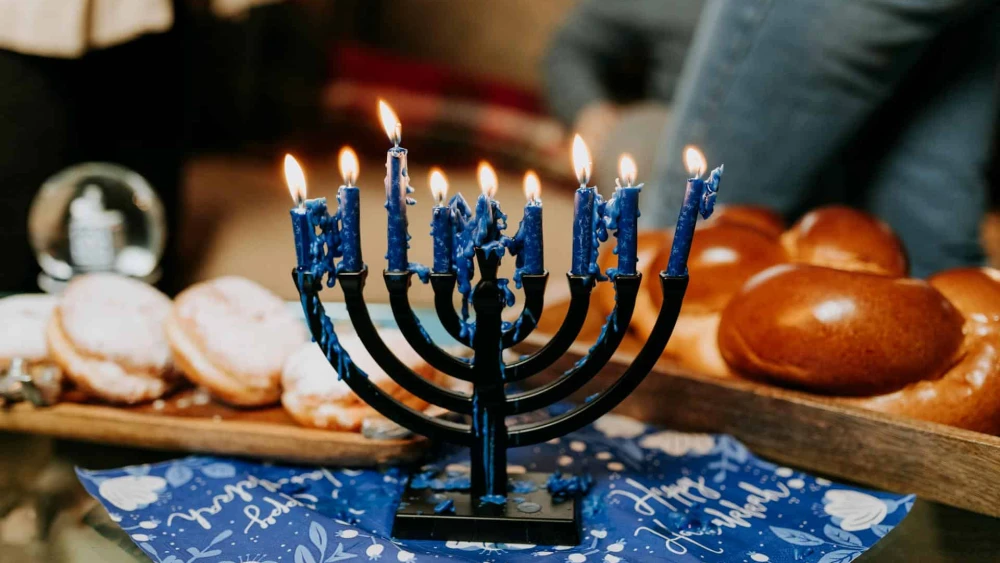
One response is hiding in plain sight within a song we usually reserve for eight nights a year. “Maoz Tzur” is often treated like a Chanukah accessory: a beautiful melody, a warm tradition, a moment by the candles before we move on. But listen closely to its words, and you realize that it isn’t seasonal at all. It is a weekly anthem—an argument for Jewish resilience and a reminder that even when our enemies mean to plunge us into darkness, the story doesn’t end there.
“Rock of Ages, let our song/Praise thy saving power … .”
The opening isn’t merely poetic. It’s a declaration of orientation: We praise not because everything is easy but because we remember what holds us up when it isn’t.
“Thou amidst the raging foes/Wast our sheltering tower.”
That line doesn’t deny the existence of enemies; it assumes them. It acknowledges what Jewish history has never had the luxury of forgetting: We do not live in a world where hatred is imaginary. We live in a world where it periodically organizes itself—politically, militarily, culturally—and comes for us.
And then: “Furious, they assailed us … And thy Word broke their sword/When our own strength failed us.”
This is not naive optimism. It is hard-earned optimism: the kind that can stare down real danger and still say, without blinking, we have outlived empires before.
That’s why “Maoz Tzur” belongs not only when we light the Chanukah menorah but as part of our regular spiritual vocabulary, especially now, when so many Jews feel unsteady.
The song does something the Jewish people have always done at our best: It ties today’s fear to yesterday’s rescue—not to minimize the pain of the present, but to keep it from becoming the whole story.
Consider the verse that many paraphrase about the Seleucid Greeks: “Greeks gathered against me … they defiled all the oils … and from the one remnant. … a miracle was wrought. … Men of insight—eight days established for song and jubilation.”
It is worth pausing on what that means.
The Hasmonean struggle was not simply a battle against foreign soldiers. It was a battle against a worldview held by many Jews of the time that demanded Jewish distinctiveness be diluted, domesticated or erased. The defiling of the oils was not a random act of vandalism; it was a message: Your holiness is fragile. Your worship is replaceable. Your identity is negotiable.
And yet, the Jewish response was not despair. It was repair. It was persistence. It was the audacity to search for even a “one remnant” of purity and light it anyway.
That is the lesson for our moment.
When terror strikes, the goal is not only to kill bodies. It is to break spirit—to convince Jews that public Jewish life is too dangerous, that visibility is too costly, that hope is irresponsible. Terror wants Jews whispering, hiding, shrinking.
“Maoz Tzur” teaches the opposite: In the face of darkness, we do not negotiate away our light. We protect it, we kindle it, we multiply it.
That doesn’t mean being reckless. Jewish law does not glorify needless risk. We take security seriously, and we use wisdom. We lock doors and hire guards, and coordinate with law enforcement because preserving life is a sacred duty.
But we do not respond by surrendering our Jewishness. We do not internalize the message that our faith must be practiced only behind closed blinds. We do not allow murderers and their cheerleaders to become the authors of our communal future.
The final verse’s plea—“Unsheath your holy arm … bring the end that is salvation … claim the vengeance of your servants’ blood … for the hour has lengthened on us, and there is no end to the days of evil”—is uncomfortable for modern ears, and it should be treated with seriousness, not slogans. It is not a license for vigilante rage. It is the cry of a people who have learned, repeatedly, that evil does not retire on its own. It is a prayer that history bends toward justice and that the moral order of the universe is not a fairy tale.
In other words, it is a plea that the world not become numb.
When Jews sing that verse, we are not celebrating vengeance for its own sake. We are insisting that innocent blood matters, that the slaughter of Jews is not background noise and that God—and human society—must not treat it as normal.
And then comes the quiet miracle: Despite that pain, the song remains ultimately hopeful. It is not a dirge. It is not a eulogy for Judaism. It is a soundtrack for Jewish continuity. That’s why it can be sung each week.
Imagine if we treated “Maoz Tzur” the way we treat other weekly anchors—“Lecha Dodi” or “Adon Olam”—as a spiritual recalibration. Not only “remember what happened,” but “remember what always happens”: Enemies rise, and they fall; threats gather, and they scatter; the Jewish people get knocked down, and we get up—sometimes with bruises, sometimes with tears, always with stubborn faith.
This is not denial. It is defiance.
It is saying: The darkness of these days, as it was in the days of the struggle against the Seleucid Greeks, will be broken. Not by pretending it isn’t dark, but by refusing to let it become permanent.
So, dear reader, sing it—by the menorah, yes. But also when the news is heavy. When a Jewish community is mourning. When you feel that familiar ache of vulnerability that Jews know too well.
Sing it in synagogue. Sing it at your Shabbat table. Sing it with your children so they learn that Jewish history is not only a catalog of enemies but a record of survival—powered by faith, fortified by community, and lit, again and again, by one more flame than the darkness expected.
It reminds us—quietly, stubbornly, beautifully—that all is not lost.
Because “Maoz Tzur” is not only a Chanukah song. It is a Jewish answer to fear.
With thanks to Rabbi Nasanyl Braun of Long Branch, N.J., who asked the question in the synagogue on Dec. 12, “Why do we sing it?”