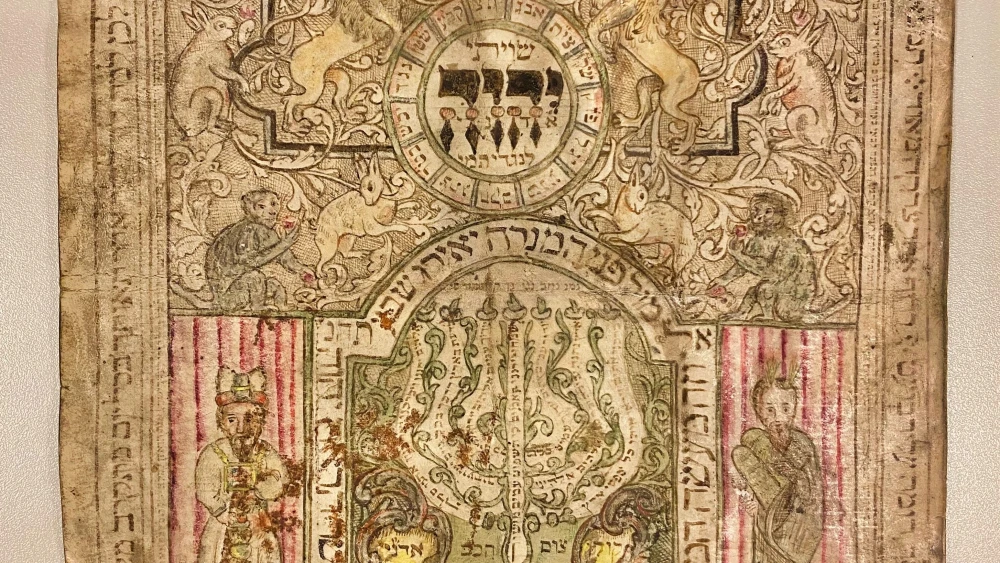
Among the new acquisitions that the Israel Museum announced earlier this month are a “rare” 18th-century decorated shiviti booklet and an “extremely rare” 1828 wall map of the Holy Land with important Jewish and Christian narrative illustrations.
The two items, plus the other recent acquisitions, span “multiple continents and many centuries, marking significant growth for the museum’s encyclopedic collection over the past year,” stated the museum.
The central European booklet is a shiviti, which takes its name from Psalm 16:8, “I have placed God before me always, for when He is at my right hand, I will not fall.” The first word, shiviti, comes from a root, whose meanings include “to place.”
The new acquisition is “the most lavish example of shiviti represented in the collection,” the Israel Museum stated. (The Jewish Museum has 10 shiviti works, which can also be found at the Minneapolis Institute of Art, Museum of International Folk Art and Jewish Museum of Greece.)
“Wrestling with ways to externalize the presence of God,” shiviti objects “center upon the graphic representation of God’s ineffable four-letter Hebrew name, the Tetragrammaton,” writes Francesco Spagnolo, curator of the Magnes Collection of Jewish Art and Life, which contains several dozen shiviti objects, dating at least as far back as an 1844 German amulet.
“Deciphering the content of a shiviti, or simply classifying it within the realm of cultural production, is a fascinating puzzle for today’s scholars. Research on these documents encompasses the analysis of biblical and prayer texts, magical formulae, visual motifs and material culture across the world,” added Spagnolo. “The persistence of these documents into the present, including the Internet, attests to the ongoing beliefs in the power and efficacy of magic and meditation that accompany the more normative aspects of Judaism as we know them.”
The Israel Museum also gained the wall map by D. Haines of Philadelphia dated to 1828. The map describes “the most important events in the Old and New Testaments,” including the Exodus, Moses receiving the Ten Commandments at Sinai as well as Christian scenes, per the museum.
“The map was created in the tradition established by the 17th-century Dutch family of cartographers, van Doetechum, and depicts a panoramic bird’s-eye-view of the Holy Land, divided among the Twelve Tribes of Israel,” it stated. According to other images of a Haines 1828 map of the Holy Land, an inscription appears to misspell the Hebrew Tetragrammaton.