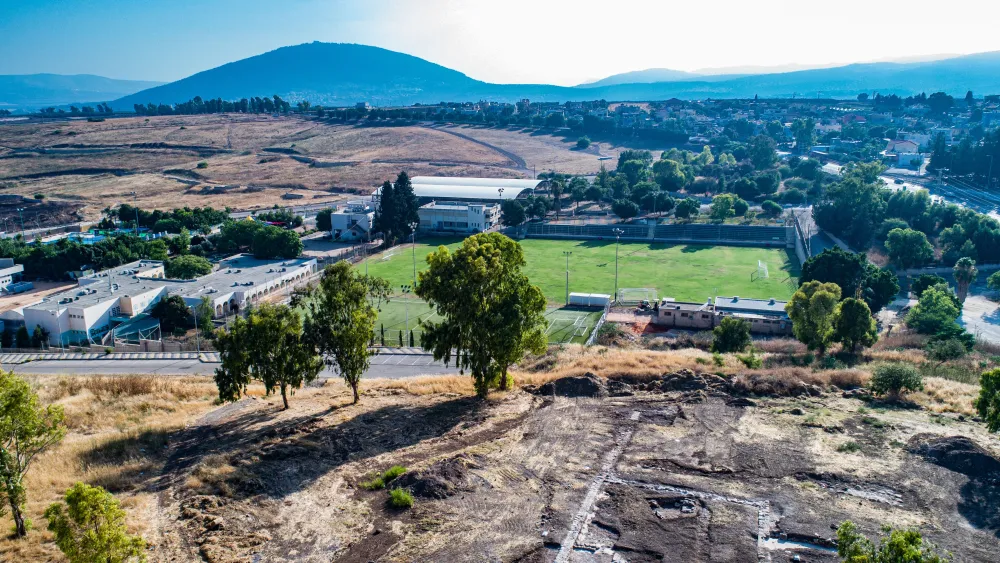
Israeli archaeologists have announced that they have unearthed a 1,300-year-old Byzantine-era church in the Lower Galilee in the village of Kfar Kama near Mount Tabor, which Christians believe is the Mount of Transfiguration where Jesus performed one his miracles.
The excavation was conducted by the Israel Antiquities Authority, in collaboration with the Kinneret Academic College and local volunteers. The head of the Greek Catholic Church in Israel also personally visited the site, which was conducted prior to the construction of a playground, at the initiative of the Kfar Kama local council and Jewish National Fund.
According to lead archaeologist Nurit Feig, “the church, measuring 12×36 [meters], includes a large courtyard, a narthex foyer and a central hall. Particular to this church is the existence of three apses (prayer niches), while most churches were characterized by a single apse. ”
Additionally, Feig noted that the aisles of the church were paved with mosaics that have partially survived.
“Their colorful decoration stands out, incorporating geometric patterns, and blue, black and red floral patterns,” she said.

Feig also said that a special discovery was the small reliquary, a stone box used to preserve sacred relics.
Additional series of rooms were also partially uncovered adjacent to the church. Ground-penetrating radar indicated that there are more rooms at the site that have yet to be excavated, leading researchers to believe that this large complex served as a monastery.
In the early 1960s, a church was excavated inside of the village of Kfar Kama, which archaeologists now believe was probably the village church, while the newly discovered church was probably part of a monastery on the outskirts of the village.
The latest discovery in Kfar Kama highlights the importance of the Christian village settled during the Byzantine period near Mount Tabor.
According to the Christian Gospels, Jesus and three of his apostles—Peter, James and John—go to the Mount of Transfiguration to pray. While on the mountain, Jesus began to shine with bright rays of light with the prophets Moses and Elijah appearing next to him and speaking with him. Jesus is then called “son” by a voice in the sky, assumed to be God. Today, several major Christian traditions commemorate the event as the Feast of Transfiguration.
Later in the late 19th century, Circassian tribes settled in Kfar Kama and used the stones of the ancient village to build their houses.
The discovery of the church in Kfar Kama will contribute to the extensive research project on the Christian settlement in the Galilee that is being carried out by Professor Moti Aviam and Jacob Ashkenazi of the Kinneret Institute of Galilean Archaeology in the Kinneret Academic College.