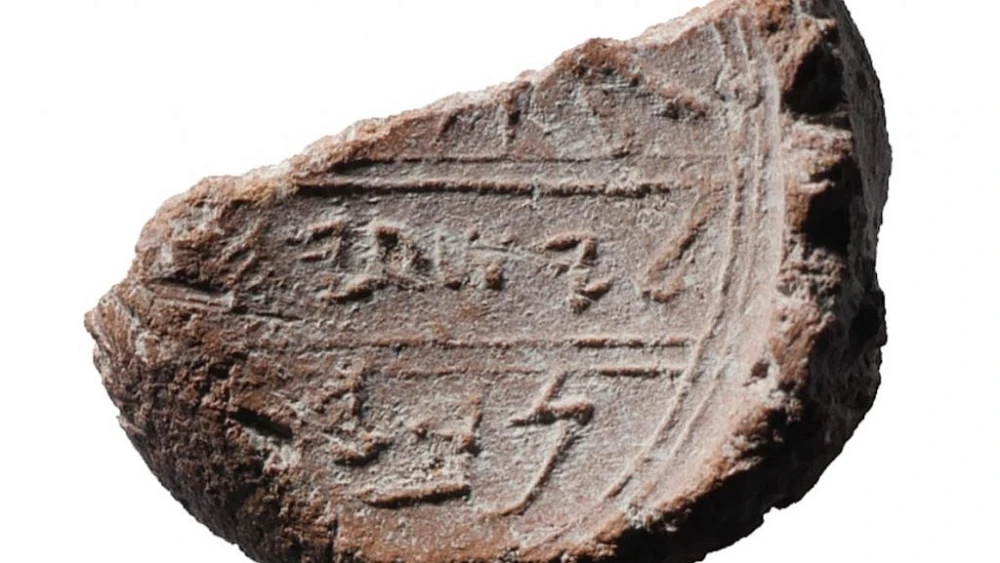
A historic archaeological discovery near Jerusalem’s Temple Mount may be proof of the life of the biblical prophet Isaiah, according to an article in the Biblical Archaeology Review. A broken, eighth-century BCE clay seal impression, or bulla, appears to be inscribed with the words “Belonging to Isaiah,” as well as a partial word containing letters of the word “prophet.”
“We appear to have discovered a seal impression, which may have belonged to the prophet Isaiah, in a scientific, archaeological excavation,” said Eilat Mazar, Ph.D., a Hebrew University archeologist, whose team uncovered the find at the Temple Mount’s southern wall Ophel excavation.
In addition to the words on the bulla, a grazing doe is impressed on the seal, which is “a motif of blessing and protection found in Judah, particularly in Jerusalem,” according to the article.
Isaiah ministered to the Jewish people during the reigns of Judean kings Uzziah, Jotham, Ahaz and Hezekiah, and prophesied that “out of Zion shall come forth Torah, and the word of the Lord from Jerusalem.”
The Isaiah bulla was found just 10 feet from where Mazar’s team found a groundbreaking, intact bulla bearing the inscription “of King Hezekiah of Judah” in 2015. Hezekiah, the 12th king of the Kingdom of Judah, ruled between 727 BCE and 698 BCE.
“The names of King Hezekiah and the prophet Isaiah are mentioned in one breath 14 of the 29 times the name of Isaiah is recalled [in the Bible] (2 Kings 19–20; Isaiah 37–39),” said Mazar. “No other figure was closer to King Hezekiah than the prophet Isaiah.”