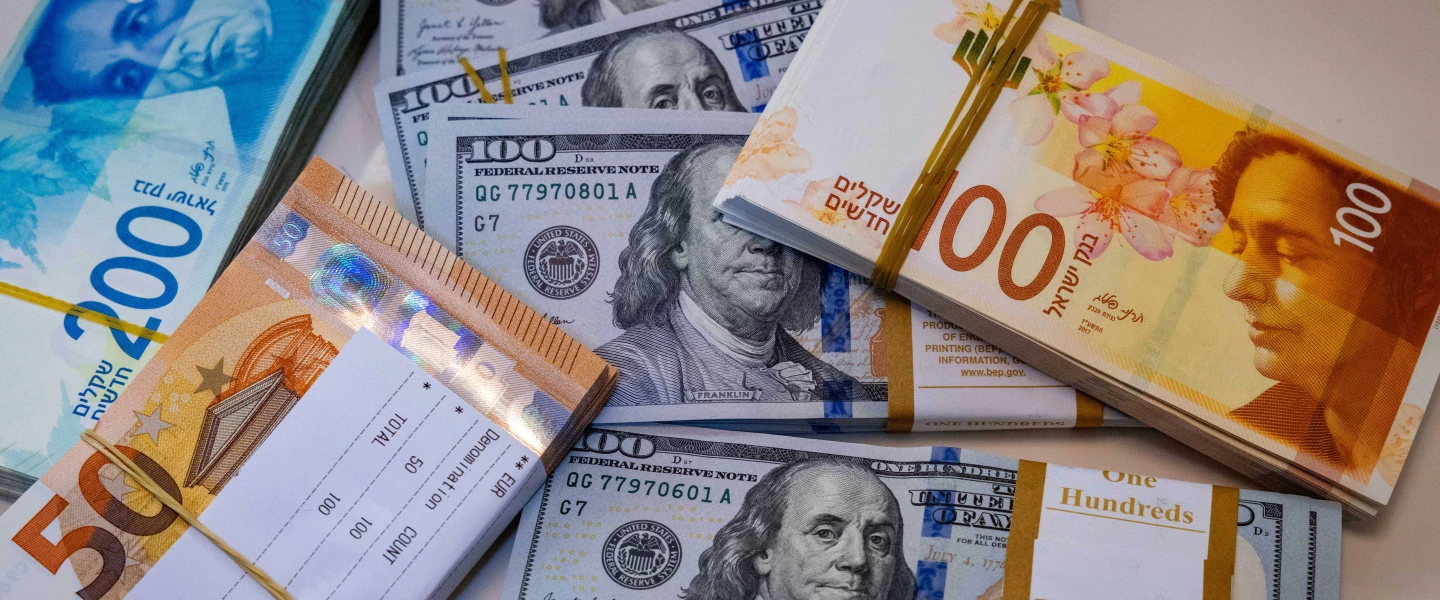
At a foreign exchange kiosk on Tel Aviv’s Allenby Street, the shekel is trading at a rate few expected just months ago: one United States dollar for NIS 3.33. One euro is worth almost NIS 4.
Against a backdrop of ongoing war, political tension and economic strain, Israel’s currency is doing the unexpected: rising in value.
After a sharp drop in the wake of Hamas’s Oct. 7, 2023, attack and the ensuing war in Gaza, the new Israeli shekel (NIS) has staged a notable recovery. Since January 2025, the shekel has gained over 8% against the American dollar, puzzling some observers and heartening others.
“On the surface, it seems paradoxical,” Jacob Schmidt, a professor of finance and economics at Regent’s University London and an expert in investments and international finance, told JNS. “But currency movements often reflect future expectations more than present realities. Investors are betting that Israel’s economy is stabilizing faster than anticipated.”
Resilience under pressure
The rebound comes despite persistent uncertainty on Israel’s northern and southern borders and continuing economic pressures at home.
What’s driving the shekel’s strength? A few key factors, according to financial analysts:
• Tight monetary policy from the Bank of Israel;
• Renewed foreign investment, especially in high-tech;
• Global appetite for higher yields amid U.S. rate uncertainty.
“The Bank of Israel has maintained a disciplined stance on inflation, keeping interest rates relatively high,” Schmidt explained. “For global investors chasing yield, that makes Israeli assets—and the shekel— more attractive.”
Schmidt, who is also the founder and CEO of Schmidt Research Partners Limited with offices in the United Kingdom, Israel and Austria, brings decades of experience as an economist, educator and entrepreneur to his analysis of global currency trends. He has worked with Israeli companies and investors for more than three decades.
He stated that as tech returns, capital follows. Perhaps the biggest reversal is happening in Israel’s tech sector, which drives a significant portion of the country’s foreign currency earnings. In recent months, signs of a return to normalcy in venture capital, mergers and acquisitions (M&A) and initial public offering (IPO) activity have begun to emerge, he noted.
“A lot of foreign capital flows into Israel through tech,” said Schmidt. “Every time a U.S. fund invests in the Tel Aviv Stock Exchange (TASE) stocks or an Israeli startup, they’re buying shekels. Multiply that across dozens of deals, and it creates real currency demand. Even since Oct. 2023, Israeli stocks are up almost 100%, driven by strong corporate results, despite the war.”
The largest Israeli tech acquisition in history was sealed in March 2025, when Google’s parent company, Alphabet, announced the acquisition of the cloud security startup Wiz for $32 billion. In the first half of 2025, Israeli tech saw a significant rebound in funding, reaching $9.3 billion, the highest in three years.
According to government figures, foreign direct investment jumped 12% in the second quarter of 2025, as investors regained confidence that Israel’s innovation ecosystem—battered but still intact—is back online.
Another important factor is the ongoing aliyah from North America, the U.K. and Europe, particularly from France, presenting a conundrum: Despite the war, many educated and wealthy families have decided to move to Israel. That contributes to the demand for the shekel.
A strong shekel: Who benefits?
While a stronger shekel eases the cost of imported goods and benefits Israeli travelers abroad, it’s a double-edged sword.
Exporters, who earn in dollars or euros but pay expenses in shekels, are feeling the pinch. Tourism operators, too, may struggle as foreign visitors find Israel more expensive.
“For exporters, a strong shekel can be a serious margin killer,” Schmidt noted. “It’s good for inflation control, but bad for competitiveness abroad.”
At the same time, Israelis with savings or salaries pegged to the dollar may see lower returns in shekel terms, a reality already hitting single- and dual-income families in the tech sector.
Is it sustainable?
While the rebound is real, some economists remain cautious. “Any rally could be fragile,” Schmidt cautioned.
The biggest risks are domestic political instability and, of course, a continuous war and escalation with Israel’s neighbors, which are all very costly to the country.
Much depends on geopolitical developments, central bank decisions, and the broader health of the global economy. For now, though, Israel’s currency is telling a story of unexpected resilience, one that belies the mainstream news headlines.
As foreign exchange desks adjust to the shekel’s recovery, Israelis are left to wonder whether this newfound strength is a short-term correction or the sign of something deeper—a vote of confidence from international markets, even amid crisis and war.
“In many ways, the shekel is Israel’s economic barometer,” Schmidt said. “Right now, it’s pointing upward, but storms can form quickly. In the long term, I continue to be bullish on the shekel and the Israeli economy.”