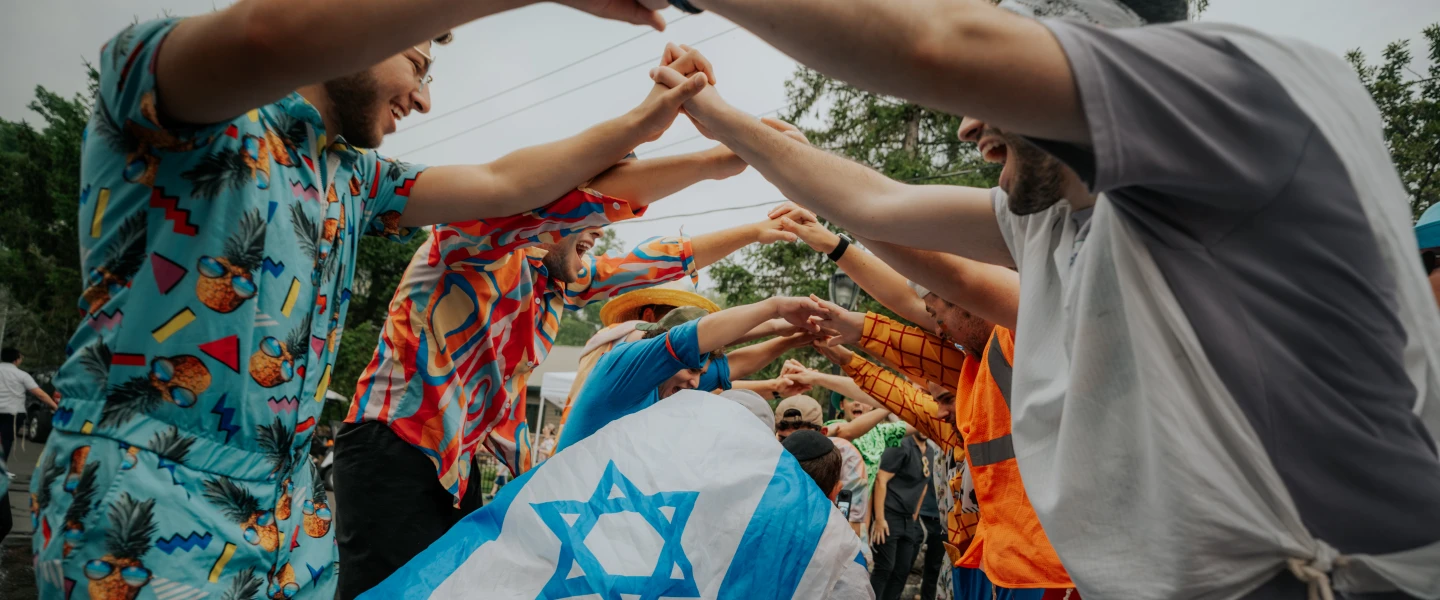
When more than 700 cyclists from around the world crossed what organizers call “The World’s Greatest Finish Line” and entered Camp Simcha in Sullivan County, N.Y., on July 30 after riding up to 180 miles over two days in the annual Bike4Chai fundraiser, they were greeted by hundreds of cheering counselors, staff members, volunteers, family members—and, most important, children battling cancer and other life-threatening illnesses.
The riders knew that Camp Simcha’s world-class programs and specialized medical care are made possible by the funds they raise each year.
“This isn’t about crossing a finish line on pavement; it’s about arriving for children who need us,” said Rabbi Simcha Scholar, CEO of Chai Lifeline. “Every mile ridden and every dollar raised helps ensure that families facing serious illness have a community standing beside them. When our riders arrive at Camp Simcha, they see exactly why they ride. They’ve helped create hope.”
Funds raised through Bike4Chai support Chai Lifeline’s broad range of services, including professional case management, meal delivery to hospitals and homes, transportation to medical appointments, emergency financial assistance, insurance advocacy, crisis intervention, trauma response, the i-Shine afterschool program, Camp Simcha and Camp Simcha Special, and dozens of additional initiatives serving families year-round.
Scholar told JNS that Chai Lifeline, one of the world’s largest Jewish organizations serving children with serious illnesses, assists some 6,000 families each day through offices in the United States, Canada, Europe and Israel, benefiting an estimated 35,000 people.
“The entire family suffers where there is illness,” Scholar said. “We assess needs and offer a holistic, practical approach, from something as simple as providing dinner to arranging an appointment with a top doctor.”
‘The only place where peyot and ponytails meet’
For Scholar, Camp Simcha’s greatest achievement is creating a place where children from every background can simply be children.
“It is the only place left in this world where peyot [sidelocks] and ponytails meet—and are very happy with each other,” he said.
“We don’t have different divisions, titles, political parties or philosophies. We have one philosophy called ‘loving our fellow person.’”
Camp Simcha serves children battling cancer as well as those living with lifelong illnesses.
“We deal with sick children, but we believe that a sick child is a normal child going through an illness,” Scholar said.
“Cancer has a beginning and an end, which is sometimes great and sometimes tragic. Children with lifelong illnesses—we have to teach them how to be regular kids.”
The camp cares for children with more than 80 different medical conditions each summer.
“We don’t use the word ‘disability’ at Camp Simcha,” Scholar added. “We use the term ‘different ability.’ We all have different abilities. Some run to get to a destination, some walk and some roll.”
Scholar describes Camp Simcha as “Disneyland in New York,” with a level of medical support unmatched by most summer camps.
The camp is staffed by doctors and nurses, provides transportation free of charge, maintains an ambulance on site and can arrange emergency helicopter transport to a hospital if necessary.
A lifeline for Israeli children
Each summer, up to 90 campers from Israel attend Camp Simcha for a two-week session.
Scholar noted that overnight camping is less common in Israel than in North America, but said he has long believed it was important to give Israeli children the opportunity to experience Camp Simcha.
Since the Hamas-led terrorist attacks on Oct. 7, 2023, and the ensuing war, that mission has taken on even greater significance.
Many of the Israeli campers come from communities near the Gaza border and northern Israel that have endured years of rocket attacks and, more recently, the trauma of war.
“So camp is a reprieve,” Scholar said. “It is therapeutic. It is a lifeline for them. It gives them a sense of hope and a future.”
For two weeks, he said, children can set aside hospital visits, medical treatments and the stresses of daily life and simply enjoy being kids.
‘You’re a VIP for two weeks’
For Shimon Yarbiv, a 23-year-old yeshivah student from Bnei Brak, Camp Simcha has become much more than a summer camp.
After undergoing chemotherapy for cancer discovered in his shoulder, Yarbiv recently returned home from his third summer at Camp Simcha.
“At camp, you’re a VIP for two weeks,” he told JNS.
His days were filled with swimming, boating and sports, while special activities included baking, making havdalah candles and mezuzot, and evening performances by well-known Jewish entertainers. One highlight was performing on stage with singer Avraham Fried.
Yarbiv also appreciated the special attention given to the Israeli delegation, including a shopping trip to the American Dream mall in New Jersey, the second largest in the U.S after the Mall of America in Minnesota.
With a laugh, he recalled that the Israelis quickly made their presence felt.
“We made the most balagan,” he said, using the Hebrew word for “chaos.” “When everyone else was sitting on chairs, the Israelis were jumping off them and dancing.”
For Scholar, stories such as Yarbiv’s are the reason Camp Simcha exists.
“Our job is to make them normal,” he said. “To take a child going through this difficulty, and a family going through this crisis, and help them return to their regular lives.”
Through Chai Lifeline’s year-round programs, families receive emotional, medical and practical support before, during and after treatment.
For the cyclists who completed Bike4Chai, the cheering crowds at the finish line in Glen Spey, N.Y., were more than a celebration of endurance. They were a reminder that every mile ridden and every dollar raised helps children like Yarbiv—and thousands of other families around the world—find hope, healing and, if only for two weeks, the chance to simply be children again.