


On a 75-degree February day in Abu Dhabi, JNS had the chance to view the Abrahamic Family House site on Saadiyat Island on its opening day in the United Arab Emirates. Three houses of worship—Moses Ben Maimon Synagogue, His Holiness Francis Church (Roman Catholic) and Eminence Ahmed El-Tayeb Mosque—stand in equal proportion. At first glance, they seem identical, but closer inspection reveals that each has features iconic to the respective customs.
Elie Abadie, the senior rabbi of the Jewish Council of the Emirates, told JNS that it is very notable for an Arab country to build a Jewish house of worship.
“In fact, this is the first one built in the region in almost a century,” he said. “By doing this, the government sends out a great message—one of tolerance and acceptance, as they allow the different Abrahamic faiths to come together here to worship. In fact, we worship the same God.”
“It is a great gift from Sheikh Mohammed to the Jewish People,” David Rosen, international director of interreligious affairs at the American Jewish Committee and former chief rabbi of Ireland, told JNS. “Myriads of people from around the world visiting the country will visit this complex simply because of its location and beauty.”
Those who come to the site can see the three Abrahamic faiths represented.
“For a people that have suffered and still suffer from prejudice and bigotry born out of ignorance and misrepresentations, this place offers an amazing opportunity to educate the world about the beauty and true values of Jewish tradition,” said Rosen.
The Abrahamic Family House opened to the public on March 1. No one associated with the site was immediately available for comment.
Ghanaian British architect David Adjaye designed the site, which was inaugurated and opened to worshippers on Feb. 16. It had been slated to open in 2022 originally, but the opening was postponed.

The interfaith site comes a few years after the signing of the Abraham Accords in the fall of 2020, under whose auspices the UAE and Bahrain, followed by Morocco and Sudan, officiated ties with Israel. The accords are widely viewed as a sign of tolerance, and many take it to be a bellwether of positive relationships between Jews in the Middle East and the Islamic world.
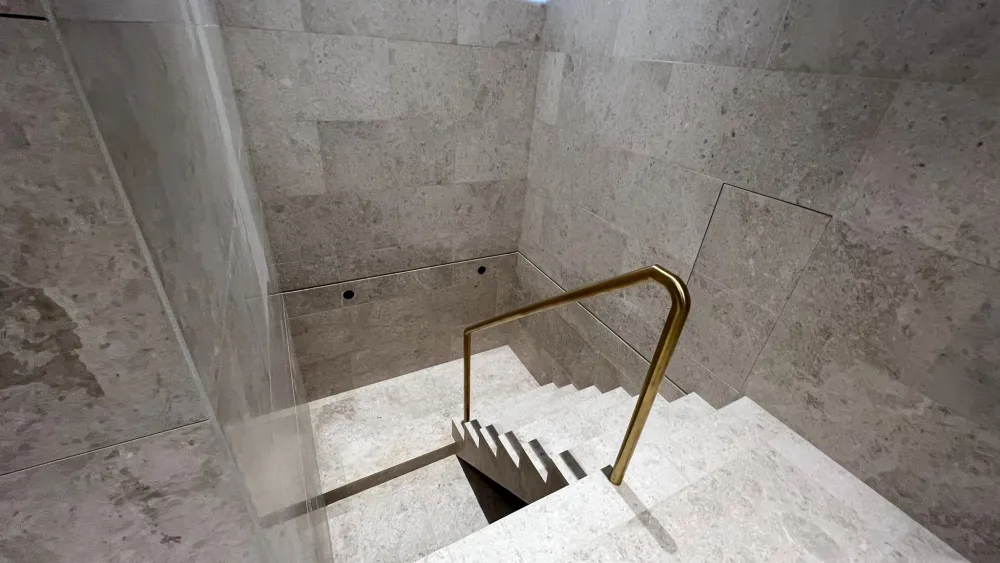
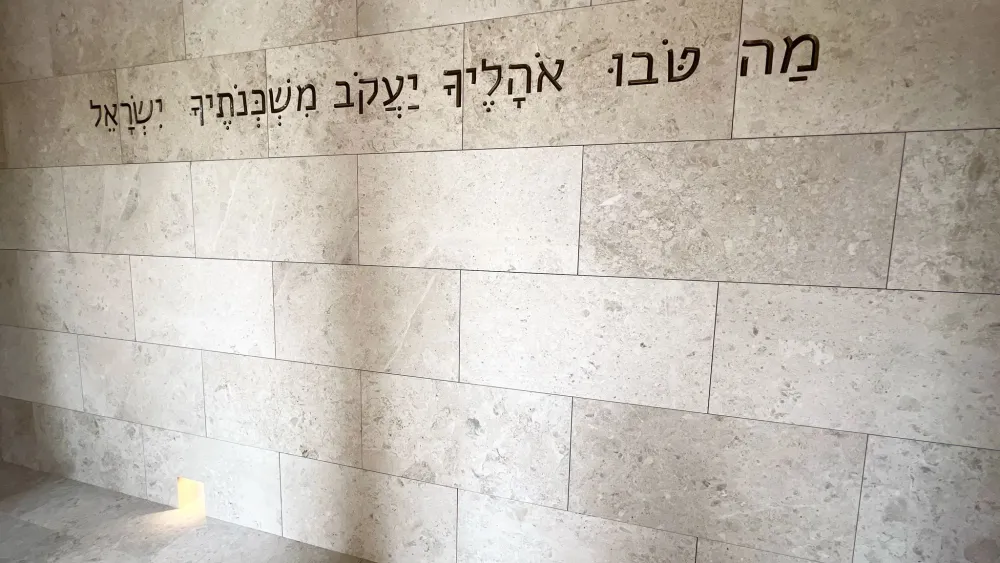
Each of the three buildings is a cube, measuring 30 meters (almost 100 feet) per side. Each has an element specific to the faith that worships within. For example, the synagogue façade is intended to evoke the ritual booths associated with Sukkot (sukkahs), as well as palm fronds, another item linked to the week-long Jewish holiday. The building includes a main sanctuary, two mikvahs and a residence where Ben de Toledo, the rabbi, and his wife will reside. The ark of the sanctuary faces Jerusalem.
Rosen, who has prayed in the synagogue, told JNS that he feels very comfortable in the modern, cubic space, whose interior he said is quite traditional and very beautiful. “If there is anything different from a conventional shul, it is the mesh curtain ascending to the skylight, which is very lovely,” he said.
In line with its tradition, the mosque faces Mecca, the synagogue is oriented towards Jerusalem and the church faces the East.
An oil-rich nation, the Emirates has a population of nearly 10 million, of which about 10% are citizens and overwhelmingly Arab Muslims. Non-citizen residents come from all over the world and practice a variety of faiths, but Jews largely did not come prior to the Abraham Accords. When American or European Jews did visit, they tended to keep a low profile. Israeli nationals were not permitted.
Since the accords, nearly half a million Israelis have visited Dubai and Abu Dhabi.
‘Culmination of Jewish presence in the Gulf’ Stella Penso Lancaster is a Turkish Jew who lived in the UAE from 2012 to 2018 (she now resides in the UK). She told JNS that while living and working there, she didn’t readily reveal her Jewish identity.
“I hid my religion fervently. For the very first time in my life, I wasn’t open about it, and that was tough,” she said. “When I discovered the ‘under-wraps’ Jewish community, I was so relieved. I was finally able to create a complete life for myself and my kids in the UAE.” Levi Duchman, a Chabad rabbi who operated under the radar in the UAE for years, taught Lancaster’s sons Hebrew.
About 2,000 Jews live in the Gulf nation, some 500 of whom may be “actively practicing” Jews, according to Abadie. Both of those numbers will likely increase, he suggested. Saadiyat Island is a five-minute drive from downtown Abu Dhabi and an hour from Dubai—the two places where most UAE Jews live.
When JNS asked how Jews, who live far away, will get to Shabbat services, Abadie quipped: “They’ll figure it out.”
Bahrain is the only nearby country with notable Jewish citizenry prior to the accords. The only verified historic Jewish presence in the UAE is a gravestone with Hebrew inscriptions that dates to the 1500s and is now part of the National Museum of Ras Al Khaimah. A small group of Yemenite Jews fleeing persecution was allowed to move to the UAE in 2020 and was granted citizenship.
The Jewish community has prayed and conducted High Holiday services in hotels or residences, such as in Abadie’s Dubai villa. Kosher food is becoming more available, including seven restaurants that have opened since the accords, according to Abadie.
“This moment is the culmination of the Jewish presence in the Gulf and its tremendous growth following the accords,” he told JNS. “This is a historic event not just for the Middle East but the world.”


