Between the start of the Jewish holidays of Sukkot and Simchat Torah comes the two-year anniversary of the Hamas-led terrorist attacks in southern Israel on Oct. 7, the darkest day in contemporary Jewish history since the Holocaust. Amid a sorrow that encapsulates the whole of Israel—bereaved families who have lost parents, children, spouses, siblings and neighbors to the invasion itself and the multifront war that ensued—there is a Jewish obligation to experience joy.
But these days, that seems hard to come by, especially when 48 captives (both living and dead) from that horrific Black Shabbat in the fall of 2023 still languish somewhere in the Gaza Strip, not far from their homes in Israel, while talking heads continue to talk. While Jews in the Diaspora watch and wait from afar, they often feel helpless in a situation that has turned the world on its head.
Still, Sukkot—the “Feast of Tabernacles” or “Feast of Booths,” which is celebrated for a week until it turns into Shemini Atzeret and Simchat Torah—is a time for family, friends, guests and happiness. It is called z’man simchateinu, the “season of our rejoicing.”
Rabbi Jesse Charyn, leader of Bet Shira Congregation, a Conservative synagogue in Miami, told JNS that we have to celebrate the holidays because we’re commanded to do so, even if we are sad. “In the same conversation, we could have tears of sadness and tears of joy. … This is the story of our survival,” he said.

Charyn added that Jews can certainly question God as to why this has happened while still doing mitzvahs related to the holidays and while seeking general comfort for continued Jewish suffering. To that end, on Tuesdays, he holds a Zoom session with his congregation where he reads a story from One Day in October: Forty Heroes, Forty Stories. The book pays homage to valiant people who were willing to sacrifice their own lives to save others on Oct. 7.
The rabbi knew one of those individuals personally. When he served in the Golani Brigade from 2003 to 2006, the commander of his unit, Col. Roi Yosef Levi, changed his life by encouraging him to stay in the army when he was having doubts. On Oct. 7, Charyn found out that Levi had been killed while he and his team eliminated approximately 10 terrorists to protect the residents of Kibbutz Re’im. “I really had kind of an emotional breakdown when I found out that he was killed—this is such a mensch, such a special person,” he said.
In November, a month after the terror attacks, Charyn went on a mission to Israel with the Greater Miami Jewish Federation, where he met Rabbi Shmuel Slotki, the father of two fallen Israeli heroes.
He listened to Slotki talk about how two of his sons, Master Sgt. Noam, 31, and Sgt. 1st Class Yishai, 24—who were not in active service wound up being killed by terrorists after they ran to defend southern border communities. (Both were married with a child.) According to World Mizrachi, they courageously neutralized tens of terrorists and saved dozens of lives. Still, Slotki felt overwhelmed by grief and sadness for the family’s losses. “I wanted to do something,” he said.
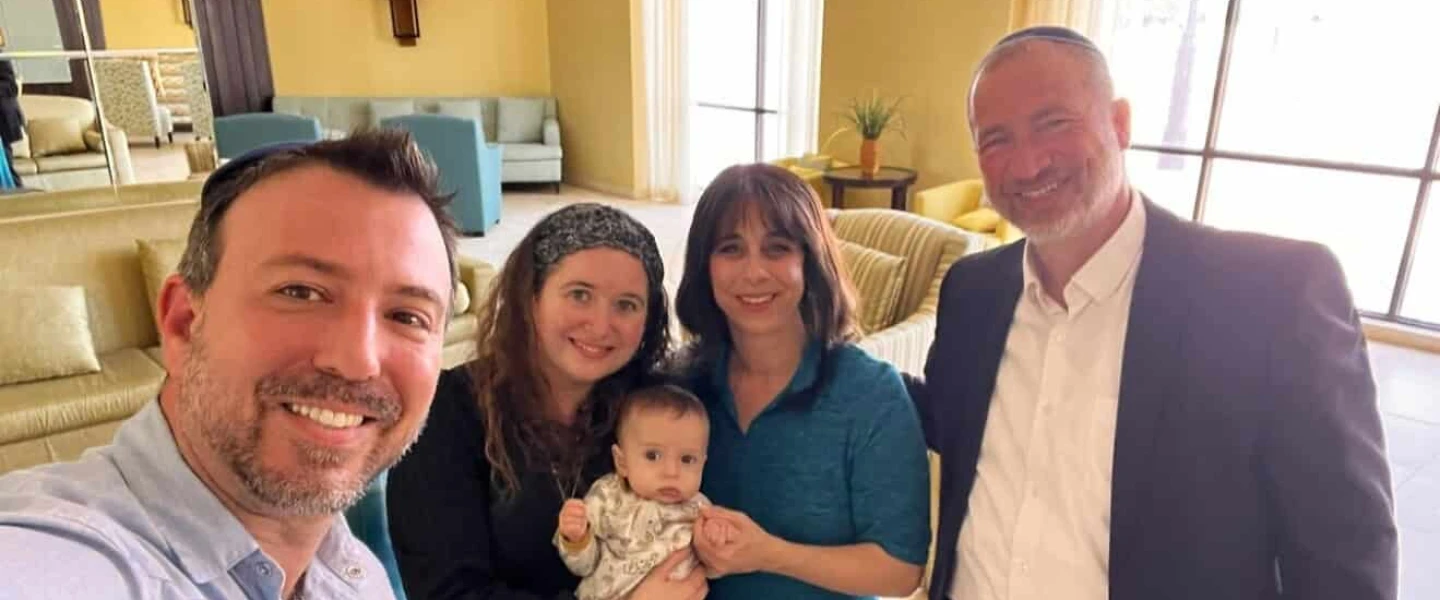
Upon returning home to Florida, Charyn learned that his wife, Shira, was pregnant with a baby boy, whom they named Amichai (Am Israeli Chai) Noam, in memory of the older son, Noam Slotki. Charyn said this name signifies that “no matter what happens, we the Jewish people are the eternal Jewish people, and we will continue to remain and not only to survive, but to thrive and to live a life of Torah and mitzvot.” (The couple has three daughters as well.)
The cycle of grief turned to joy when he introduced Slotki and his wife, Tali, to the couple’s newborn son when they came to visit Miami from Israel. It was a meeting he called “one of the greatest moments.”
Slotki was honored last year with an excellence medal from the Israeli chief of staff. After sitting shiva for his sons (he and his wife are the parents of seven), he served as commander of the IDF Rabbinate’s Casualty Search Unit, identifying victims to give their families closure. On Simchat Torah last year, at a Young Israel synagogue in Jerusalem, Slotki suggested that people dance and sing at one end of a circle, and at the other end, recite one chapter of Tehillim (Psalms) while one person prays for the kidnapped and another prays for an injured soldier.
“They mixed sadness with the happiness of the day,” Charyn told JNS.

‘Ambassadors of light’
The tragic events of that dark day also personally affected Rabbi Arthur Nemitoff, interim senior rabbi of Congregation Beth Am in Los Altos Hills, Calif., a Reform synagogue. He was good friends with Canadian-Israeli peace activist and grandmother, Vivian Silver, 74, who drove Palestinians to Jerusalem for medical care when needed and was murdered by Hamas terrorists on Oct. 7. He is also close with the brother of released Israeli-American hostage Keith Siegel, 65.
Nemitoff said the Talmud addresses how to reconcile the conflicting extreme emotions of sadness and happiness. He explained that “when a wedding procession and a funeral procession meet at an intersection, the funeral procession must wait in order for the wedding procession to proceed. In the midst of mourning, you never, ever delay a simcha.”

He emphasized that Simchat Torah is about renewal and that Jews worldwide can celebrate the holidays while still mourning and remembering the pain of what happened on Oct. 7. “Life is essentially good, and we have to embrace that goodness because that’s exactly what all those who died would want us to do,” he said.
Rabbi Levi Slonim, co-director for Chabad Downtown in Binghamton, N.Y., and the director of development at the Rohr Chabad Center for Jewish Student Life at Binghamton University, described “souls being ignited” since Oct. 7. He noted an upsurge in students attending services, classes and programs, and more requests than ever for mezuzahs to be put up on doors.
Inspired by the teachings of the Lubavitcher Rebbe—Rabbi Menachem Mendel Schneerson—Slonim said he focuses on finding positive ways to respond to pain and suffering. To that end, on the first night of Simchat Torah, Chabad will dedicate the hakafot—dancing with the Torah scrolls—to strengthening their connection to the people in Israel by reflecting on inspirational stories of strength from released hostages, soldiers and volunteers in the war.
Slonim recounted how the Rebbe once said that “a Jew doesn’t ask what will be, rather what will we do?” and encouraged everyone to ask, “How can we bring more light into the world? How can we add more mitzvahs?”
He said the Jewish people’s survival is akin to a lamb among 70 wolves, and to remember on this second anniversary of the atrocities of Oct. 7 that “God is with us. God gave us the strength to be able to respond and do what needs to be done, and to support each other and continue to be ambassadors of love and light.”

Orthodox Rabbi Steven Burg, CEO of Aish, also described how, according to the Midrash and Zohar, deceased relatives of a bride and groom are at the chuppah, rejoicing in spirit. Similarly, he said he feels very strongly that when we dance on Simchat Torah, “it’s as if those people that were taken two years ago are going to be there with us, showing that we can move on.”
‘Suffering that seems unjust and senseless’
Rabbi Jacob Blumenthal, CEO of the United Synagogue of Conservative Judaism and the Rabbinical Assembly, addressed anxiety felt by the Jewish community due to the pronounced surge in global antisemitism that followed the events of Oct. 7, especially during the holidays.
He said, “If I were to choose one day of the year where we should ask Jews to come together publicly to celebrate their Judaism, it should be on a day when we celebrate the gift of Torah. That’s what unites the Jewish people all over the world.”

He described how, although there was tremendous antisemitism in Soviet Russia, Simchat Torah was the one time of year when the Jewish community came together to express their identity proudly and even publicly.
“They felt safer because they knew they could come together in larger numbers, and the authorities sort of held back,” he related. “There’s strength in numbers.”
The rabbi said that represents “the way that we’ve always strengthened one another throughout our history and also helps with the grieving process.”
Aryeh Nivin, an Orthodox rabbi based in Israel, brought attention to another time in history when Jewish people felt joy but also despair on Simchat Torah. He referenced a song, “The Man from Vilna,” inspired by the story of Rabbi Leo Goldman, the chief rabbi of Norway, who was drafted into the Russian army to fight the Nazis.
The song captured Goldman’s experience of feeling joy, fear and anticipation when he returned to Vilna after World War II to search for lost loved ones. The lyrics describe how “slowly there was healing, darkened souls now mixed with light when someone proudly cried out, ‘Simchas Torah is tonight!’”
Survivors ran towards a demolished, blood-stained shul and were distraught upon seeing a vacant Holy Ark. They picked up two crying children who were there and danced with them instead. The lyrics state: “Though we had no sifrei Torah to gather in our arms, in their place we held those children, the Jewish people would live on.”
Nivin experienced his own dark valley of despair 12 years ago when a life-threatening bacterial infection left him with paralysis from the neck down and heart and kidney failure. A devout Torah scholar, he is widely known for teaching spiritual introspection and self-improvement classes. Suddenly, he was living everything he was teaching about transcendence and getting closer to God.

In retrospect, he said the illness “was one of the best things that ever happened to me, as crazy as it sounds. This made it all real. I had to live it.”
He felt like God was testing him and said he was forced to examine his life on a deeper level than he ever could have imagined.
An important concept Nivin learned through his health crisis was inspired by Rabbi Eliyahu Eliezer Dessler, who said that in this world, no one understands why tragedies happen. “The concept of tragedies is unfathomable to our minds,” Nivin said. “Even Moses and the angels in Heaven could not understand suffering that seems unjust and senseless.”
He advises people who are feeling anger, hurt and devastation over the Oct. 7 tragedies to talk to God about it. He said they should express their emotions, but at the same time, remember that “even though I’m broken, I’m shattered, I’m a wreck; nevertheless, I know God—that everything is from You, everything is just, everything is for the good.”
Indeed, the rabbi emphasized that all of God’s actions “are for the good, even though man can’t understand it.”