As he began his keynote address at an event in Jerusalem on Jan. 26, U.S. Ambassador to Israel Mike Huckabee called an audible. The event, held at the President’s Residence in Jerusalem—and hosted by the Jabotinsky Institute—was the annual lecture in memory of Zionist Revisionist leader Vladimir (“Ze’ev”) Jabotinsky.
Minutes earlier, news had arrived that the body of Israel’s last remaining hostage, Ran Gvili, was located in Gaza and being returned home for burial. This prompted Huckabee to abruptly and publically remove the yellow-ribbon pin he had been wearing on his lapel in solidarity with hostage families, whose loved ones had been abducted by Hamas on Oct. 7, 2023.
“I will pray that never in the history of the nation of Israel will anyone ever wear a yellow ribbon on their clothing again, because I pray there will never be a moment when another Israeli family has to endure the agony of someone among them being taken hostage by evil people,” Huckabee told the audience.
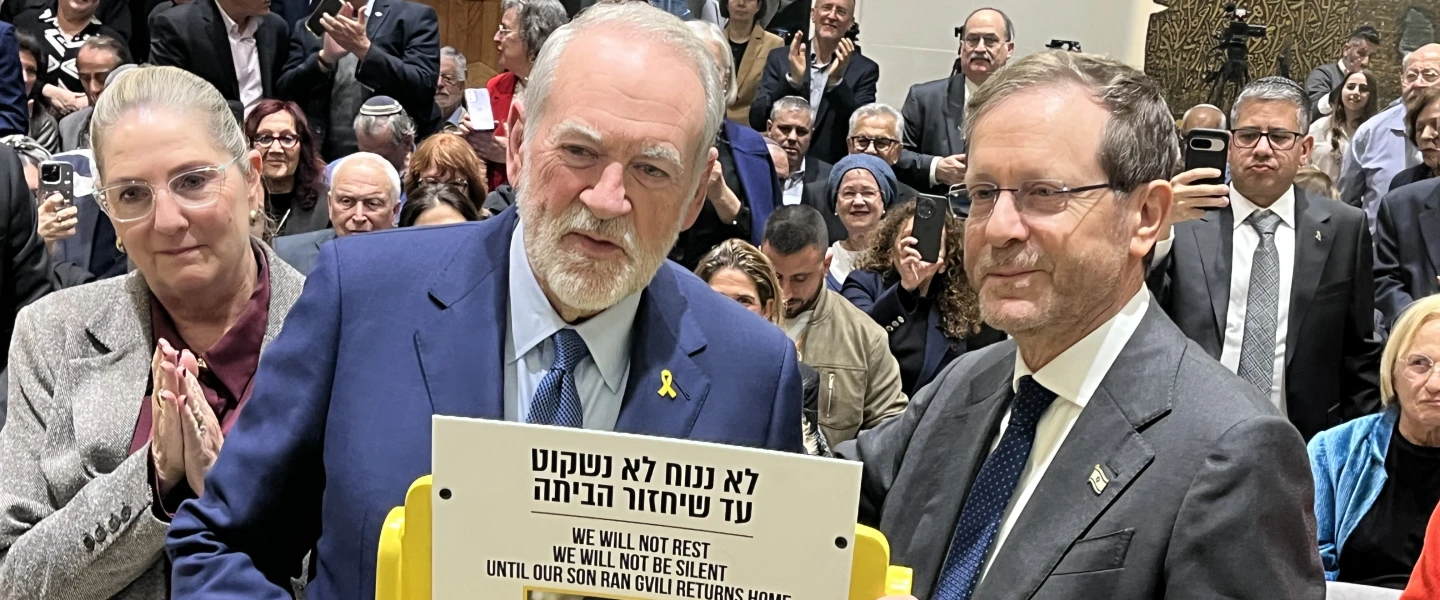
Just before his talk, Huckabee and Israeli President Isaac Herzog folded up and removed the final symbolic “yellow chair” from the presidential auditorium, signifying that no Israeli hostages, alive or deceased, remain in Gaza.
At the start of the event, Huckabee told JNS that he was honored to speak about Jabotinsky—one of the pioneers of Zionism—and the return of the Jews to their ancient homeland.
“But more importantly, I’m deeply humbled by the incredible ability to remember a person whose legacy is still being felt, even though he passed away at a young age in 1940,” Huckabee said. “He didn’t get to see the rebirth of the nation of Israel, but I believe that, looking down from above, he sees it with great joy and pride.”
Huckabee shared with the audience his belief in the power of “hope,” noting that Jabotinsky embodied extraordinary hope for the Zionist movement, ultimately leading to the “restoration” of the Jewish nation.
“Notice I said, ‘restoration,’” Huckabee stressed. “Because it was not ‘a nation before.’ That had been done 3,800 years ago, when God said to Abraham, ‘Here in this very city on Mount Moriah, this is your land. I brought you here for this purpose, and the world will be blessed through you.’”
He described Jabotinsky as a man who never wavered in his belief in Zionism, despite criticism, condemnation and the dangers he faced as a Zionist in the early 1900s.
Jabotinsky, he said, “was a person who planted trees, whose shade he would never enjoy. In many ways, the greatest gift any of us can give is to do something whose greatest impact we may never see.”
Turning to Jabotinsky’s family in attendance, including his great-granddaughter, Tamar Rubin, Huckabee said, “We get to sit under the trees that your great-grandfather planted long before you even came to this earth.”
Rubin told JNS it was a great honor to hear Huckabee speak about her great-grandfather, who “was always there for Israel, protecting the Jewish nation.” She also expressed gratitude to U.S. President Donald Trump for standing with Israel.
Quoting Jabotinsky, Huckabee said, “It’s better to have a gun and not need it than to need it and not have it.”
He explained that Jabotinsky understood the importance of strength in maintaining freedom and understood that being a warrior was necessary “if that’s what it took to provide future generations a place where freedom, integrity and legacy could endure.”
Herzog opened his remarks by reflecting on the whirlwind of emotions surrounding the return of Gvili’s body. He thanked the Israeli government, Prime Minister Benjamin Netanyahu, the Israel Defense Forces and the countries that helped broker the hostage agreement, particularly the United States under the Trump administration.
Herzog described Jabotinsky as a leader who believed that lasting peace between Jews and Arabs was possible—but only through strength. He called Jabotinsky’s ideas prophetic, noting that both then and now, Israel’s enemies “have not been fully dispelled of the notion that our Jewish state is anything but a given fact.”
He said that Oct. 7 epitomized their belief that terrorism could drive the Jews from their land.
“Hamas launched its ... barbaric attack because it continued to sustain the fantasy that we can be terrorized and driven from this land,” he asserted. He went on to say that Israel is at a historic crossroads, with the potential to forge cooperation and collaboration with neighbors, describing this vision as “one in which strength is indeed a guarantor of peace. To get there, we must disabuse our self-proclaimed enemies of the notion that they can ever annihilate Israel.”
Ronn Torossian, board member of the Jabotinsky Institute and chairman of Betar Worldwide, told JNS that Jabotinsky was perhaps the greatest Zionist who ever lived—a fighter and a prophet whose words remain relevant today.
“Jabotinsky correctly warned the Jews of Europe about the impending Holocaust and told them to get out,” Torossian said. “He was right then, and we say the same thing today to the Jews of the world: ‘You have a choice—make aliyah or stand up and do everything you can, as these are very difficult times.’”
Torossian added, “Standing here at the President’s House in Jerusalem, knowing that Jews are in danger in so many places, we urge them to stand up and come home to Israel. This, of course, was Jabotinsky’s ideology. He believed that Jews have to protect themselves—something that Jews in Israel understand and something we hope Jews worldwide will better understand.”