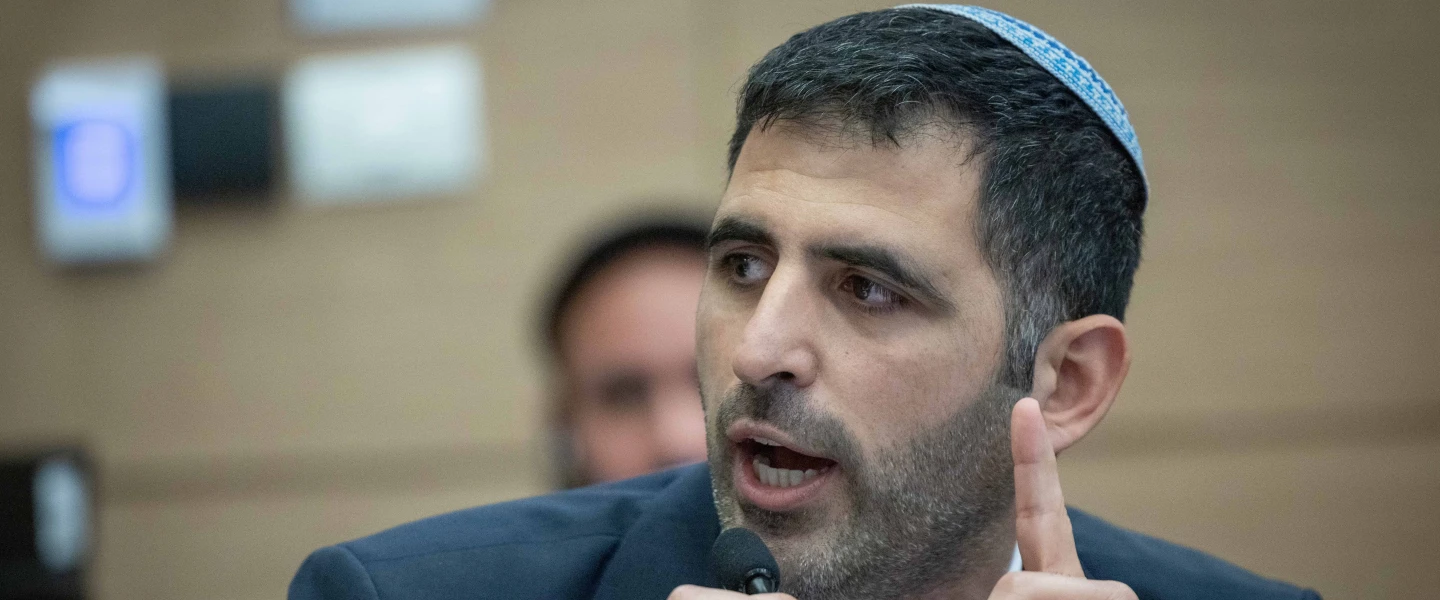
The Israeli people want a revised judicial system, a free press and Judaism, Communications Minister Shlomo Karhi told JNS during a recent interview in his Jerusalem office.
Karhi, who is from Moshav Zimrat in the “Gaza Envelope,” where he still lives, is the eldest of 17 children. He himself has eight children. His professional background is in socioeconomic policy, and he holds a master’s degree in industrial engineering from Ben-Gurion University of the Negev. He was first elected to the Knesset in 2019.
After entering the Knesset, Karhi focused on challenging banking monopolies and advancing legislation to reduce fees and increase competition. In 2022, when the current government was formed, Israeli Prime Minister Benjamin Netanyahu appointed him communications minister.
The future of Gaza
Ahead of the highly anticipated talks between Netanyahu and U.S. President Donald Trump at the White House on Wednesday, Karhi emphasized that Israel must retain decision-making authority in the Gaza Strip through continued presence on the ground there.
“Our soldiers are deep inside the Gaza Strip. They did not leave, and they will not leave until all the objectives of the war are completed,” said Karhi. “While the goal of returning the hostages has been achieved, the focus now must be on demilitarizing the Strip.”
The central mission in Gaza now, he said, was the disarmament of Hamas. He expressed concern at the prospect of enemy states’ representatives holding advisory roles within administrative bodies connected to U.S.-sanctioned Gaza committees, but said that as long as Israel remains in control of what happens on the ground in Gaza, the risk is less acute.
At the World Economic Forum in Davos, Switzerland, on Jan. 22, Trump signed a charter establishing the Board of Peace, launching Phase 2 of his administration’s Gaza peace initiative.
The board is accompanied by a multi-tiered hierarchy of oversight bodies. At its base is the General Board of Peace, a plenary forum composed of heads of state. Above that sits the Executive Committee, the main strategic and decision-making body, chaired by Trump, who retains absolute veto power and is tasked with operationalizing the board’s vision.
The final tier, the Gaza Executive Board, serves as a link between senior decision-makers and on-the-ground administration. Its members include lower-level Executive Committee officials as well as regional figures, among them Ali al-Thawadi, a senior aide to the Qatari prime minister, and Turkish Foreign Minister Hakan Fidan. The Trump administration plans to host leaders from the Board of Peace in Washington, D.C., on Feb. 19.
Karhi acknowledged that no one wants representatives of enemy countries serving in advisory capacities, but said that as long as Israel’s war objectives are achieved, from his perspective the arrangement still represents a significant political achievement.
“We do what we want in the field, and that is what matters—not a sub-adviser on a subcommittee,” said Karhi, though he added that “even there, the prime minister continues to voice objections and fight.”
The matter must be viewed “in the right proportion,” said Karhi. “At the end of the day, decision-making on the ground remains in Israel’s hands.”
On Jan. 19, Netanyahu, speaking in the Knesset, said there would be no Turkish or Qatari troops deployed to Gaza as part of Phase 2 of the Trump peace plan.
The Israeli premier has also been clear that the Palestinian Authority cannot govern the Strip, Karhi noted.
“The Palestinian Authority supports terror, and as long as it continues to do so—funding terrorism and paying wages based on the brutality of attacks—it has no place in Gaza,” Karhi said, referring to the P.A.'s notorious “pay for slay” program.
While acknowledging that Netanyahu has dismissed plans for Jewish settlement of Gaza as “not realistic,” Karhi expressed the hope “that at some point it may become realistic.”
It is only via this, he said, that Hamas will learn the cost of its actions.
“After Oct. 7, Hamas must be struck hard,” said Karhi. “Victory is one thing, but there must be a cost—one that continually hurts them and reminds them it is not worth it [to attack Israel]. Controlling the land and creating Jewish settlements will hurt them more than anything. I trust the prime minister and the Cabinet to do what is right for Israel’s security.”
An Israel Hayom poll published last year found that 52% of Israelis support the reestablishment of Jewish communities in Gaza.
“The prime minister has my support and the mandate to do what he believes is right, including on this issue,” said Karhi.
Communication reform
In 2025, Karhi presented a communication reform plan aimed at deregulating the market, drawing comparisons to Trump’s approach toward National Public Radio and the Public Broadcasting Service in the United States, and increasing competition. Two Israeli sectors—the communications market and the judicial system—remain controlled by the “old elite,” each reinforcing the other, he told JNS.
The primary objective of his reform, he explained, is to restore diversity of opinion. While the plan also seeks to lower the cost of living, reduce state intervention through a simplified licensing process, promote competition and allow consumers to customize channel packages, he emphasized that pluralism is the central goal.
“When the market is free enough, freedom of expression will prevail,” he said. “That is what the broadcasting law is meant to ensure.”
In the private sector, Karhi said he aims to eliminate bureaucratic interference and allow the free establishment of news channels.
Regarding public broadcasting, which receives billions of shekels in state funding, Karhi said he supports partially privatizing the Israeli Public Broadcasting Corporation (Kan) and closing its news and current affairs division, citing low ratings and what he described as a strongly anti-government editorial line.
“We will continue funding programs and shows with high ratings,” he said, “but news should succeed on its own if the public wants to watch it.”
Publicly funded broadcasting cannot promote what he described as the narrative of Israel’s enemies, he said, giving as an example referring to parts of Israel as the West Bank instead of Judea and Samaria.
Both his communications reform and the government’s judicial reform, Karhi said, will be central issues in the next election.
2026 elections
In 2023, Israeli Justice Minister Yariv Levin announced a far-reaching program for judicial reform, with an emphasis on reining in the Supreme Court. The reform includes four elements: changing the way judges are selected so that the Knesset members will have majority say on the Judicial Selection Committee; passing an “override clause,” a law that would give legislators the power to reverse, or “override,” the Supreme Court when it strikes down laws; abolishing the legal justification of “reasonableness” by which the court can cancel Knesset decisions; and empowering ministers to hire and fire their own legal advisers.
Karhi, proponent of the initiative to dismiss Israeli Attorney General Gali Baharav-Miara, said she represents the past.
“There cannot be an attorney general in office who fights the government all day on security, domestic and foreign policy,” he said. “The government acted according to the law, yet we are blocked from appointing someone else.”
Israel’s governing coalition has been at loggerheads with the attorney general since its election on Nov. 1, 2022. Baharav-Miara was appointed to the post by the previous government, led by Naftali Bennett. In November 2024, Netanyahu tasked Levin with finding a solution to the ongoing opposition of Baharav-Miara to his government.
On Aug. 4, the Cabinet voted unanimously to dismiss Baharav-Miara under new procedures, but the Supreme Court ruled the decision could not take effect pending review. In December, the Supreme Court, sitting as the High Court, canceled two Cabinet decisions that had eased her dismissal, effectively nullifying the termination. The court ruled there were numerous procedural flaws in the government’s changes to the mechanism for firing the attorney general.
While the Cabinet has the authority to fire an attorney general, in the past the decision could only be made after a recommendation by a public professional committee composed of justices, lawyers, academics and ministers.
However, in a unanimous decision on June 8, the Israeli Cabinet approved a proposal to circumvent the independent committee responsible for appointing and firing attorney generals.
Looking ahead to the upcoming elections, which must be held by Oct. 27, Karhi said right-wing voters must understand they are voting for legal advisers to assume an actual advisory role, for the Supreme Court’s authority to be capped and for the communications market to open to competition.
Anyone who chooses to join a future right-wing coalition would be welcome, provided they accept the coalition’s fundamental principles, he said.
“If they impose conditions such as canceling judicial or communications reform and abandoning your values, it won’t work. If they understand they are joining under the umbrella of a Jewish and democratic state, they are welcome,” he said.
The Iranian threat
At Netanyahu‘s pivotal meeting with Trump in Washington, D.C., Israeli concerns and red lines regarding Iran’s nuclear program and missile production took center stage.
Trump characterized the meeting as “very good,” but added that “there was nothing definitive reached other than I insisted that negotiations with Iran continue to see whether or not a deal can be consummated.”
“If it can, I let the prime minister know that will be a preference,” Trump wrote. “If it cannot, we will just have to see what the outcome will be.”
U.S. officials have said that the talks will cover a range of Iranian actions, including its brutal suppression of domestic protests.
“I’d rather make a deal that’s going to be a good deal,” Trump told Fox News on Tuesday. “No nuclear weapons. No missiles. No this, no that. All of the different things that you want.”
Trump ordered additional U.S. forces to deploy to the region ahead of the talks, led by the aircraft carrier USS Abraham Lincoln, which the president has described as leading an “armada” that could take part in military strikes on Iran.
He alluded to that threat again in his readout of the meeting with Netanyahu on Wednesday.
“Last time Iran decided that they were better off not making a deal, and they were hit with ‘Midnight Hammer,’” Trump stated, referring to “Operation Midnight Hammer,” the U.S. strikes on Iranian nuclear facilities in June. “That did not work well for them. Hopefully this time they will be more reasonable and responsible.”
With regard to the situation with Iran, Karhi said Israel is independent in ensuring its security, and does not require U.S. participation to do so.
“We struck first when we understood there was an existential threat, and the Americans joined later,” he said, referring to “Operation Rising Lion,” Israel’s 12-day war against Iran in June. “If we identify such a threat again, America may join—but it does not always have to be together.”