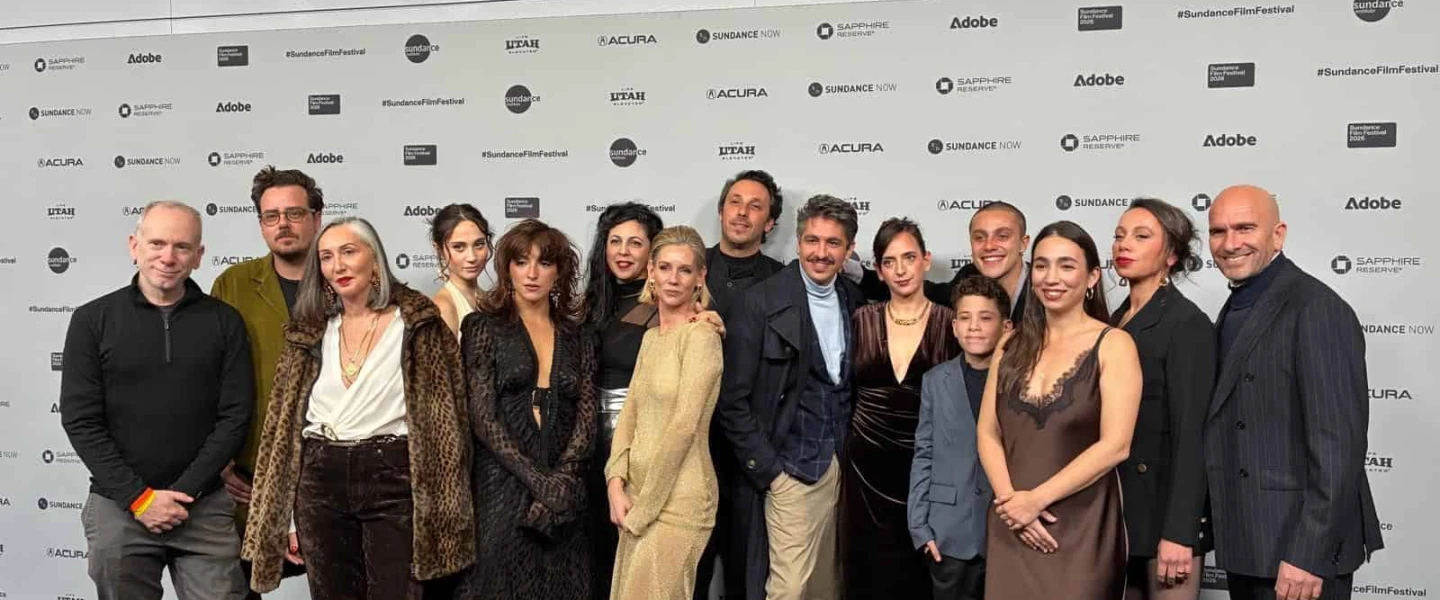
An Israeli film returned to the Sundance Film Festival in January for the first time in a decade with the premiere of director Moshe Rosenthal’s Tell Me Everything in Park City, Utah.
The Israeli-French co-production represented Israel’s first selection at Sundance since 2017 and was supported by the Israeli consulate of the Pacific Southwest. The news was shared on Sunday by the official X account of the State of Israel, operated by the Foreign Ministry.
History in the making. The Israeli consulate of the Pacific Southwest was proud to see director Moshe Rosenthal’s “Tell Me Everything” representing Israel at Sundance 2026.
— Israel ישראל (@Israel) February 1, 2026
Incredible to see Rosenthal’s vision recognized on the world stage. As the first Israeli film at Sundance… pic.twitter.com/52CFKrZ7U2
Only a few Israeli films have been screened in Sundance’s official competition. Dror Shaul’s Sweet Mud (2006) and Elite Zexer’s Sand Storm (2016) both won the festival’s Grand Jury Prize. The last Israeli feature at the 2017 Sundance Film Festival was Avi Nesher’s Past Life, which follows two Israeli sisters as they uncover their family’s hidden Holocaust-era past.
The latest screening comes just months after a petition signed in September by some 5,000 film-industry figures calling for a boycott of Israeli films.
Rosenthal’s film tells the story of a teenage boy who feels increasingly alienated from his father after discovering that his father is gay, unfolding across two timelines set in 1987 and 1996.
In media interviews, Rosenthal focused on the film’s personal and emotional themes, avoiding politics and current events. Its central family story focuses on a boy and his older sisters, a dynamic inspired by Rosenthal’s own experience growing up with two older sisters.
He described the project as deeply personal, though not strictly autobiographical. “The world, the characters and especially the emotions are very autobiographical,” Rosenthal said in an interview with Cineuropa. “But the story itself is largely fictional. In real life, it was my coming-out experience, not my father’s. Switching the roles allowed me to explore my fears more honestly.”
Rosenthal said the late 1980s and mid-1990s were chosen deliberately, reflecting a period of dramatic change in attitudes toward gay identity in the midst of the AIDS epidemic.
“It was a time filled with fear, but also transformation,” he said. “The way society viewed the gay community changed significantly during those years, and I wanted to explore that shift, both socially and personally.”
Rejecting the glossy nostalgia often associated with portrayals of the era, Rosenthal said he aimed for realism in both set design and tone, drawing heavily on family photographs and personal memories.
“There was a strong American cultural influence, but it was always imperfect—almost a messy imitation,” he said. “That felt true to how it actually looked and felt in Israel and Europe at the time.”
The film stars Israeli actors Assi Cohen, Yair Mazor, Ido Tako, Keren Tzur, Mor Dimri and Neta Orbach. Rosenthal said his casting process focused less on finding actors who naturally fit a role and more on emotional authenticity.
One of its most emotionally charged scenes—featuring the protagonist and his older sisters riding together in a car after a painful confrontation with their father—was filmed on the actors’ final day together.
“It became very personal,” Rosenthal said. “At one point, someone was crying off camera and I realized it was Yair Mazor, who wasn’t even supposed to cry. We knew immediately the scene was special.”
Music plays a central role in Tell Me Everything, with Rosenthal describing the film as “almost a rock opera.”
“The music follows the boy’s emotional journey—from pop and vulnerability to punk and rebellion,” he said. “I wanted sounds that felt forgotten, not polished nostalgia.”