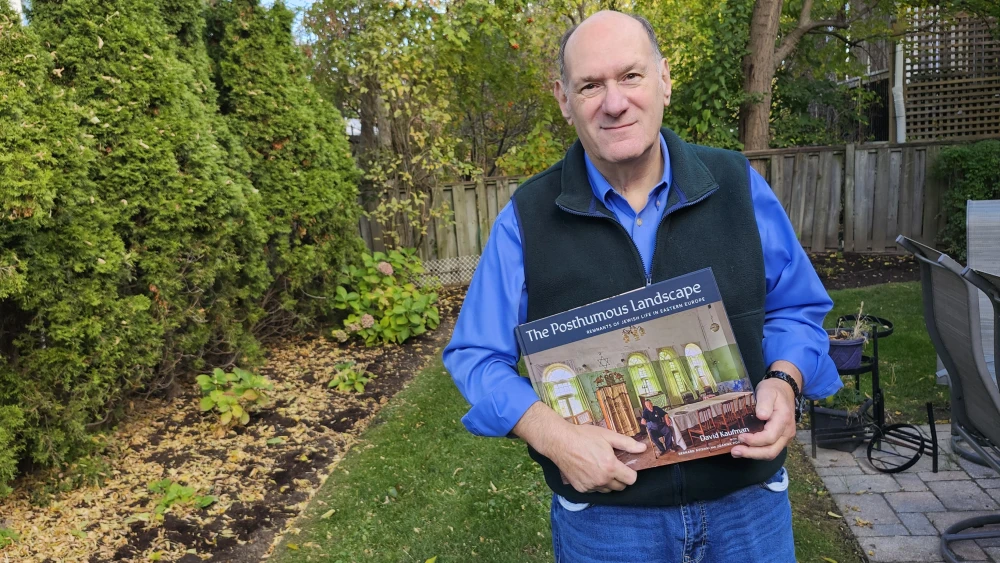
Documenting Jewish cemeteries and synagogues over a decade for what became his book The Posthumous Landscape: Remnants of Jewish Life in Eastern Europe, Jewish photojournalist David Kaufman found helpers and those who got in his way.
“Every place we went, there was someone who knew where the former cemetery or synagogue was. Those people were invariably happy to help us find our way and did this graciously, often out of a commitment to preserve Jewish material culture,” the Toronto-based filmmaker and former CBC documentarian told JNS.
Some non-Jewish caretakers have long tended to Jewish sites, like the man who has cared for and catalogued every stone in the Jewish cemetery in Bochnia, some 25 miles southeast of Kraków, for 50 years.
Kaufman asked the man why he did it. “I cared for the Jews who lived in this town before the war,” the man told Kaufman. “They were my brothers.” The man’s sibling had been a political prisoner in Auschwitz, he told the photographer.
A “very interesting phenomenon” that Kaufman encountered was in smaller cemeteries, whose only visitors were Chassidim from abroad who came to gravesites of revered rebbes. Kaufman learned that a new generation of Poles, including those who are outsiders in their communities like gay and socially marginalized people, has taken up the responsibility of protecting Jewish heritage.
But not all of his encounters were positive. When he tried to photograph a marketplace built over a medieval Jewish cemetery in Lviv, Ukraine, people in the market, who were wary of outsiders due to court battles over the land, told him he couldn’t take pictures, he told JNS.
“Traveling through all these places,” he told JNS, “underlines how precarious Jewish communal life is everywhere.”
At some shuls and cemeteries in Europe, Jewish sites are quite precarious.
“There are parts of the Warsaw Jewish cemetery and parts of the Lodz Jewish cemetery where you simply cannot walk in anymore, because they have not cleared the vegetation for five or seven years,” he told JNS.
The coffee table book, published last month, contains 163 photographs—culled from 600—documenting landmarks in dozens of once-vibrant Jewish communities in Poland, Ukraine, Latvia and Lithuania that are now in tatters and ruins after decades of disuse.
“This was the heart of Jewish civilization for hundreds, almost a thousand years,” he said.
Greenery has overtaken many of those sites. “If you look at pictures of the Warsaw cemetery before the war,” he told JNS, “there are no trees. But these cemeteries were partly damaged, and trees were allowed to grow up during the Soviet period.”
“Now they’re like forests—beautiful green forests with huge numbers of carved memorial stones,” he said.

‘Very strong mental note’
Raised in an Orthodox home in Montreal, Kaufman had a strong Jewish education and long aspired to “express my Jewishness in my professional work.”
His early career led him to documentary filmmaking, including work for CBC’s The Fifth Estate. He recalls a 1992 reporting trip to a small town in Poland, called Kazimierz Dolny, about 30 miles from Lublin.
“They were trying to build a hot water line across a football field in a high school, ironically a high school named after Janusz Korczak, who, of course, had been the director of the orphanage in the Warsaw Ghetto, and who chose to go to Treblinka with his young charges instead of letting them go by themselves,” he told JNS.
Returning to Canada from that trip, he picked up a copy in the airport of A Tribe of Stones: Jewish Cemeteries in Poland, a book of black-and-white photos that Polish-Jewish artist Monika Krajewska published in 1983.

“I made a very strong mental note,” he told JNS. “This is a project you should do, you should take up sometime in your life.”
“And I pored over that book, and the photographs were beautiful, I thought this could be a worthy subject for a photography project,” he said.
For the project that became his new book, Kaufman mapped and photographed nearly 50 sites, often using detailed U.S. congressional reports to identify cemeteries and synagogues.
The project stretched across regions “where Jews once made up 30%, 40%, 50%, sometimes 90% of the population,” he said. “There is nothing left except maybe a cemetery or maybe a ruin of a synagogue, and sometimes not even that.”

Wherever there is a shul and ruins, “that place will definitely not be there in 10 or 20 years,” he said. “The synagogue in Brody, in western Ukraine, it’s completely collapsed now.”
That synagogue has extensive water damage, and the roof collapsed, according to Kaufman.
“It’s in a residential area in a small town, where children play, and the mothers are not happy that children are playing in the ruins,” he said. “Unless the Jewish community spends considerable money to restore the synagogue, which is very unlikely in that place, it’ll eventually be torn down. There’s just no question.”
Ten years have passed since Kaufman started his project. It’s now a “different historical era” with fewer survivors and rising Jew-hatred. There is “renewed urgency” now to learn the lessons of Jewish history, he said.
“I don’t think I’m exaggerating,” he said. “Jewish life everywhere is more fragile than ever.”