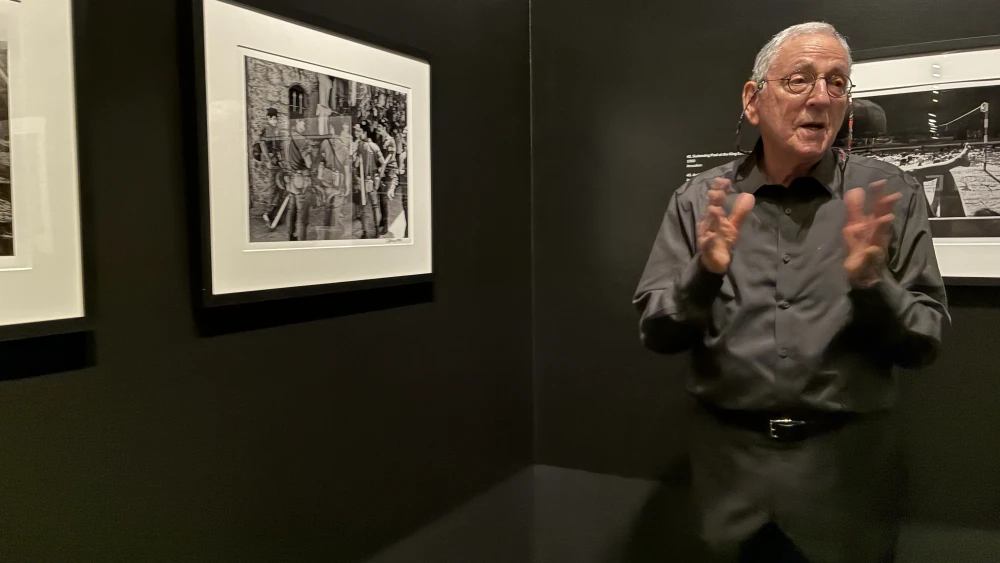
On a recent Thursday, JNS previewed a retrospective of Bill Aron’s photographs at the American Jewish Historical Society in Manhattan with the 84-year-old artist.
“It was difficult to trim it down to 52 photos,” the octogenarian, clad in black trousers, a black shirt and red sneakers, told JNS. “I started with 90, and I wanted all the aspects of my career represented.”
Aron, who lives in Los Angeles with his wife Isa, with whom he has two sons, curated the retrospective, “The World in Front of Me,” with the society. The show is on view until June 4.
The Philadelphia native’s work has been shown at the Museum of Fine Arts Boston, Museum of Modern Art (New York), Art Institute of Chicago, Jewish Museum (New York) and the Israel Museum in Jerusalem, according to Pucker Gallery, in Boston, which has represented him since 1976.

Aron teaches at the New Community Jewish High School in West Hills, Calif., according to Pucker, and the photographer states on his website that he has “come to be known as the ‘dean’ of American Jewish photographers.”
The American Jewish Historical Society show is organized thematically: early black‑and‑white images from Cuba and other international Jewish communities (including the former Soviet Union), his work in New York, exploration of Jewish life in the American South, portraits from Israel and of Holocaust survivors and of cancer survivors.
Looking at a photograph in the first section, which related to his first book, “From the Corners of the Earth,” Aron told JNS that he was with a group of about 10 people in a synagogue, and everyone spoke different languages and couldn’t communicate.

“We were all looking for a common language, and I had spent four years in Turkey with the State Department and Peace Corps,” he told JNS. “I just threw out Turkish as a joke, and this woman’s face dropped and she said, ‘Do you speak Turkish? I’m from Turkey.’”
“It was like finding family,” he said.
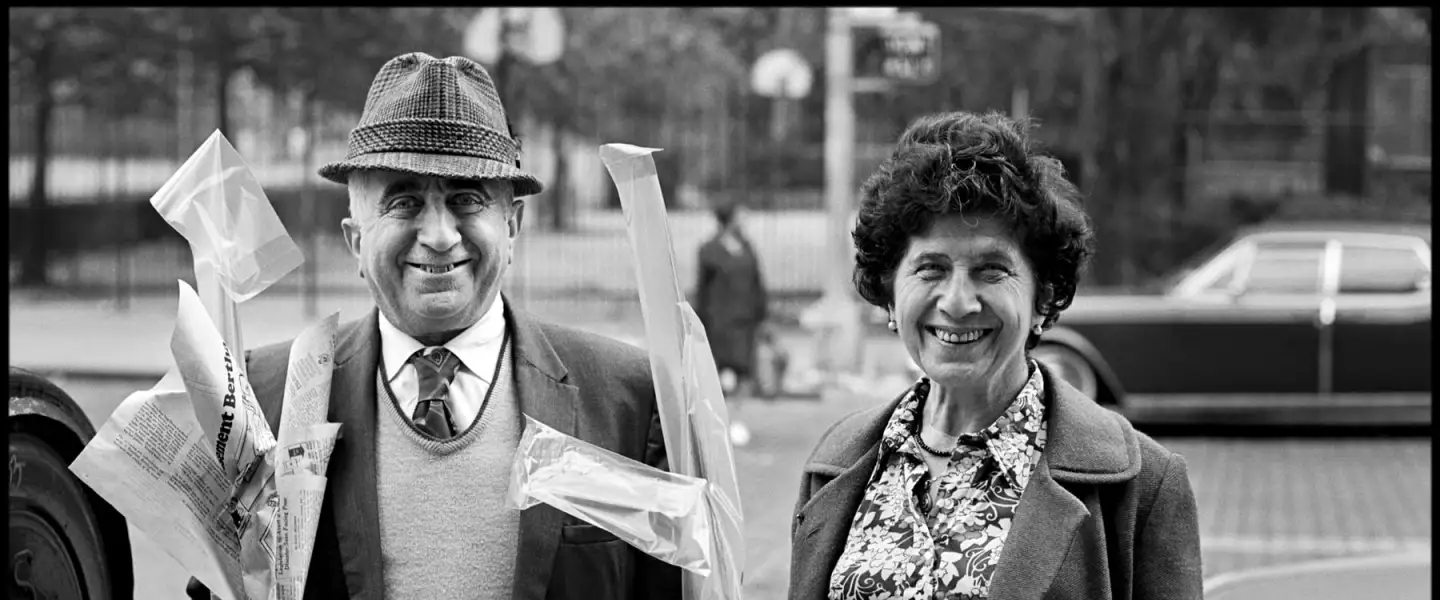
A focus of the show is Jewish life in New York in the 1970s. “My first portfolio was taken on the Lower East Side, and it became the first place where I did actual series photography,” Aron told JNS. “That’s when I realized I wanted to focus on Jewish subjects.”
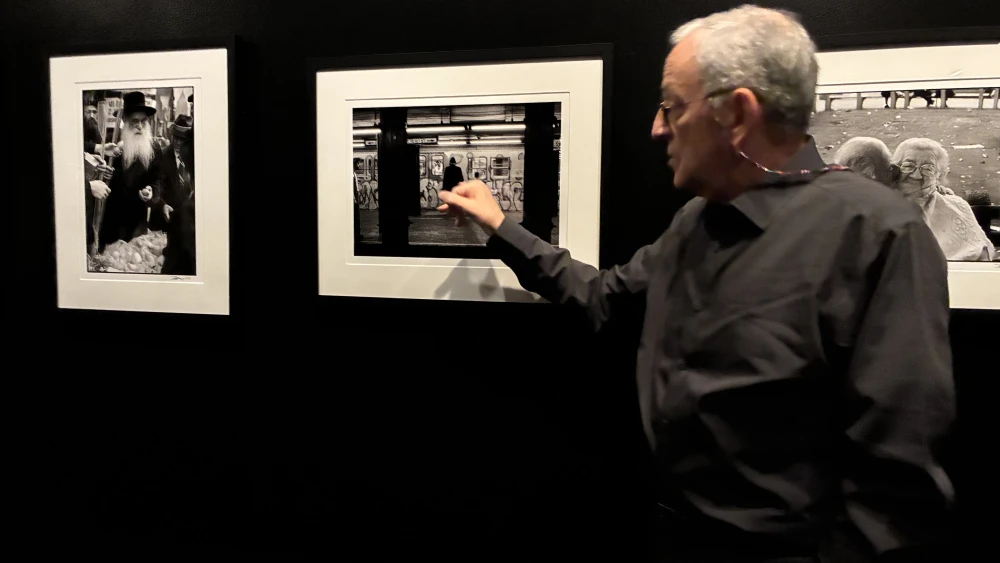
A defining image from that period was “To 16th Street, New York City (Chassid in Subway),” which he took in 1976.
“I had one frame left when I got on the subway platform on the uptown side, and the subject was on the other side of the platform,” he told JNS. “I took my camera out, and he turned around giving me his back as soon as the other gentleman walked into the frame.”
He thinks that “Rabbi Eisenbach: Scribe, the Lower East Side” is one of his best-known photographs.
“Every week, while Rabbi Eisenbach was working on the scroll in this photograph, I would enter his store, ask questions about his work and seek permission to take his picture,” Aron states. “He always answered my questions but refused to grant permission for the photograph.”

“On the first warm day of spring, I happened to be leading a youth group on a tour of the Lower East Side. We stopped at Rabbi Eisenbach’s door, which was open, and I explained as much of the scribe’s work as I could,” the photographer adds. “As I was about to walk away, I saw the photograph that I wanted to take. My camera was around my neck, and so, with only the slightest hesitation, I took advantage of the situation.”
The rabbi “raised his eyes over his glasses while I quickly left the scene,” Aron states. “Several weeks after the incident, I entered his store to show and give him a print, holding my breath, of course. He looked at it for a very long moment and then smiled and said, ‘It’s very nice, Thank you.’”
The rabbi’s son, who was also his apprentice, also saw the image and “asked me to photograph him, as well,” the photographer adds.
Aron told JNS about his connection to the Havurah movement, a grassroots, egalitarian Jewish fellowship in the 1960s and 70s that embraced informal prayer and song. That influenced his work.
“She was from an observant family and all the Havurah people were her friends, so it was natural when we moved to New York that she re‑established her friendships and they said, ‘Why don’t you join us?’” he said. “We did from 1974 to 1978.”
“Havurah was a generationally unique and unrepeatable moment that was incredibly formative for my life,” he said.

Aron noted what he sees as the complexity of Jewish identity in his New York imagery.
“There was a gradual shift in my thinking to wanting to photograph Jews who didn’t look like Jews and express something,” he told JNS. “The Jewish community is much more complex than just the Orthodox look.”
His photographic exploration of Jewish communities in the American South, a project that occupied much of the 1990s, forms one section of the show.
“Before I was introduced to this project I had no idea there were Jews in the South, and I had no concept of the geography of how everything was far from each other,” he said. “It took most of the 1990s to shoot the series—about 10 different trips.”
Leading JNS through that section, Aron laughed as he reflected on a kitchen scene.
“Best chopped liver, I’m told, in the world but I don’t know, because my mother’s was pretty good,” he said. “My mom had the same chopper and the wooden bowl.”

The picture “Joe Martin Erber, a USPS Postman, and his Uncle, Meyer Gelman, Greenwood, Mississippi” comes from Aron’s work in the American South.
Erber, wearing a U.S. Postal Service cap, and Gelman hold Torah scrolls in front of the ark at Congregation Ahavath Rayim, the last Orthodox synagogue in Mississippi, according to the photographer.
“Until recently, Greenwood had both Orthodox and Reform congregations, each with their own building. Now there is only the Orthodox synagogue with very few members remaining,” he states.
Erber told him about the state governor speaking at the funeral of one of the synagogue’s members. “He pounded his fist and remarked, ‘There was never a finer Christian gentleman than....,’” Erber told the photographer. “And of course the funeral was held in the synagogue.”
“The point is that Southerners rarely connect ‘Christian’ with being a ‘Christ follower.’ It doesn’t necessarily mean anything to refer to a good Jew as a ‘Christian person,’” the photographer was told. “In the same vein, most local people call our place of worship a ‘church.’”
Erber also told the photographer that he learned at Peter Rabbit Kindergarten that the Shema was to be said at home and in synagogue, and “Our Father who art in heaven” was for saying in kindergarten.
Sarah Hopley, who curated the exhibit, told JNS that Aron “shows the joy in everyday life, so I really wanted photos that showed joy.”
Later galleries in the show include portraits of Holocaust survivors and, after Aron’s cancer diagnosis at age 50, people afflicted with that disease.
“I am a cancer survivor and at a support group, someone said, ‘It’s the best thing that happened to me.’ And I said that ‘cancer was the worst thing that happened to me,’” he told JNS. “He told me of the changes he made in his life because of the reckoning with his mortality, and I started asking around and it’s not an uncommon perspective.”

“The cancer survivors and Holocaust survivors were my teachers, really,” he said. “I’m 84, and these people were a part of me.”
Aron told JNS that he got his first camera after winning a round of roulette in Atlantic City. It was a trip he took with his mother after his father died.
He told JNS that if he was living in New York City, he would have found a way to explore Oct. 7 more.
“I have not done anything with the idea of Oct. 7, although it’s an interesting idea,” he said. “I don’t know what I would do.”