Newsletter
Newsletter Support JNS

Fleeing hardship and war, some 400 Ukrainians leave for Israel

The latest immigrants succeed 740 others across 19 flights from eight countries who arrived in the Jewish state earlier this summer.

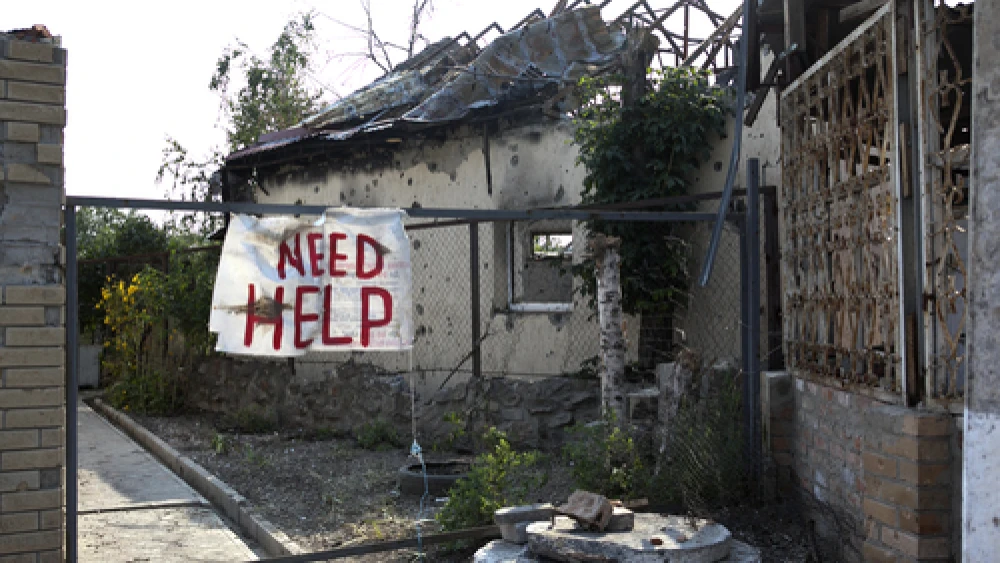
A plea for assistance in eastern Ukraine. Credit: JDC.

Fleeing economic hardship and ongoing war in their native country, some 400 new immigrants from Ukraine are scheduled to arrive in Israel on Wednesday and Thursday via two special flights coordinated by the International Fellowship of Christians and Jews.

This is part of an influx of more than 1,000 immigrants from eight countries who have emigrated to Israel this summer through the organization.

The latest immigrants succeed 740 others across 19 flights from eight countries who arrived with the Fellowship earlier this summer.

Since the 2013-2014 Maidan revolution and government crackdown, which brought violence to the streets of Kiev and was subsequently followed by a Russia-backed invasion of eastern Ukraine—heavy fighting was seen in Mariupol, Donetsk and Lugansk, the last two of which remain occupied by Russian separatists. Many Jews have been forced to leave their homes, while others have seen their homes, synagogues and communities damaged by shelling or lost people close to them.

As of 2014, at least 13,500 Jews have fled Ukraine.

Many who have remained include the elderly or those who still have jobs in the country, whose eastern front bore the brunt of the conflict.

The New York City Police Department told JNS that the suspect is being charged with “attempted murder as a hate crime, attempted murder, assault as a hate crime, two counts of assault and two counts of criminal possession of a weapon.”
The teacher alleged Portland Public Schools allowed Palestinian flags and anti-Israel displays while administrators told him that displaying “an Israeli flag or related symbols would be too disruptive.”
The Islamic Republic’s foreign minister threatened on Friday to kill a U.S. soldier for every Iranian killed in the war, as Trump speculated that regime leaders might “cry uncle” or “go into a cave and hide.”
Art historian Jacob Wisse told JNS that he is concerned “when museums, which I value for the rigor, depth and richness of their curatorial voice, fall back, lazily, on untruths.”
“Shame on Mamdani and those who continue to parade this dangerous rhetoric,” Daniel S. Mariaschin of B’nai B’rith International told JNS.
“Every community deserves a seat at the table when healthcare policy is being shaped,” Eveline Shekhman, CEO of the American Jewish Medical Association, told JNS.
