Newsletter
Newsletter Support JNS

German newspaper launches tool to search Nazi Party membership records

“This tool makes it easier to confront and understand family histories connected to the Nazi era,” Die Zeit stated in its introduction of the database.

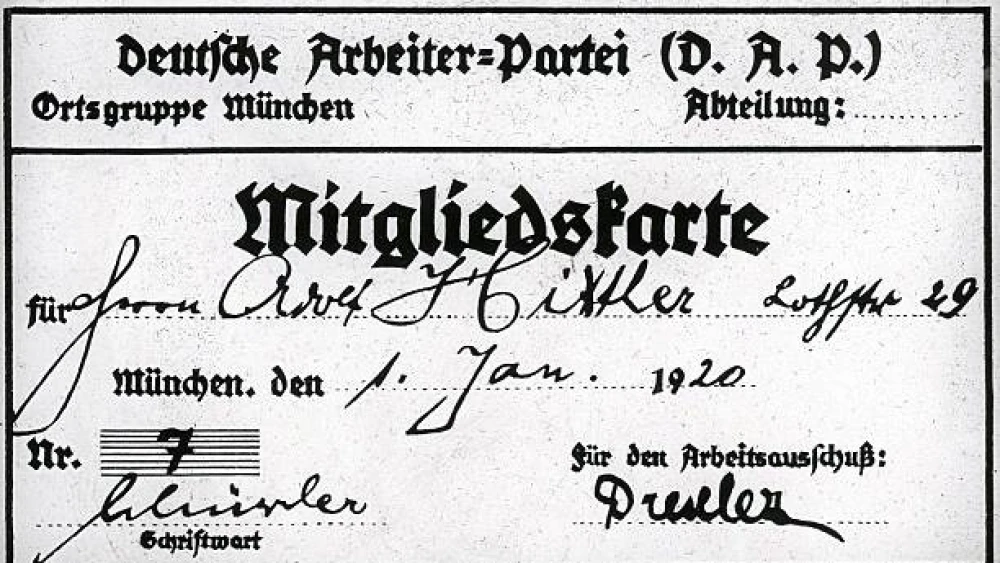
A forged copy of Adolf Hitler's membership card in the German Worker Party (DAP), which would later become the National Socialist German Workers' Party (NSDAP). Credit: Eloquence via Wikimedia Commons.
A forged copy of Adolf Hitler’s membership card in the German Worker Party (DAP), which would later become the National Socialist German Workers’ Party (NSDAP). Credit: Eloquence via Wikimedia Commons.

German newspaper Die Zeit has launched a searchable database that allows users to check whether relatives appear in Nazi Party membership records, drawing on millions of digitized index cards from the era.

“Were your father, grandmother or great-grandfather members of the Nazi Party?” the outlet asks in its introduction to the tool, noting that such searches previously required formal requests to Germany’s Federal Archives or use of microfilm collections held online by the U.S. National Archives.

Because finding individual names within the archives was difficult and rare, Die Zeit said it obtained, processed and statistically analyzed the complete Nazi Party membership card index, making it searchable by name and place of birth.

A copy of the pamphlet Who Was a Nazi? Facts about the Membership Procedure of the Nazi Party (1947) produced by the 7771 Document Center of the Office of Military Government United States. Credit: Brigade Piron via Wikimedia Commons.

The database contains about 8.2 million records, part of a broader set of Nazi-era membership files estimated at roughly 10.2 million entries from 1925 to 1945. The records are divided into two major collections: a central index and a regional index. Researchers note that the surviving material is incomplete because some files were destroyed near the end of World War II.

“Around 90% of former members can still be found,” the newspaper stated.

“No one was forced to join,” Die Zeit said, listing ideological beliefs, opportunities for career advancement and social pressure as common reasons individuals joined the Nazi Party. “Claims of accidental or unknown membership are not considered credible by historians.”

“This tool makes it easier to confront and understand family histories connected to the Nazi era,” the newspaper stated, acknowledging that “finding such information can be emotionally challenging.”

The move aims to boost long-haul capacity as other airlines scale back routes to and from Israel.
“School districts, like colleges and universities, must take prompt and effective action to address antisemitic harassment,” stated Harmeet Dhillon, assistant U.S. attorney general for civil rights.
Just one Democratic congressman voted against the measure to require U.S. forces to be withdrawn from the conflict with Iran.
The owners of La Chatelaine French Bakery & Bistro stated that they had relatives who suffered under Nazism, “will not host individuals who are at odds with our stance” against extremism.
Twenty honorees, including Julian Edelman, Omri Casspi and Bruce Pearl, will be inducted June 29 in Israel, highlighting global Jewish achievement across sports.
“In order to achieve peace between their countries, they will formally begin a 10-day ceasefire at 5 p.m. Eastern,” the president wrote on social media.