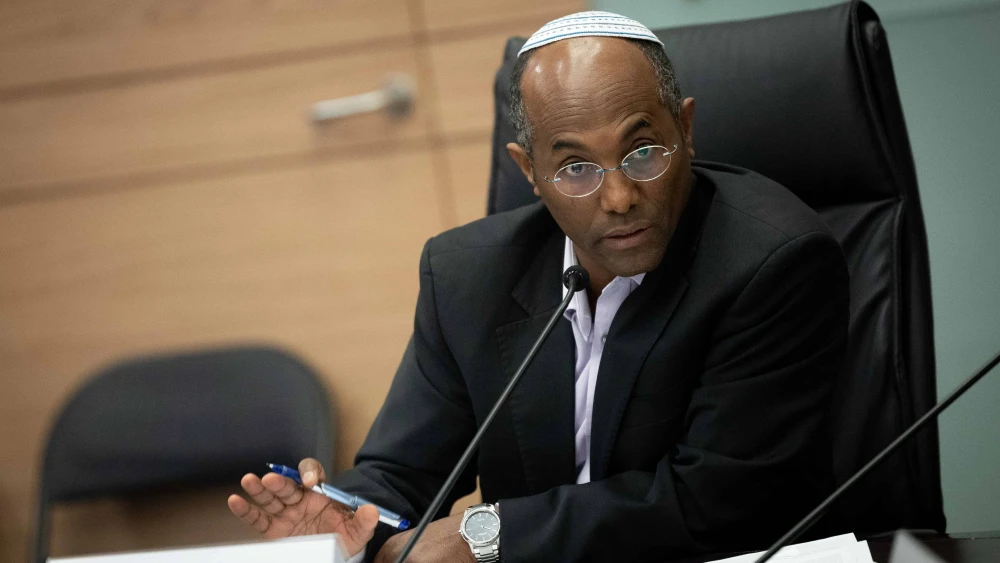
Pending legislation abolishing restrictions on Jews buying privately-owned land in Judea and Samaria would correct a historic injustice, Religious Zionism Party lawmaker Moshe Solomon told JNS Tuesday.
“The current situation is absurd,” said the member of Israeli Prime Benjamin Netanyahu’s governing coalition. “We have an entire region in the country where Arabs are allowed to purchase land and Jews are not,” he added.
“The goal of this law is to correct the situation,” explained Solomon, who sponsored the bill. The proposed legislation would allow Jews to purchase land in the area directly, without receiving rare approval from the Israeli Defense Ministry.
Israel has not annexed Judea and Samaria, instead setting up the Civil Administration in 1981 to replace the military government that ruled there since Jerusalem liberated the territory in the 1967 Six-Day War. The Israeli government body has maintained a combination of Ottoman, Jordanian and British Mandate laws in the region.
Up until now, only citizens of the Hashemite Kingdom of Jordan could purchase land in Judea and Samaria without going through the Defense Ministry. Jordan, which occupied Judea and Samaria between 1948 and 1967, applied to the region the “The law on renting and selling immovable property to foreigners,” which bans non-Jordanians from buying land in Judea and Samaria.
On Sunday, Israel’s Ministerial Committee for Legislation gave formal government backing to Solomon’s bill, which would legally establish that “every person will be allowed to acquire rights in real estate in the Judea and Samaria region, as in any other place.”
“While the Palestinian Arabs constantly accuse Israel of apartheid in territory under Israeli jurisdiction, Jordanian legislation that imposes anti-Jewish apartheid remains in force,” Knesset Land of Israel Caucus co-chairs Simcha Rothman (Religious Zionism), Yuli Edelstein (Likud) and Limor Son Har-Melech (Otzma Yehudit) stated on Sunday.
“The law we are proposing will bring an end to years of discrimination and will allow more and more Jews to purchase property and to build their homes in Judea and Samaria without the anachronistic constraints put in place by the illegal Arab occupation regime in an attempt to maintain the ethnic cleansing of Jews,” the statement added.
Solomon told JNS on Monday that Israeli Defense Minister Israel Katz should ensure that all Israeli laws are equally applied to Judea and Samaria.
“I am sure that the Trump administration and its various representatives in the country, who have publicly expressed support for the recognition of Israel’s right to all territories in its land, including Judea and Samaria and the Jordan Valley, will support this and subsequent laws,” he said.
On his first day in office, U.S. President Donald Trump revoked a host of what he called “harmful” executive orders and actions under former President Joe Biden, including Executive Order 14115 of Feb. 1, 2024, which sanctioned Jews living in Judea and Samaria accused of “undermining peace, security and stability in the West Bank.”
Mike Huckabee, who Trump has nominated as Washington’s next ambassador to Israel, has said that “of course” Israeli annexation of Judea and Samaria was a possibility during Trump’s second term.
The decision to extend Jerusalem’s sovereignty is one “for Israel to make,” Huckabee said, speaking to the Arutz 7 network on Nov. 15.