


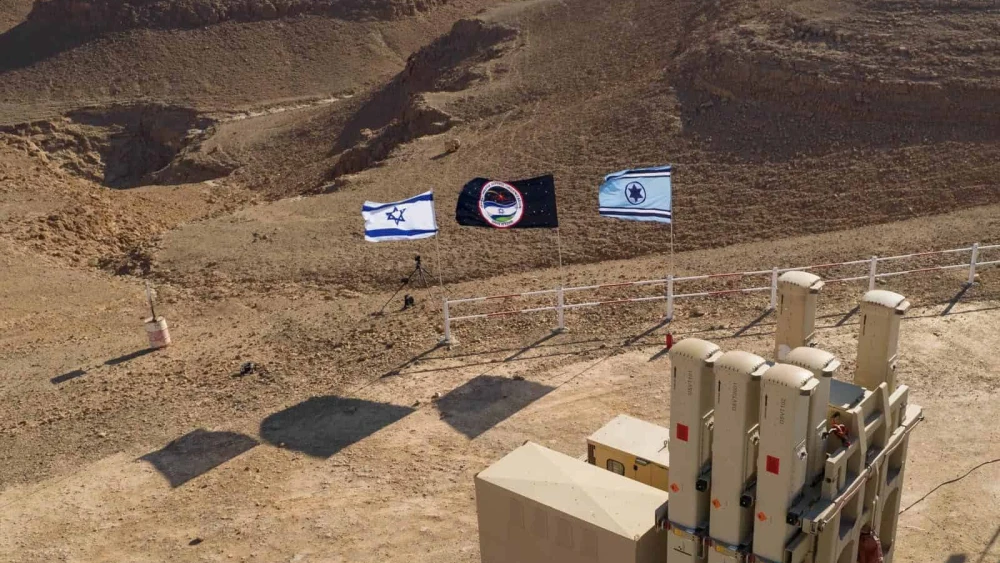
The Israeli Air Force recently completed a successful series of tests in an “important milestone” for the David’s Sling air defense system, the Israeli Defense Ministry and Israel Defense Forces announced on Sunday.
The system was tested against “advanced threats, which enhances its capabilities and significantly improves the defense layers of the State of Israel,” according to a joint statement.
“The system [was presented with] a number of challenging scenarios, which prove its capabilities during a conflict,” it added.
IAF chief Brig. Gen. Eyal Grinboim said in a statement that “the Israeli Air Force operates tirelessly day and night to fully unleash the potential of the system and optimize its performance in diverse and demanding scenarios.
“Through the testing of this model, we have successfully demonstrated our ability to carry out successful interceptions even in the most challenging scenarios. The combat soldiers have proven their outstanding operational capabilities yet again.”
David’s Sling made its operational debut during May’s five-day “Operation Shield and Arrow” against Palestinian Islamic Jihad terrorists in Gaza, shooting down its first rocket.
It supplements the missile defense provided by the Iron Dome, Arrow 2 and Arrow 3 systems
David’s Sling was developed by Haifa-based Rafael Advanced Defensive Systems and U.S. defense giant Raytheon Technologies.
It became operational in April 2017, and can intercept missiles fired by countries such as Iran and Syria, including “large-caliber rockets, short-range ballistic missiles and other developing threats,” the Israeli Air Force said.
Its projectiles, known as stunners, are two-stage missiles that use multiple sensors. They are launched in a near-vertical orientation from a stationary location. They have a range of 250 kilometers (155 miles).
The system’s interceptor missiles carry no warhead and are designed to strike targets directly, defeating them with kinetic force. Each firing unit can carry up to 12 missiles. In 2018, Israel fired interceptors from David’s Sling at ballistic missiles launched from Syria, but the intercepts were aborted after the IDF determined the rockets were not a threat.
In April, Finland became the first foreign purchaser of David’s Sling in a deal worth some $347 million, with further options worth $237 million, according to the Finnish Defense Ministry.
Israel began developing David’s Sling in 2006 and signed an agreement with the United States in 2008 to co-develop it. From 2006 to 2020, the United States contributed more than $2.4 billion in aid for its development.



