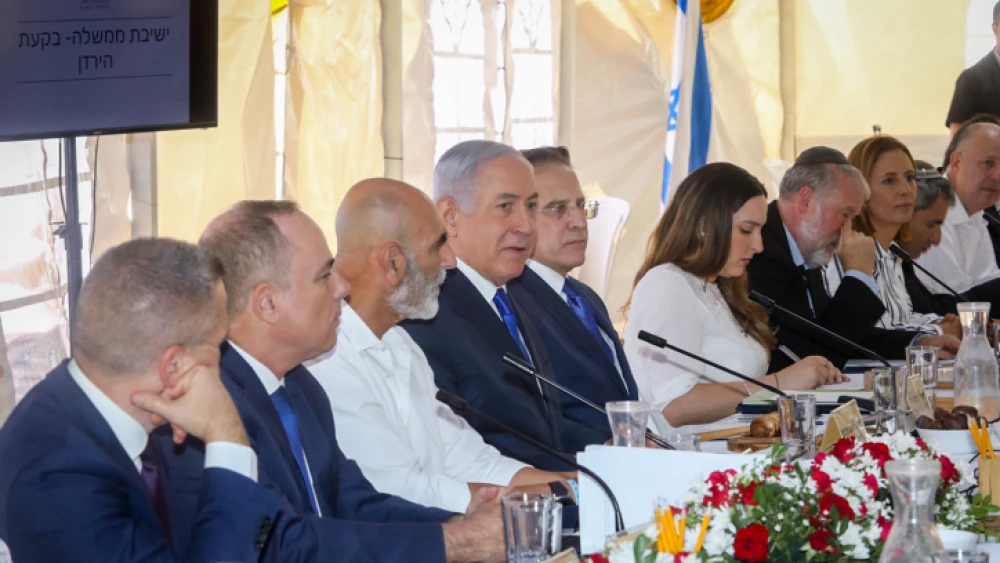
At its weekly meeting on Sunday, held in the Jordan Valley, the Cabinet approved Israeli Prime Minister Benjamin Netanyahu’s proposal to officially recognize the community of Mevo’ot Yericho. Netanyahu also reiterated his pledge to annex the Jordan Valley if reelected.
At the meeting, Netanyahu said it was clear that the U.S. peace plan was going to be released just days after Tuesday’s election, even before a new coalition is formed and a new government sworn in. The assessment of Israel’s Ambassador to the United States was the same, he said, and therefore it was imperative to green-light Mevo’ot Yericho immediately.
The meeting, along with the new pledges, came despite an international outcry over Netanyahu’s promise last week to annex the Jordan Valley if re-elected. Annexing the area, which is considered to be the heartland of any future Palestinian state, would all but extinguish any remaining Palestinian hopes for independence.
Netanyahu has staged a flurry of media appearances to beseech supporters to vote in large numbers to stave off the prospect of a left-wing government that he says will endanger the country’s security.
A centerpiece of his last-minute agenda has been the pledge to extend Israeli sovereignty over the Jordan Valley and to annex Jewish settlements, something he refrained from doing during his decade-plus in power.
Seated in a makeshift tent and flanked by his ministers against a backdrop of Israeli flags, Netanyahu said at the meeting that he was proud to establish what he expects to be the country’s future eastern border and officially incorporate its settlements into Israel.
The Jordan Valley is not only the “eastern gate” of Israel, said Netanyahu, “it is a defensive wall from the east because the Jordan Valley, together with the areas that control it, which will be part of the State of Israel, ensure that the IDF will be here forever. Instead of having a state that is only a few kilometers wide, this will be a state with strategic depth.”
His Likud Party is locked in a dead heat in the polls with the centrist Blue and White alliance, and re-election seems to be his best shot at avoiding having to face the pending corruption charges against him in a courtroom.
This article first appeared in Israel Hayom.