Three Israel Defense Forces soldiers were lightly wounded by a Hezbollah suicide drone in Southern Lebanon on Monday, the military confirmed to JNS.
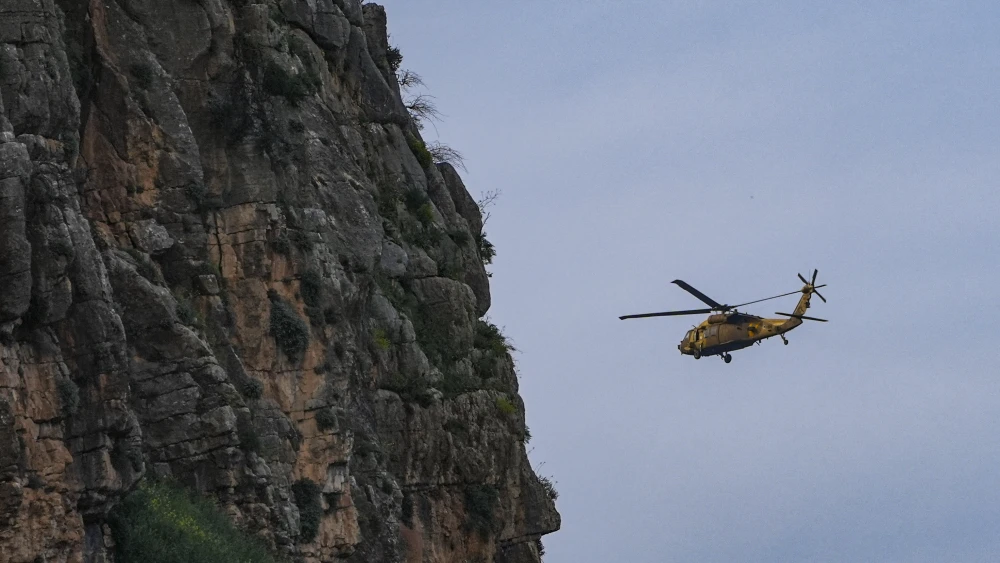
An Israeli Air Force helicopter that was sent to rescue the injured “landed in the extraction area with no ability to take off due to a technical error,” the IDF said in a separate statement.
A second IAF helicopter was dispatched and successfully evacuated the injured soldiers for treatment in Israel, according to the army.
IAF soldiers subsequently repaired the first helicopter and it safely departed, it said, adding that the chopper “was not damaged by Hezbollah’s fire.”
On Sunday, an Israeli soldier was mortally wounded in a Hezbollah drone attack near the northern border with Lebanon, the IDF confirmed earlier on Monday.
According to Israel’s Ynet news outlet, IDF Command Sgt.-Maj. (res.) Alexander Glovanyov, 47, from the central city of Petah Tikvah, was killed when an UAV launched by the Iranian-backed terrorist organization impacted inside Israeli territory.
Hezbollah began firing rockets and drones at Israel on March 2, following the targeted killing of Iranian Supreme Leader Ali Khamenei in the opening strikes of Israel’s “Operation Roaring Lion” on Feb. 28.
In response to the terrorist organization’s violation of the U.S.-brokered Nov. 27, 2024, truce agreement, Jerusalem launched an aerial campaign against Hezbollah and ordered the IDF to advance and take control of additional areas in Southern Lebanon to halt cross-border attacks.
Jerusalem and Beirut agreed on April 16 to a 10-day ceasefire following mediation by U.S. President Donald Trump. The two countries agreed on April 23 to extend the truce for three more weeks following direct talks in Washington, D.C.
However, Israeli Prime Minister Benjamin Netanyahu on April 26 accused Hezbollah of “essentially disintegrating” the temporary ceasefire through its ongoing attacks.
“Therefore, as far as we are concerned, what obligates us is the security of Israel, the security of our soldiers, and the security of our communities. We are acting vigorously according to the rules we agreed upon with the United States, and incidentally, with Lebanon as well,” the premier said.