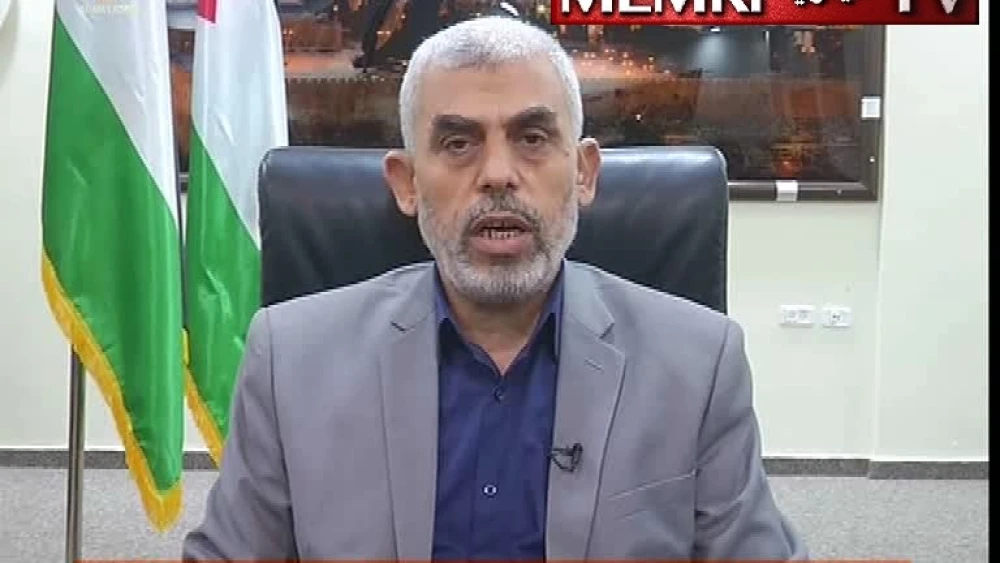
Hamas military leader Yahya Sinwar said on Wednesday that an opportunity to change the dire situation in the Gaza Strip can arise from recent tensions between the enclave’s rulers and Israel.
“A new war with Israel is in neither party’s interest. Certainly, not ours,” he said in an interview with Italian daily La Repubblica that was carried by Israeli daily Yediot Achronot. “Who would want to pit four slingshots against a nuclear power? War will achieve nothing.”
Sinwar, who served 22 years in Israeli prison for terrorism offenses and was released as part of the 2011 Schalit deal, stressed that the surprising statement “doesn’t mean I’ll never fight the occupation [Israel] again. What I’m saying is that I don’t want more wars. I want an end to the siege. My first interest is to work for my people. To protect them and protect their right to freedom and independence.”
Israel imposed a maritime blockade on the Gaza Strip after Hamas seized control of the coastal enclave in 2007 in a military coup. Israel maintains the measure is necessary to prevent Hamas, an Islamist terrorist group that calls for Israel’s destruction, from smuggling weapons and terrorists into Gaza.
The maritime blockage and strict limitations both Israel and Egypt have imposed on Palestinians’ movements between Gaza and their territories over security concerns have plunged Gaza into a dire economic crisis. Unemployment is at 50 percent, and 80 percent of Gazans receive humanitarian aid.
Sinwar, for his part, does not believe that Hamas is responsible for this situation.
“The responsibility lies with those who closed the borders—not those who try to open them. My responsibility is to cooperate with anyone who can help us end the siege. As things stand, [security] escalation is inevitable,” he said.
Over the past few weeks, Egypt has been trying to broker a long-term ceasefire between Israel and Hamas in an effort to prevent recent tensions, fueled by border riots and a Palestinian arson terrorism campaign, from escalating into war.
Israel and Hamas fought three wars over the past decade, in 2008, 2012 and 2014.
Asked what Hamas means when talking about a truce with Israel, Sinwar replied: “Total calm—and an end to the siege.”
Israel has long maintained that when it comes to its counter-terrorism operations in Gaza, “calm will be met with calm,” but Sinwar clarified that he means “calm in exchange for calm and an end to the siege. The siege is not calm.”
Before the Egyptian-led talks stalled, much was reported in Israeli media about the possibility of an Israel-Hamas agreement including a prisoner-exchange deal.
Gaza’s rulers are holding the remains of Staff Sgt. Oron Shaul and Lt. Hadar Goldin, killed in the 2014 Gaza conflict, as well as two living Israeli citizens, Ethiopian Israeli Avera Mengistu and Bedouin Israeli Hisham al-Sayed, both suffering from mental health issues, who crossed into Gaza willingly in 2014 and 2015, and were captured by Hamas.
Contradicting a previous statement, Sinwar said a prisoner exchange deal is “vital” to any agreement reached between Israel and Hamas.
“It’s imperative. This isn’t a political question, it’s a moral question. I see this as our duty to have every Palestinian prisoner released.”
As for the chances of a cease-fire failing, Sinwar noted that “there’s no agreement yet. Hamas and the other Palestinian organizations are ready to sign a deal and respect it, so it’s up to the occupation.
“It’s important that we make one thing clear,” he stressed. “If we are attacked we will defend ourselves, as we always do. This will mean another war, but until that happens, all I can do is reiterate that war will achieve nothing.”
Also on Wednesday, The Telegraph quoted Sinwar as telling senior Hamas officials that he believes indirect negotiations with Israel could achieve a cease-fire deal as early as in the next few weeks, providing Israel lifts the Gaza blockade.
A Palestinian official who attended the meeting told the British daily that Sinwar pledged that “unless this deal happens, everyone—the Israelis, the Palestinian Authority, the Egyptians—will suffer.”
Palestinian Authority leader Mahmoud Abbas has recently admitted that Ramallah was actively trying to torpedo Egypt’s efforts to broker a truce between Israel and Hamas, saying that the latter lacks the authority to hold any type of negotiations with Israel.