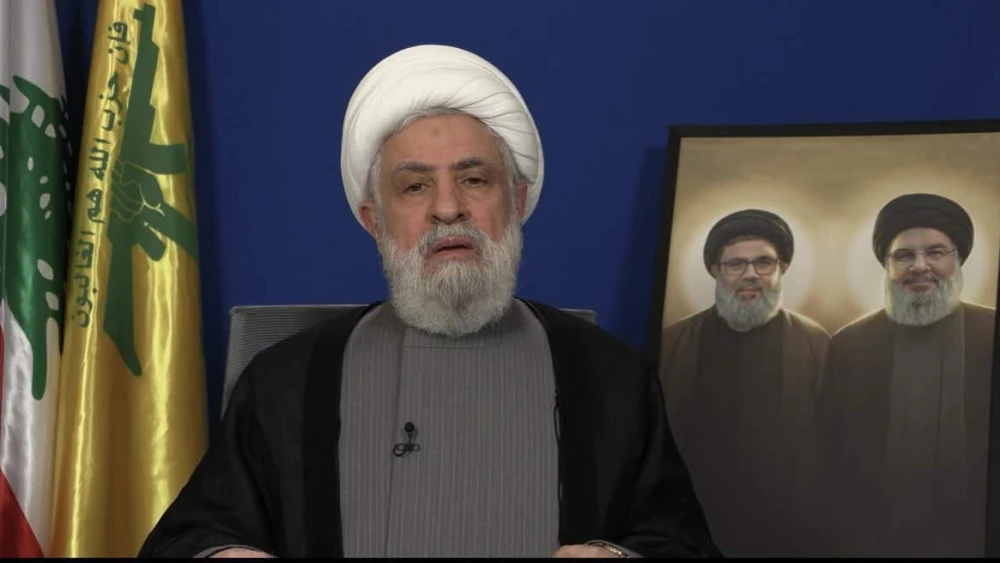
Hezbollah leader Naim Qassem said on Saturday that the Iranian-backed terrorist group will not disarm, that “the aggression against Lebanon cannot continue” and “we have the right to defend ourselves.”
His comments, made during a televised address broadcast on Iranian media, come against the backdrop of continued Israeli strikes on Hezbollah targets in Southern Lebanon nearly 14 months after a U.S.-brokered ceasefire between Israel and Lebanon ended more than a year of cross-border fighting.
Israeli troops from the Israel Defense Forces’ Multi-Dimensional Unit have wrapped up a two-month mission in Southern Lebanon aimed at preventing Hezbollah from entrenching along the border. Operating under the 91st Division, the unit gathered intelligence, located enemy infrastructure and directed fire, helping ground and air forces dismantle Hezbollah positions and kill or capture operatives, the military said on Sunday.
The terror leader claimed that Hezbollah’s weapons are intended to defend the Lebanese people.
“We will not surrender; we will not accept the continuation of attacks in the country without doing anything—there must be a limit to everything,” said Qassem.
The remarks followed statements by Lebanese Foreign Minister Youssef Rajji, who said in a recent interview with Sky News Arabia that Israel retains the right to strike Lebanon until Hezbollah fully disarms.
Rajji was quoted as saying that “as long as weapons are not permanently restricted,” Israel “unfortunately has the right to continue its attacks according to the agreement.”
Qassem criticized Rajji for inciting division among Lebanese citizens and acting contrary to his official duties.
“He is inciting hatred against some of the Lebanese. He is a foreign minister acting contrary to the directives he is supposed to fulfill,” said Qassem.
Qassem also echoed recent accusations by Iranian Supreme Leader Ali Khamenei that the United States and Israel orchestrated deadly protests in Iran, arguing that President Donald Trump seeks to undermine the Islamic Republic and control regional resources.
“They are trying to punish the Islamic Republic and weaken it—all to achieve the goal that Trump and Netanyahu set for themselves: to destroy the Islamic Republic from within,” said Qassem.