


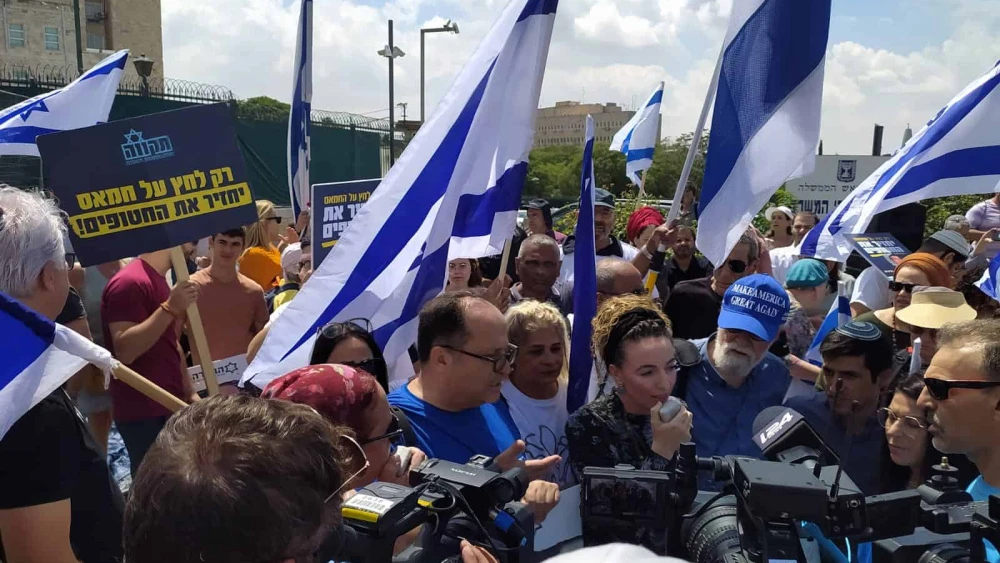
Hundreds of protesters gathered in front of the Prime Minister’s Office in Jerusalem on Sunday morning to demand that the government keep up the military pressure on Hamas. The protest comes a day after Israel carried out a strike in southern Gaza targeting Hamas terror mastermind Mohammed Deif.
“Deif is responsible for the murder of dozens of Israelis. We are showing Hamas that we are still fighting and we will continue to fight until they surrender,” Tzvika Mor, co-founder of the Tikva Forum for Families of Hostages, the organizer of Sunday’s demonstration, told JNS.
The group, an alternative to the larger Hostages and Missing Families Forum, is opposed to the idea of a ceasefire deal at any cost, and believes that only military pressure will lead to their loved ones’ release.
Deif, the commander of Hamas’s military wing, was targeted together with Rafa’a Salama, the commander of Hamas’s Khan Younis Brigade, near Gaza’s Al-Mawasi humanitarian zone. Both were responsible for planning and carrying out Hamas’s Oct. 7 massacre, according to Israeli officials.
“I think that it’s good for the negotiations. They [Hamas] kidnapped our loved ones seeking the release of their terrorists from Israeli prison,” added Mor, whose son Eitan was kidnapped from the Supernova music festival near Kibbutz Re’im on Oct. 7.
In November, one of the hostages released as part of a ceasefire agreement that month revealed that they had been held with Eitan for a couple of days, and said that he had been in relatively good condition at that time. In March, Israeli intelligence confirmed that Eitan was still alive.
In April, Mor called on the Israeli government to launch a military operation in Rafah to destroy Hamas and bring about the release of the remaining hostages.
“Hamas wants us to pay the highest price for our loved ones. If we continue the war, we will pay a lower price,” he said.
Israeli Prime Minister Benjamin Netanyahu reiterated at a press briefing on Saturday four red lines for a new ceasefire and hostage deal.
“First, I insist on our right to continue the war until all of our objectives have been achieved,” he said.
“Second, I insist on preventing the smuggling of weapons to Hamas via Egypt. This requires our continued control of the Philadelphi Corridor and the Rafah Crossing,” he added. The Philadelphi Corridor is a narrow strip of land running along the Gaza side of the Egypt-Gaza border.
“Third, I insist on preventing the return of armed terrorists and war materiel to the northern Gaza Strip,” said Netanyahu.
“Fourth, I insist that we return as many living hostages as possible in the first stage of the outline,” he continued.
The outline he referred to was presented by U.S. President Joe Biden in May, and comprises three stages.
Netanyahu said that he would not allow Hamas to deviate from the terms of the outline Israel has accepted.
“Hamas has sought to add 29 changes to the outline. I told both the negotiating team and the Americans: Not even one change,” he said.
A JNS/Direct Polls survey of public opinion carried out on July 9 revealed that a total of 57% of Israelis oppose the U.S.-mediated deal being negotiated with Hamas, while 33% support the prospective agreement.


