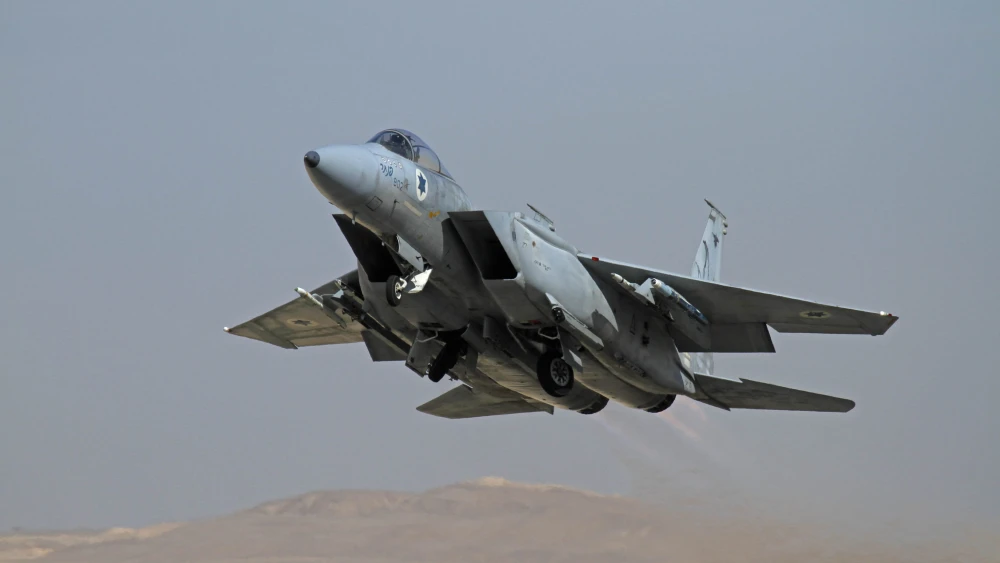
The Israeli military conducted strikes throughout Southern Lebanon on Sunday night in response to Iranian-backed Hezbollah’s “continuous violations” of the ceasefire, killing terrorists and destroying “military” sites.
“Following the strikes conducted earlier today, in which shafts used for weapons storage in Southern Lebanon were struck, the IDF completed an additional strike,” the Israel Defense Forces said.
“As part of the strike, an underground site used for arms storage belonging to Hezbollah in Lebanon was struck,” the statement continued.
According to the military, it notified the Lebanese Armed Forces of the existence of the site last week, but the LAF failed to dismantle it in accordance with the U.S.-brokered truce between Jerusalem and Beirut.
The IDF subsequently hit the Hezbollah site around a week ago, and again on Sunday night, the statement said, adding that the terrorist organization’s activity constituted “a violation of the understandings between Israel and Lebanon and poses a threat to the State of Israel.
Before both strikes, “steps were taken to mitigate harm to civilians.”
In a separate statement on Sunday evening, the military confirmed it eliminated a Hezbollah operative tasked with rebuilding the terrorist group’s infrastructure in the Bint Jbeil area of southeastern Lebanon.
The targeted terrorist “was engaged in attempts to rehabilitate military infrastructure of the Hezbollah terror group,” in breach of the ceasefire terms, the IDF statement stressed.
On Sunday afternoon, the army had already struck “shafts used to store weapons at several military sites” where activity by the Iranian proxy army was detected in recent months, according to an earlier IDF statement.
Hezbollah started attacking the Jewish state’s north on Oct. 8, 2023, one day after the Hamas-led terrorist massacre in the south, opening a second front on the country’s borders that lasted until a U.S.-brokered ceasefire agreement between Beirut and Jerusalem entered into effect on Nov. 27, 2024.
The truce deal requires Hezbollah to be disarmed, starting in the area adjacent to the border, with the Lebanese Armed Forces mandated to establish a monopoly over arms in the country under the terms of the ceasefire and a subsequent Lebanese Cabinet decision.
The Lebanese Armed Forces said on Thursday that it had completed the first phase of its national disarmament plan, expanding its control in the south as part of efforts to “extend the state’s authority exclusively through its own forces over the entirety of Lebanese territory.”
Israel’s Prime Minister’s Office, in a statement the same day, said that while Lebanese efforts were “an encouraging beginning,” they were “far from sufficient” due to Hezbollah’s Iranian-aided rearmament efforts.
“The ceasefire agreement brokered by the United States between Israel and Lebanon states clearly, Hezbollah must be fully disarmed. This is imperative for Israel’s security and Lebanon’s future,” Jerusalem said.
Prime Minister Benjamin Netanyahu received a green light from President Donald Trump at Mar-a-Lago in Palm Beach, Fla. on Dec. 29 to restart the Israel Defense Forces’ campaign against Hezbollah, Israel Hayom reported last week.
The IDF has already put together operational plans, including different levels of intensity and clearly defined targets within the terrorist organization’s power bases, according to last week’s report.