Newsletter
Newsletter Support JNS

Israeli study finds math in ancient Mesopotamian flower art

Hebrew University researchers uncovered 8,000-year-old pottery showing floral patterns built on precise geometric progressions.

Pottery, Archeology
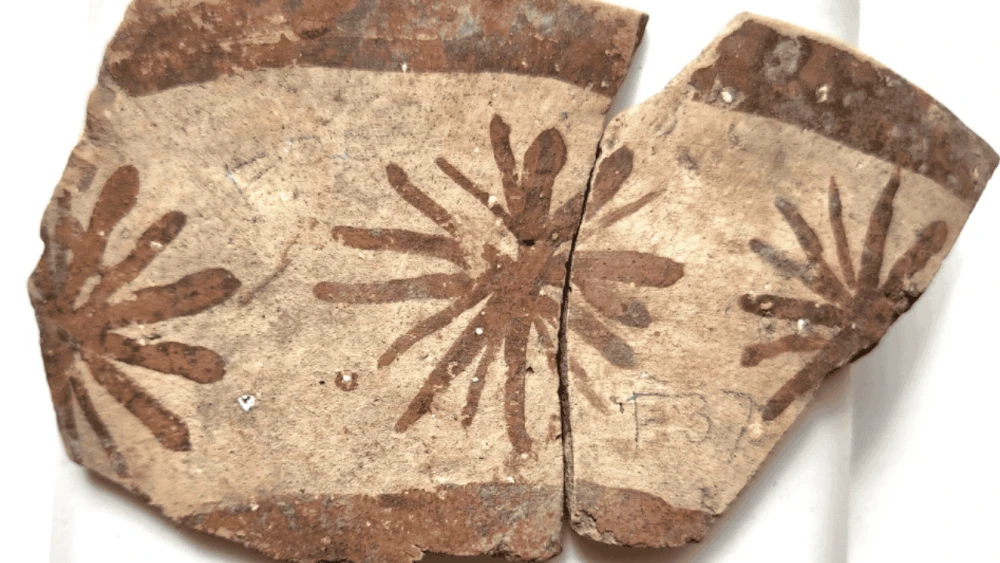
Pottery from the Max Mallowan excavation at Arpachiyah, Iraq, now held in the collections of the British Museum and University College London. Photo courtesy of Yosef Garfinkel.

Researchers at Israel’s Hebrew University have identified the world’s earliest systematic botanical art, dating back more than 8,000 years, that demonstrates sophisticated mathematical reasoning.

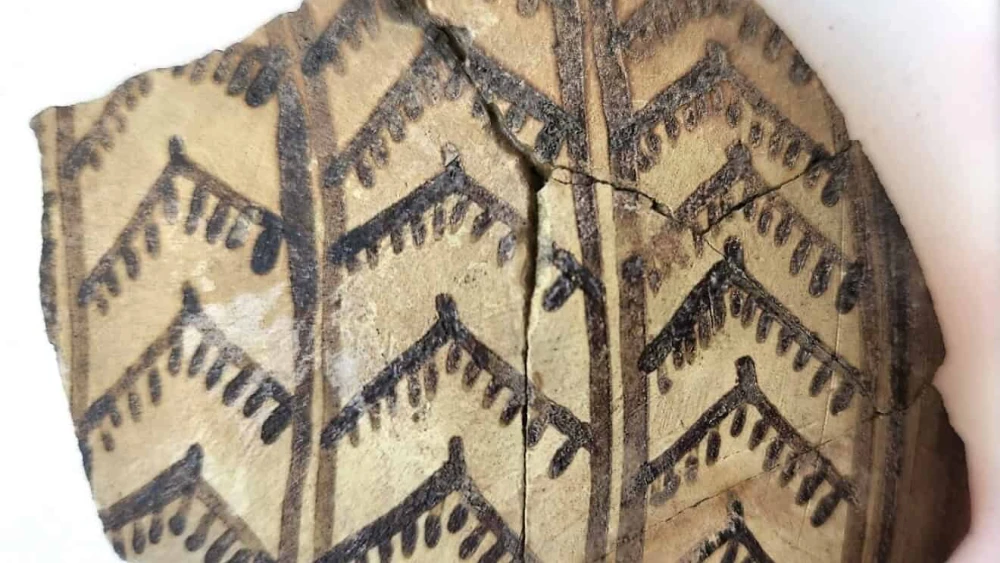
Professor Yosef Garfinkel and Sarah Krulwich analyzed pottery from the Halafian culture of northern Mesopotamia (circa 6200-5500 BCE) across 29 archaeological sites. Their study, published in the Journal of World Prehistory, found that flowers, shrubs and trees painted on vessels displayed precise numerical patterns—particularly petal counts following geometric progressions of 4, 8, 16, 32 and 64.
Pottery, Archeology
Pottery from the Max Mallowan excavation at Arpachiyah, Iraq, now held in the collections of the British Museum and University College London. Photo courtesy of Yosef Garfinkel.

The researchers argue these sequences weren’t decorative accidents but reflected intentional mathematical thinking about dividing space and quantities, likely tied to practical needs such as sharing harvests from communal fields.

“These patterns show that mathematical thinking began long before writing,” said Krulwich. “People visualized divisions, sequences and balance through their art.”

The discovery challenges previous assumptions about when mathematical reasoning emerged, providing evidence that it predated written number systems by millennia. The pottery marks the first time in human history that the plant world became a systematic subject of artistic expression.

None of the images depict edible crops, suggesting the purpose was aesthetic rather than agricultural or ritualistic, according to the researchers.

Jewish News Syndicate (JNS) is the fastest-growing news agency covering Israel and the Jewish world. We provide news briefs features opinions and analysis to 100 print newspapers and digital publications on a daily basis.
“Opining on world affairs is not the job of a teachers’ union,” said Mika Hackner, director of research at the North American Values Institute.

“We’re launching a campaign to show the difference in the attitude towards Israel and towards Iran,” Daniel Meron, the Israeli ambassador to the United Nations in Geneva, told JNS.
Sara Brown, of the AJC, told JNS that “today we saw the very best of the democratic process.”
“Campaigns defined largely by opposition to AIPAC, our members and the values we represent continue to fall short on election night,” the pro-Israel group said.
Jewish organizations are urging Toronto police to lay hate charges after antisemitic caricatures of Jews were displayed at a Bathurst and Sheppard protest.
“It’s just absolutely critical that we get more funding appropriated, and at the same time, we also need to make sure that we break the log jam,” the Florida legislator said.