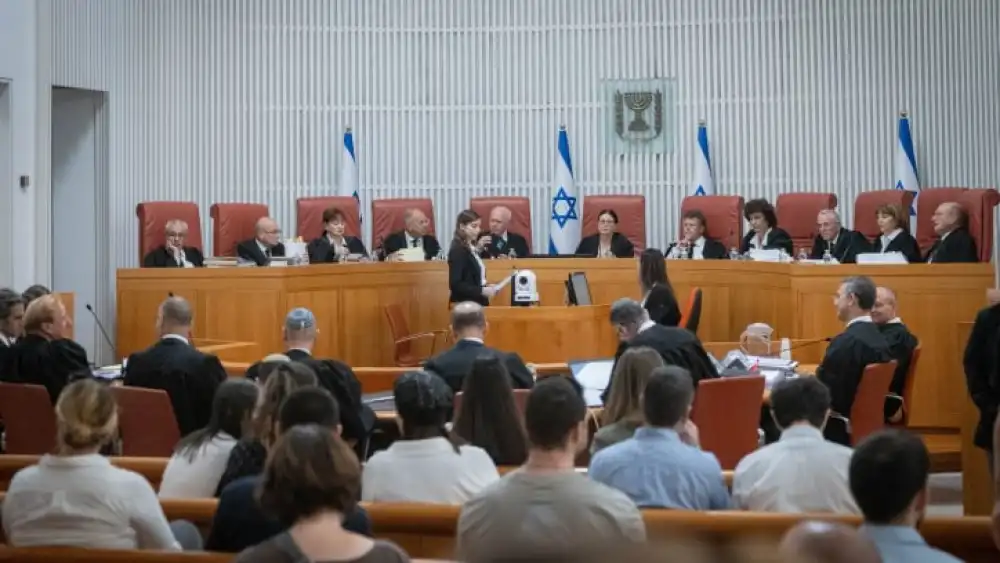
Israel’s High Court of Justice on Monday issued an injunction ordering the Netanyahu government and Israeli Defense Minister Israel Katz to justify their decision to close Israel’s Army Radio (“Galei Tzahal”).
The court gave the government until March 15 to submit an affidavit explaining “why the government’s decision regarding the closure of the Army Radio broadcasting station should not be canceled.”
Katz announced his intention to close the station on Nov. 12, 2025, with the station’s final broadcast date being set for March 1, 2026. He made the decision based on the final report of a committee convened to study the matter.
Katz accused the Israel Defense Forces-run station of having become politicized, veering from its original purpose of serving as a voice for IDF soldiers and their families, and instead becoming “a platform for expressing opinions, many of which attack the IDF and the IDF soldiers themselves.”
However, High Court Justices Daphne Barak-Erez, Alex Stein and Yechiel Kasher suggested that the process leading to the government’s decision to close the station was flawed.
First, they implied that the decision of the advisory committee was predetermined. “The impression is that the committee received a clear message about where it needs to go,” Barak-Erez said at Monday’s hearing.
The justices also questioned the makeup of the committee, noting its first chairman resigned over a conflict of interest.
Maj. Gen. (res.) Yiftah Ron-Tal, who served as committee chairman, resigned after he learned that Israeli television’s Channel 14, where he works as a commentator, also owned Radio Kol Chai.
“If I had known this in advance, I would have refrained from taking on the task because of the possibility of a conflict of interest,” he said in his resignation letter.
Two other members of the committee had close ties to the Likud Party, the court noted.
Government members reacted forcefully to the court’s order. Israeli Communications Minister Shlomo Karhi tweeted that the government’s decision to close Army Radio was well within the law, and that there was no legal obligation to establish an advisory committee, which had been formed “out of an excess of caution.”
“The timetable set by the High Court does not override the law and the government’s authority to govern,” said Karhi, noting that the March 1 closure precedes the court’s demand for a March 15 affidavit. He said the Court’s “unlawful order” should be met with a “shoulder shrug.”
If the law is not implemented, Karhi said, government members should refuse interviews on Army Radio starting on March 1.
Israeli National Security Minister Itamar Ben-Gvir of the Otzma Yehudit Party said the Supreme Court was once more intervening in decisions of an elected government, acting as a “political body instead of as a judicial authority.”
He called the decision “another step” toward “trampling” the rights of the voters. “Government policy is determined at the ballot box, not in the halls of the Supreme Court.”
Makor Rishon columnist Shlomo Piotrkowski, in an analysis of the hearings, which took place last week, said that even though the justices sided with the petitioners against the government’s decision, the peculiar arguments made by lawyers representing those petitioners amazed even the activist judges.
Yael Grossman, representing a petition brought by the Israeli Public Council for Press and Ethics, argued that the government isn’t authorized to close a military unit, compelling Justice Barak-Erez to remind Grossman that Israel’s Basic Law: the Army explicitly states that the IDF is subordinate to the government, said Piotrkowski.
Attorney Boaz Ben-Zur, representing the Army Radio Workers’ Committee, said the government’s decision violates the limitation clause of the Basic Law: Human Dignity and Liberty, which restricts the Knesset from violating protected rights unless the law meets specific criteria, including that it aligns with Israel’s values and serves a legitimate purpose.
Justice Stein replied with a smile, “What the gentlemen is saying is that it is not possible to shut down Army Radio in any way.”
Attorney General’s representative Aner Helman argued that closing Army Radio violated not only the right to freedom of expression “but also the constitutional rights to vote and to be elected to the Knesset.”
Helman made this claim based on the expectation that elections will be held in late October. “The public listens to current affairs programs and thus formulates its position before the elections on the question of who will lead us in the next four years. It’s a basic thing. Did the government, when it decided to close Army Radio, take into account the public’s listening habits?” said Helman.
Despite the “outlandish” arguments of the government’s opponents, Piotrkowski wrote that by the time the turn came for the government’s representative, Attorney David Peter, to speak, “everyone listening to the hearing quickly understood that this time, too, the [government] decision would be disqualified.”