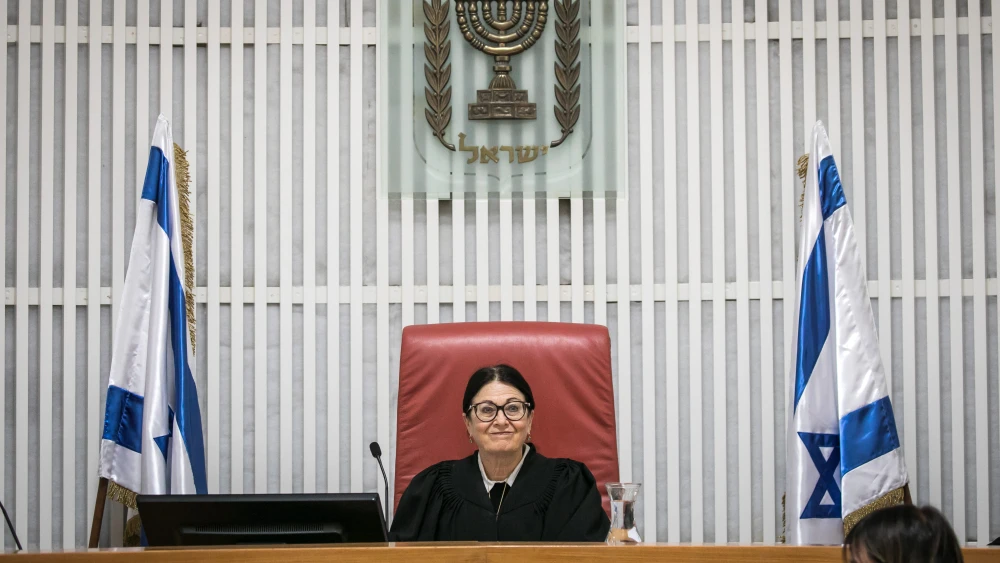
In an unprecedented move, Israel’s Supreme Court ordered Knesset Speaker Yuli Edelstein to hold a vote for a Knesset speaker on Wednesday, just an hour after the speaker ignored a non-binding call by the court to hold the vote.
“The continued refusal to allow the Knesset to vote on the election of a permanent speaker is undermining the foundations of the democratic process,” Supreme Court president Justice Esther Hayut said in a ruling.
“It clearly harms the status of the Knesset as an independent authority [while also harming] the process of government transition, the more so as the days pass since the inauguration of the 23rd Knesset,” she wrote. “There is no escaping the conclusion that in the circumstances created, this is one of those exceptional cases where this court is required to intervene to prevent a violation of our parliamentary system.”
The order by Israel’s top court comes amid a bitter political impasse following the March 2 national. While Blue and White Party leader Benny Gantz was tasked by Israeli President Reuven Rivlin to form a government after being endorsed by 61 MKs, he would likely only be able to form a minority government backed by the Joint Arab List.
Meanwhile, Israeli Prime Minister Benjamin Netanyahu, who is guiding Israel through the coronavirus pandemic, only secured 58 seats with his right-wing bloc.
If a vote for the Knesset speaker is held on Wednesday, Edelstein, who belongs to Netanyahu’s Likud Party, would likely lose the speakership to Blue and White’s Meir Cohen.
Earlier, Edelstein explained his reasoning for pushing off the vote, saying “I decided to hold off on the vote for a new speaker because I know that having that vote now means we won’t have a unity government.”
Prior to the court’s ruling, the Likud Party threatened that “if Blue and White ousts the Knesset speaker, then the unity negotiations will cease immediately. Blue and White will be responsible for the outcome.”
Edelstein shuttered the Knesset temporarily on March 18 when it was clear that Blue and White was trying to wrestle control of key committees and advance a vote on a new speaker prior to the formation of a majority coalition. He explained that he paused the committee votes for a few days in order to give the parties time to negotiate.