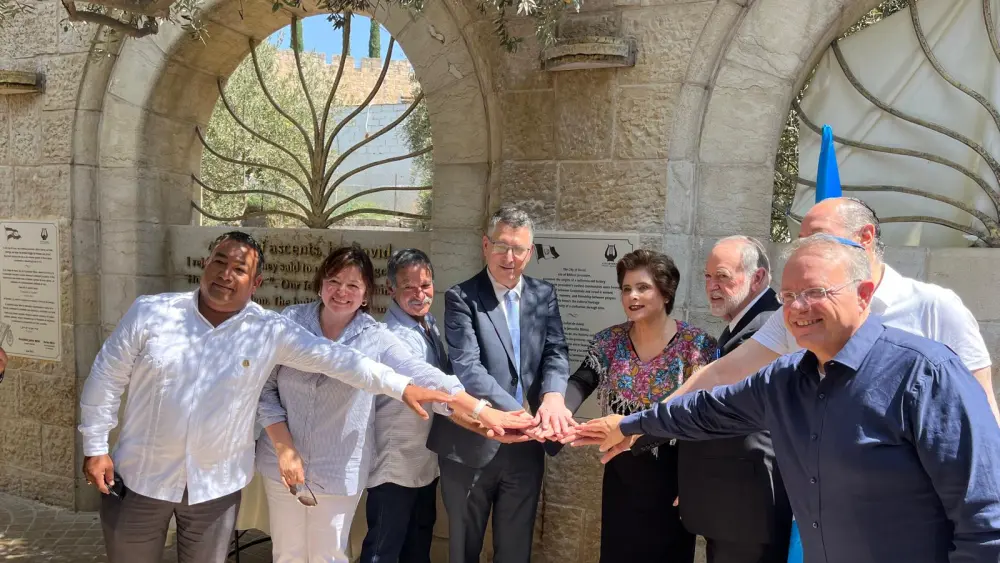
In a ceremony at Jerusalem’s City of David National Park on Friday, Guatemala dedicated a commemorative plaque recognizing the City of David—the site of biblical Jerusalem—and the millennia of history uncovered there as part of the cultural heritage of the Guatemalan people.
The plaque, dedicated by Guatemalan President César Bernardo Arévalo de León, bears his name alongside that of Guatemala’s ambassador to Israel, Ava Atzum Arévalo de Moscoso, who unveiled it on the president’s behalf.
Guatemala is the third country to recognize the City of David archaeological site as part of its national heritage, following similar declarations by the United States in 2021 and Argentina in 2025. Both countries also dedicated commemorative plaques at the site highlighting their historical and cultural ties to Jerusalem.
Speaking to JNS, Arévalo de Moscoso said she was honored to dedicate the plaque, describing the City of David as a symbol of the deep historical and cultural connection between Guatemala and Israel.

During the ceremony, she said the plaque represented far more than a ceremonial gesture, calling it a reaffirmation of the enduring friendship between the two countries.
Calling it “a great honor” to represent Guatemala at the unveiling, she said Jerusalem has always held “profound historical and spiritual significance” for the Guatemalan people.
“From this day forward, Guatemala becomes part of this remarkable place,” she said, adding that the plaque permanently links her country to the City of David and reaffirms “a friendship that has endured through time and will continue to grow stronger for generations to come.”
Arévalo de Moscoso also praised the City of David Foundation for preserving “one of Jerusalem’s most remarkable historical treasures.”
Marking 78 years of diplomatic relations, she noted that Guatemala was the second country to recognize the State of Israel in 1948, describing the relationship as one built on “mutual respect, cooperation and a sincere friendship that has endured for nearly eight decades.”
She concluded by recalling Guatemala’s support for Jerusalem at the United Nations in 1947.
“Today, standing on its oldest ground, we reaffirm the enduring friendship between Guatemala and Israel and our profound respect for Jerusalem’s history, heritage and significance to humanity,” she said.
Guatemala further underscored its ties to Jerusalem by becoming the second country, after the United States, to relocate its embassy there in May 2018.
President Arévalo also has personal ties to Jerusalem. He studied sociology at the Hebrew University of Jerusalem, where he learned Hebrew. His father, former Guatemalan President Juan José Arévalo, served as Guatemala’s ambassador to Israel after the country recognized the Jewish state in 1948.

Israeli Foreign Minister Gideon Sa’ar said the dedication reaffirmed that the Jewish people’s history, heritage and connection to the Land of Israel “can never be taken away.”
He accused the Palestinian Authority and its supporters in international institutions of attempting to rewrite history.
“They are trying to fabricate an entirely false narrative, erasing and denying the Jewish connection to this land,” he said.
Sa’ar pointed to the Palestinian Authority’s campaign at UNESCO’s World Heritage Committee meeting in Busan, South Korea, seeking recognition of ancient Sebastia in Samaria—identified in the Bible as the capital of the Kingdom of Israel—as a Palestinian heritage site.
“Like the City of David, it bears witness to the kings of Israel. It holds the evidence of our people’s deep historical roots in this land,” he said.
Thanking Guatemala for standing against what he called campaigns of distortion, Sa’ar added: “You are affirming that facts still matter. Our history remains written not only in our books and in our prayers, but in the stones beneath our feet.”

U.S. Ambassador to Israel Mike Huckabee said Guatemala’s decision to “put its own flag at the City of David” reflected not only a historical connection but a spiritual one.
“Just as the U.S. has discovered that we have roots here, so Guatemala has discovered and now is unafraid and unashamed to say to the world, Guatemala has roots here as well,” he said.
Huckabee added that Jerusalem—using the Hebrew name, Yerushalayim—is the Jewish state’s only capital, calling it “the united, indigenous, forever indivisible city” of the Jewish people.
He said Guatemala had joined the 10 countries that now recognize Jerusalem as Israel’s capital.

David Be’eri, chairman of the Ir David (City of David) Foundation and an Israel Prize laureate, welcomed guests from atop what he identified as King David’s palace, joking that his nearby home was “only 2,800 years old.”
He said excavations beneath his home have uncovered what he believes was King David’s sanctuary, where, according to the Bible, the Ark of the Covenant rested before Solomon built the First Temple on Mount Moriah.
Be’eri said excavations are continuing in search of inscriptions and other archaeological evidence that he believes further demonstrate the Jewish people’s ancient connection to Jerusalem.
Like Sa’ar, he criticized UNESCO for what he described as efforts to deny the Jewish connection to Jerusalem, arguing that archaeology provides tangible evidence to the contrary. He noted that about 10,000 schoolchildren participate in excavations at the City of David each year and predicted that millions more visitors would eventually come to see what he described as archaeological proof of biblical Jerusalem.
Ze’ev Orenstein, director of international affairs at the City of David Foundation, told JNS it was remarkable that, within a few years, the United States, Argentina and now Guatemala had all recognized the City of David’s significance to their own heritage and national identities.
“This recognition is not about honoring Israel and the Jewish people specifically, but about connecting themselves and their nations to Jerusalem and her story,” Orenstein said. “The heritage we are uncovering every day here in the City of David carries enduring relevance to billions of people around the world, just as it has for 3,000 years—and will continue to do so for generations to come.”