


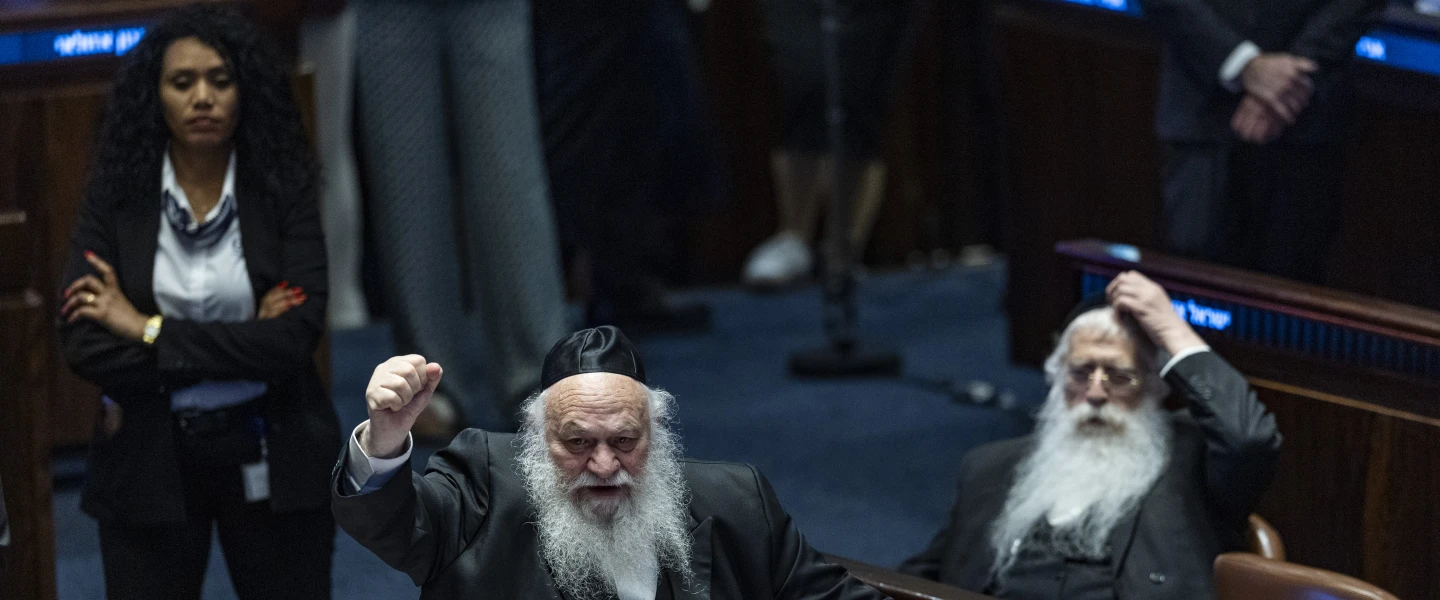
The 25th Knesset dissolved on July 17, and while polls differ sharply over the balance between Israeli Prime Minister Benjamin Netanyahu’s bloc and its opponents, most surveys leave neither side with much room to spare. That once again places Israel’s smaller parties—particularly the Haredi parties—at the center of the coalition arithmetic that will determine who governs after the election set for Oct. 27.
Therein lies one of the enduring paradoxes of Israeli politics. Shas and United Torah Judaism (UTJ) hold only about 15% of the Knesset’s 120 seats. They do not compete for the premiership, have never sought to become Israel’s largest party and campaign primarily around the interests of the communities they represent. Yet their pivotal position in coalition negotiations gives them influence far beyond their electoral strength.
Their influence extends well beyond determining who becomes prime minister. Participation in successive governments has given the Haredi parties leverage over education funding, yeshivah budgets, welfare policy, national-religious institutions and the broader relationship between their communities and the state.
That observation raises the central question behind the Haredi parties’ political success: How did movements representing a minority population, intent on remaining outside Israel’s broader political struggle, find themselves at the center of coalition politics? The answer lies not in electoral strength alone, but in the combination of highly organized constituencies, concentrated political priorities, Israel’s fragmented parliamentary system, effective coalition bargaining and, over time, an increasingly durable alliance with the Israeli right.
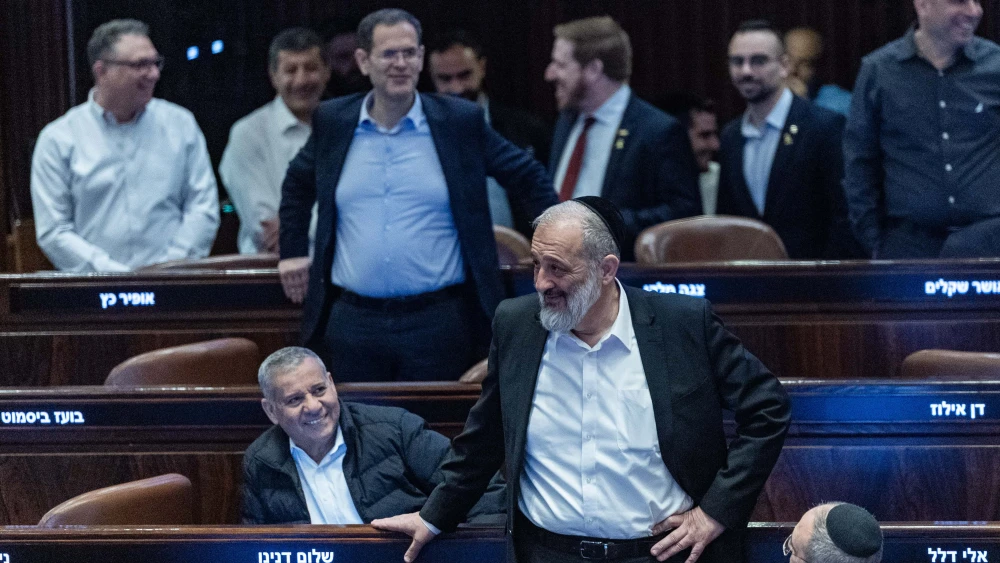
The Haredi rise
Haredi political organization did not begin as a project to govern Israel as a whole. Its original purpose was to ensure that communities seeking to preserve a distinct religious and institutional way of life had political representatives capable of negotiating with the state.
Following Israel’s establishment, Haredi parties joined the country’s early governing coalitions, using their political leverage primarily to protect independent religious education, communal autonomy and military exemptions for yeshivah students. However, their relationship with the state soon became strained. In 1952, they left the governing coalition during a dispute over military or national service for religious women and remained outside government for the next quarter-century.
The major transformation came in 1977, when Menachem Begin’s Likud ended three decades of Labor dominance. Agudat Yisrael returned to government for the first time in 25 years. More significantly, genuine competition emerged between the left- and right-wing blocs, thrusting the Haredi parties into the role of kingmaker.
The transformation that followed was not only political. According to Dr. Gilad Malach, a research fellow at the Israel Democracy Institute, the changes introduced under Begin also helped reshape the structure of Haredi society.
“In 1977, when Begin became prime minister and formed a coalition with Agudat Yisrael, he broadened the possibility of exemption from the army and removed the numerical limits. He also substantially increased financial support for the system. From that point, studying Torah for many years and not serving at all became much more common,” he told JNS.
The expansion of political influence and the growth of the Haredi institutional world developed in parallel. Greater access to state resources helped sustain a growing network of yeshivahs, kollels and communal institutions, while the expanding community increased the electoral weight of the parties representing it.
The Haredi parties embraced their kingmaker role. Since the 1977 election, they have served in the coalitions of the vast majority of Israeli governments, joining administrations led by prime ministers across the political spectrum, including Yitzhak Rabin, Benjamin Netanyahu, Ehud Barak and Ehud Olmert.
As political power grew, internal divisions became inevitable. The next major development came with the creation of Shas in 1984. The party emerged in response to the underrepresentation and perceived discrimination of Sephardi and Mizrahi Haredim within the predominantly Ashkenazi Haredi establishment.
Led spiritually by Rabbi Ovadia Yosef and politically by figures such as Aryeh Deri, Shas developed a much broader electoral appeal than the traditional Ashkenazi Haredi parties. Its support extended beyond the strictly Haredi population to include large numbers of traditional and religious Sephardi voters.
Ashkenazi Haredi politics underwent its own major split in 1988, when the Lithuanian, yeshivah-oriented Degel HaTorah broke away from the largely Hasidic Agudat Yisrael. The two parties reunited electorally in 1992 under the banner of United Torah Judaism, or UTJ. However, they continued to operate as distinct internal factions with separate rabbinic leaderships and political interests.
Despite these divisions, the Haredi parties largely continued to operate as a unified political bloc, almost always sitting together in either the coalition or the opposition. Their political strength rested on collective bargaining, narrowly focused communal priorities and broad flexibility in choosing coalition partners.
Right-wing bloc
While the Haredi political alliance remains largely intact today, its once-independent role has diminished. The Haredi parties remain indispensable to coalition arithmetic, but they are increasingly viewed as a cornerstone of the right-wing bloc rather than as neutral kingmakers.
A major shift away from political neutrality came after the 2013 election, when both Shas and UTJ were excluded from Netanyahu’s coalition. The outcome was driven by a political alliance between Yair Lapid and Naftali Bennett, whose combined strength allowed them to insist on entering the government together and effectively prevented Netanyahu from bringing the Haredi parties into the coalition.
Within the Haredi political establishment, however, Lapid became the principal symbol of the new government’s approach. His Yesh Atid Party had campaigned heavily on expanding Haredi military service and reducing what it viewed as unequal privileges. The coalition subsequently advanced policies affecting conscription and Haredi education without the Haredi parties at the negotiating table.
The experience reinforced a sense of political vulnerability and helped accelerate the Haredi parties’ growing alignment with Netanyahu and the right-wing bloc. In 2015, both Shas and UTJ returned to government and have remained critical members of the right-wing bloc over the past decade. Meanwhile, Haredi conscription and the relationship between religion and state have become increasingly prominent issues for centrist and left-wing parties, further strengthening the Haredi-right alliance.
UTJ leader Yitzhak Goldknopf put it succinctly in a recent interview, saying, “We belong to the right-wing bloc.”
The resulting alliance should not be mistaken for complete ideological convergence. UTJ has historically taken positions on diplomatic and security issues that differ from those of the nationalist right, while Shas has shown greater flexibility on some questions involving territorial concessions to the Palestinians.
The modern Haredi-right bloc is therefore better understood as the product of overlapping social conservatism, decades of accumulated political trust and increasingly strong mutual dependence in coalition politics.
Spending political power
The political leverage accumulated by the Haredi parties is closely tied to the institutional structure of Haredi society. Educational institutions, including schools, yeshivahs and kollels, and other communal institutions depend heavily on government funding, meaning coalition agreements can directly affect the resources available to sustain the community’s social model.
The central tension in Haredi political engagement, however, lies in increasing state support without accepting a proportional increase in state control.
From within Haredi society, this use of political power is not necessarily understood simply as conventional interest-group politics, but rather as part of a larger religious mission. Gedalia Guttentag, deputy editor of Mishpacha magazine, described it as part of a much broader project of communal reconstruction in the aftermath of the Holocaust.
“The Haredi attempt has been nothing less than the rebuilding of a Torah-based civilization. You cannot simply say that this is about supporting a small number of elite scholars. That misunderstands the project. To sustain that civilization, you need an ecosystem, large numbers of people aspiring toward Torah study,” he told JNS. “This is something that the Jewish people need; it’s not something parochial; it’s not something just for the Haredi community,” he added.
Seen from this perspective, government support for schools, yeshivahs and kollels is not viewed solely as a material benefit. These institutions form the infrastructure through which Haredi society seeks to reproduce its religious and communal model across generations, preserving what it sees as the heart of Jewish culture.
Education offers perhaps the clearest example of the balance the Haredi parties have sought to strike between state support and communal independence. Much of the Haredi school system receives substantial public funding. However, the extent of state involvement varies sharply among institutions.
The two major Haredi education networks and state-Haredi schools receive full government funding and are formally required to teach the national core curriculum. Other independent schools receive reduced funding in exchange for greater autonomy, while many boys attend “exempt” institutions that receive just over half the standard level of state support and are subject to correspondingly limited core curriculum requirements. In practice, state oversight of those requirements has often been limited.
The result is a system that reflects the broader Haredi political bargain: combining sufficient participation in the state to secure the resources needed to sustain communal institutions while resisting the level of state control that could fundamentally reshape them.
Coalition participation is a crucial pillar of this political model. In 2023 alone, state support for yeshivahs and kollels totaled approximately 1.7 billion shekels. In a recent study, Malach found that, following the Haredi parties’ return to government, funding for yeshivahs and kollelis “increased by approximately 50%.” As a result, the number of yeshivah and kollel students rose by 7.3% during 2023, reaching roughly 167,000 at the beginning of 2024.
The resulting political structure is self-reinforcing. Highly organized communities produce reliable electoral support; that support creates parliamentary leverage; and that leverage helps sustain the institutions around which communal life is organized.
Conclusion
Haredi political power was built not by capturing the center of Israeli politics, but by mastering the system around it. Highly organized constituencies produced disciplined representation, concentrated priorities strengthened coalition bargaining, and decades of cooperation ultimately embedded the established parties within the right-wing bloc.
However, that model now faces a challenge created in part by its own success. By 2025, Israel’s Haredi population had reached approximately 1.45 million, or 14.3% of the country’s population, and is projected to reach 16% by 2030. As the community grows, its ability to fly under the political radar has diminished.
The established parties therefore face a different challenge from the one they were originally created to address. Rabbi Yehoshua Pfeffer, a prominent Haredi writer and rabbi, framed it directly.
“We’re not a minority anymore. We’re a big part of Israel’s Jewish majority, and therefore we have to take responsibility,” he told JNS.
That shift may increasingly define the next stage of Haredi politics as Israel approaches the Oct. 27 election. The established parties remain highly effective at protecting communal autonomy and securing resources for the institutions they represent. The harder question is whether a political model developed to protect a distinct minority can adapt as that minority becomes an increasingly large and influential part of the country it once sought to keep at arm’s length.



