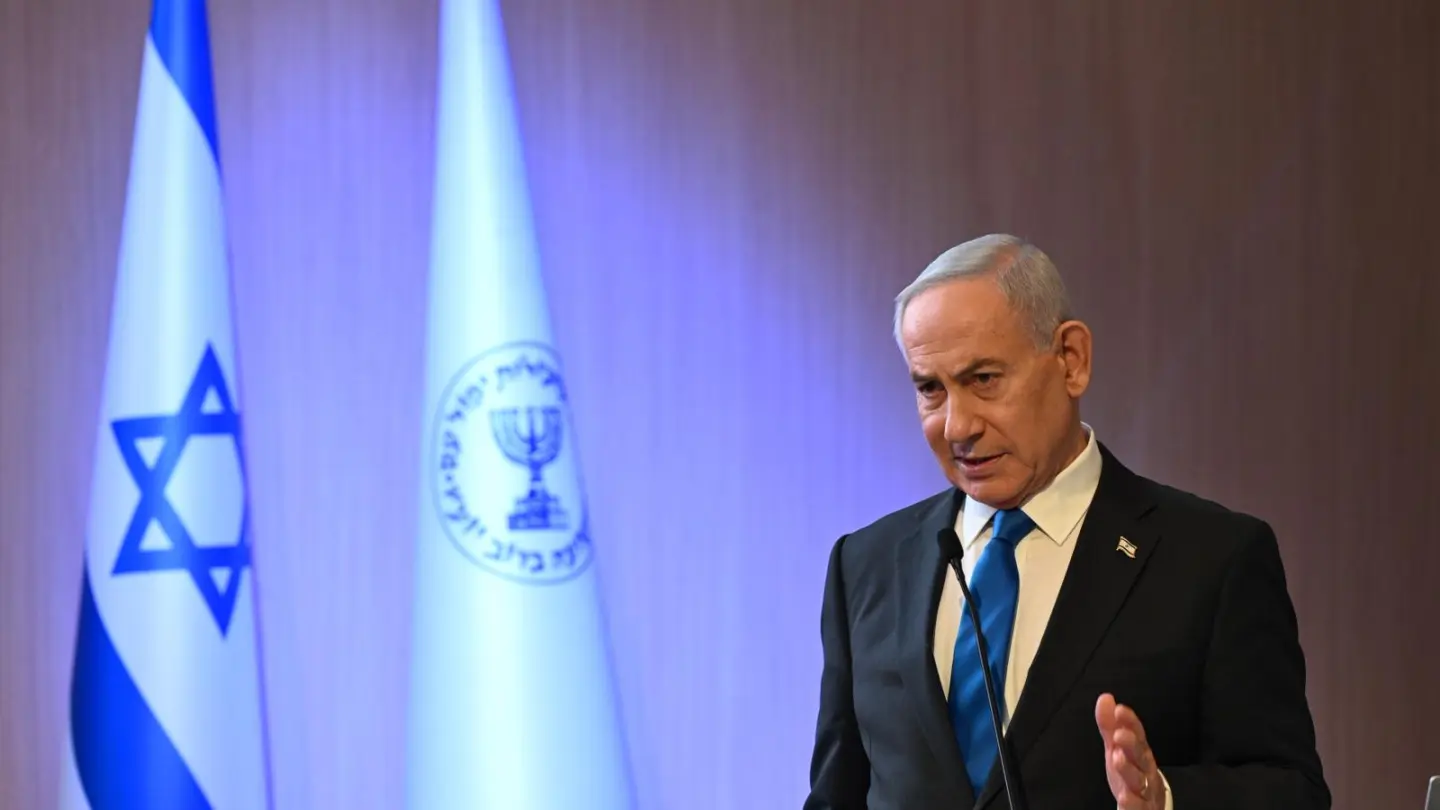
The annual State Memorial Ceremony for Ze’ev Jabotinsky was held on July 15 at Mount Herzl in Jerusalem. Israeli President Isaac Herzog spoke (though there were no transcripts on his official website). Israeli Prime Minister Benjamin Netanyahu also addressed those present; his remarks are here.
Is Jabotinsky, who died in 1940, still relevant nearly nine decades after his passing? Is his thinking in the political, intellectual and cultural fields a source for judging how we should be considering what Israel should be doing, what Jews should be engaged in, or, in general, how we should be confronting challenges?
One of those themes is facing what has become a resurgent Islam on a global scale. It has become difficult to discuss the matter to any serious extent without the ever-present threat of triggered denunciations of “Islamophobia.”
Jabotinsky dealt with the issue once in 1932.
At a conference in Warsaw that year, the Times of London misquoted him. The Zionist leader employed the term “dynamite” to describe the negative potential that could be directed at the British Empire and the Times indicated that he was referring to the Jews. Of course, that actually did develop, but only in the 1940s, after Britain’s betrayal of the 1939 White Paper that outlined a new policy for the British Mandate of Palestine.
In a letter to the editor, Jabotinsky clarified that indeed, he saw a form of “incendiarism” facing the empire, though its source was:
“the systematic galvanisation of pan-Islamic fanaticism in its most medieval and reactionary form. Jerusalem is being converted into a centre of incitement vying with the worst efforts of the Muscovite Comintern, a centre from which innumerable sticks of dynamite are to be showered all round, threatening not only our Jewish settlers in Palestine but also the whole of Europe’s colonial system.” He further wrote that “England may soon have to render accounts for this shortsighted and dangerous gamble with the world’s security conducted under her aegis.”
Did Jabotinsky warn of an earlier version of the contemporary Red-Green axis?
In a 1926 essay, the founder of Zionist Revisionism and the Betar Zionist youth movement had turned his attention to a parallel matter that is one still relevant to our time.
We are living in the midst of an attempted conquest by Islam of Western Europe, well underway, as well as America. A century ago, a debate developed about whether Zionism represents a movement of Western culture becoming ensconced in the Middle East or a movement of Jews returning to their Eastern roots.
The first characterization Jabotinsky described so:
“We, Jews, are an Eastern people by origin; despite Western influences, the basis of our soul has remained Eastern. For the East has its own special soul … this Eastern spirituality, in its qualities, is superior to the soul of the West. … Going to Eretz Yisrael, we return to the environment of peoples who have preserved the Eastern psychology in more or less integrity. We must therefore seek out, even in our own depths, elements of Easternness, contaminated by the dust of the West … .”
Jabotinsky was not at all impressed by such a painted picture. Jews, he thought, should be:
“Going to Eretz Yisrael, firstly, for our own national convenience, and secondly, as Nordau said, to ‘expand the boundaries of Europe to the Euphrates’ … to sweep from Eretz Yisrael, as far as the present and future Jewry there is concerned, all traces of the ‘Eastern soul.’”
What about the Arabs there? He was curt, saying “that is their business; but if we can render them a service, it is only one: to help them rid themselves of the ‘East.’”
And their religion?
Jabotinsky accepted that “Islam is probably a very wise and noble religion.”
However, being a liberal, he had a problem:
“The East strives to introduce religion into every aspect of everyday life … on everything … on the pastimes of Ahmed and Fatima, … The West firmly holds the view that the realm of religion is strictly limited: It is a person’s inner relationship with the deity. Religion … does not determine any of the active aspects of domestic life. This affects women’s status most of all … .”
Jabotinsky rejected the allure of the East and called on his fellow Zionists to remain, in spirit, part of the West:
“ … we, more than any other people, have the right to say: ‘Western’ culture is flesh of our flesh, blood of our blood, spirit of our spirit. To reject ‘Westernism,’ to embrace anything characteristic of the ‘East,’ would be to deny ourselves.”
But, he added, “I’m speaking, of course, of a moral ‘Europe.’”
Europe in the first quarter of the 21st century is very different from the “moral” Europe of Jabotinsky’s time. To a much greater extent, Islamism has grown worse.
Jabotinsky raised a relevant and important issue. Of course, in today’s world of wokeness, moral relativism and extreme tolerance for cultural differences, his writing on this matter is anathema. This subject should not even be discussed.
Nevertheless, we need to ask if Europe today is moral enough and cultured enough to withstand the influence of a growing Islamist presence. Can it counter the taking over of its public square? Will it continue to allow the influx of Muslims, who are not at all interested in integrating into existing societies, but rather, to preempt and usurp the countries where they live? For that is not only what they are doing, but what their religion instructs and even requires.
In his essay, Jabotinsky notes that:
“Europe has traveled all the way from the Huns and Teutons to the League of Nations and wireless telegraphy. Enough time to wean ourselves off the ‘Asiatic’ pace of life and become accustomed to the ‘European’ one.”
He expressed a preference and judged the alternative a better choice—morally, culturally, politically and religiously. Who has the courage these days to likewise declare a better choice for a nation’s character and performance?