


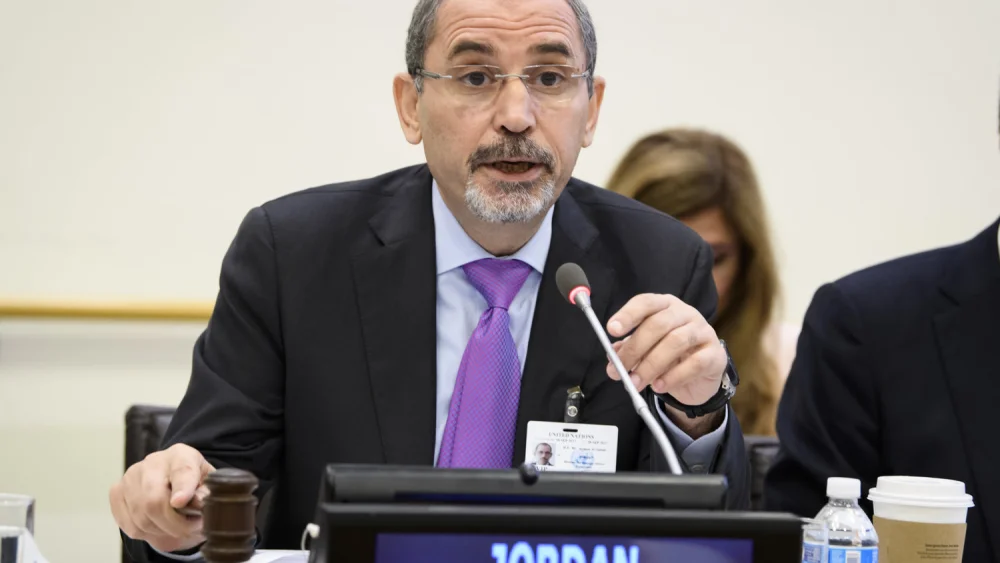
Jordan and Germany said on Saturday that the International Stabilization Force envisioned under U.S. President Donald Trump’s peace plan for the Gaza Strip should be deployed under a United Nations mandate.
“In order for that Stabilization Force to be able to be effective in getting the job done, it has to have a Security Council mandate,” said Jordanian Foreign Minister Ayman Safadi, speaking at the International Institute for Strategic Studies (IISS) Manama Dialogue in Bahrain.
A U.N. mandate will allow other nations to “come in and so that we [can] really work out the details of the interfacing between the international force and the Palestinian force which, again, must be in charge of security of the Palestinians,” Amman’s top diplomat continued.
“We in Jordan, along with our brothers in Egypt, have said repeatedly that we’re willing, ready and able to train Palestinian police and deploy that force,” he said, adding that the Hashemite Kingdom is “too close to the issue” and therefore cannot deploy its own soldiers to police Gaza.
“Of course, the elephant in the room is going to be Israeli presence in Gaza. Israel remains in about 53% of Gaza,” he said of the peace plan.
German Foreign Minister Johann Wadephul told attendees that the peacekeeping force would “need a clear basis in international law.”
“We understand that this is of utmost importance to those countries who might be willing to send troops,” the German diplomat said. He noted that Berlin “also wants to see a clear mandate for this mission.”
“It is important that we pressure and contain those who actively work against this vision,” said Wadephul. “Let us counter those strive to instability and ensure that opponents to peace cannot succeed.”
The Israeli Prime Minister’s Office and the U.S. State Department had not replied to a request for comment on Safadi and Wadephul’s remarks at time of publication.
The 20-point peace plan accepted by Israel and Hamas terrorists calls for the creation of a “temporary international stabilization force” that “will train and provide support to vetted Palestinian police forces.”
France and Britain, working in coordination with Washington, were reportedly working last month to finalize “in the coming days” a U.N. Security Council resolution to define the peacekeepers’ mandate.
“France is working closely with its partners on the establishment of such an international mission,” a spokesman for the French Foreign Ministry told reporters on Oct. 16. He said that “discussions, notably with the Americans and British,” were ongoing regarding a U.N. resolution.
Also last month, the Israel Hayom outlet reported that troops from Azerbaijan and Indonesia could lead the mission to the Gaza Strip.
Trump, meeting with Qatar’s Emir Tamim bin Hamad Al Thani aboard Air Force One during a refueling stop in Doha on Oct. 25, claimed that the Gulf nation had also signaled its willingness to contribute soldiers.
Israeli Prime Minister Benjamin Netanyahu has ruled out Turkey’s participation in the Trump plan, defining it as Jerusalem’s “red line.”
Israel Hayom last month cited political sources as saying Netanyahu’s mention of “new threats” in a speech on Oct. 20 referred to the growing influence of Turkey and Qatar. Trump is said to hold Ankara and Doha in high regard, while Israel views both nations as destabilizing forces.



