Newsletter
Newsletter Support JNS

Knesset approves first reading of bill to dissolve government

A 64-44 vote moves Israel closer to new elections, tentatively set for Sept. 17 • Final readings could come on the night of May 29.

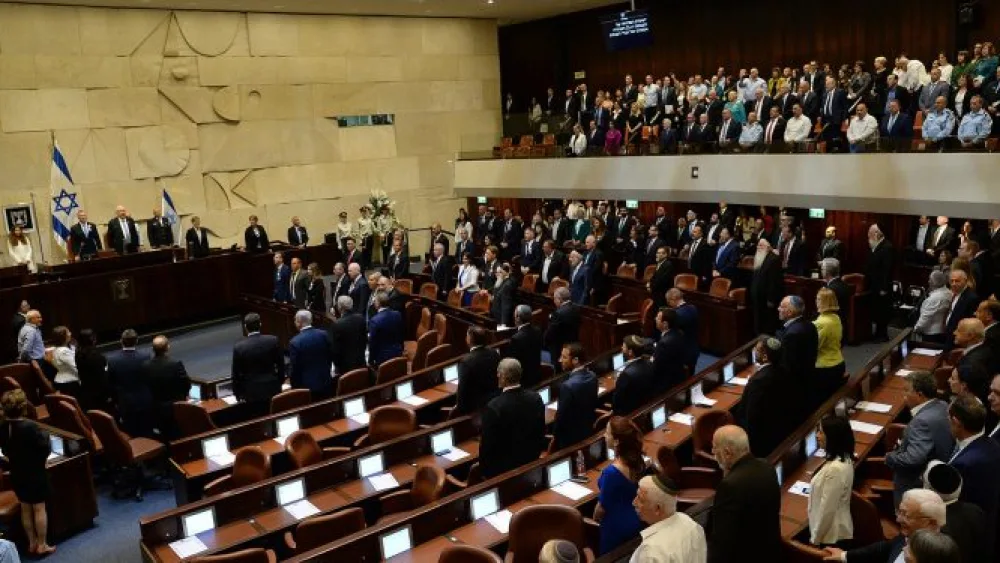
Israeli lawmakers stand during the inauguration of the 21st Knesset on May 28, 2019. Photo: Haim Zach/GPO.

In a vote of 64-44, the Israeli Knesset on Monday night approved in its first reading a bill to disband the legislature.

Second and third readings will likely be held Wednesday night if Israeli Prime Minister Benjamin Netanyahu fails to secure a coalition by then. Only if the bill is approved in all three readings can new elections be held.

A tentative date for another round of elections is Sept. 17, just 161 days after the previous election, which is an unprecedentedly short interval.

The failure of coalition negotiations has hinged on talks between Netanyahu and Israel Beiteinu leader Avigdor Lieberman, who has refused to join the government unless he is promised the passage of a law subjecting ultra-Orthodox Israeli men to the country’s mandatory draft. The ultra-Orthodox United Torah Judaism and Shas parties have refused to be part of Netanyahu’s coalition if such a law is drafted.

Opposition leaders have said they want to be given the opportunity to form a government, rather than go to elections.

Recent polls have shown that a new election would yield an even stronger right-wing bloc than was chosen on April 9, with Naftali Bennett and Ayelet Shaked predicted to pass the threshold, Likud to gain a seat, the Union of Right Wing Parties to gain a seat and the United Arab List and Kulanu Party dropping out of the legislature.

Analysts believe Kulanu would merge with Likud if new elections are called.

In a draft report delivered to the U.S. president, the commission also called for improved religious accommodations for U.S. service members.
Salah Salem Sarsour, accused of concealing Israeli military court convictions on immigration forms, argued his detention was part of a Trump admin effort to target the pro-Palestinian movement.
CENTCOM stated that the strikes targeted missile, drone and radar facilities after the Islamic Republic attacked a cargo ship in the Strait of Hormuz, calling the assault a violation of the ceasefire.
Now that the primaries are over, “we hope that everyone will come together and be united,” Christine Quinn, chair of the executive committee of the New York State Democratic Party, told JNS.
An Iranian official warned on Friday that the safety of ships passing through the Strait of Hormuz without Iran’s permission “cannot be guaranteed.”
“We have put the train back on the tracks and going in the right direction,” said Yechiel Leiter, Israeli ambassador in Washington. “Final destination? Peace between our two countries.”
Benny Gantz, JNS editor-in-chief Jonathan S. Tobin, Gilad Erdan, Mosab Hassan Yousef, Nissim Black and leading voices in security, diplomacy, media, law and Jewish communal affairs headline the summit’s third day in Jerusalem.