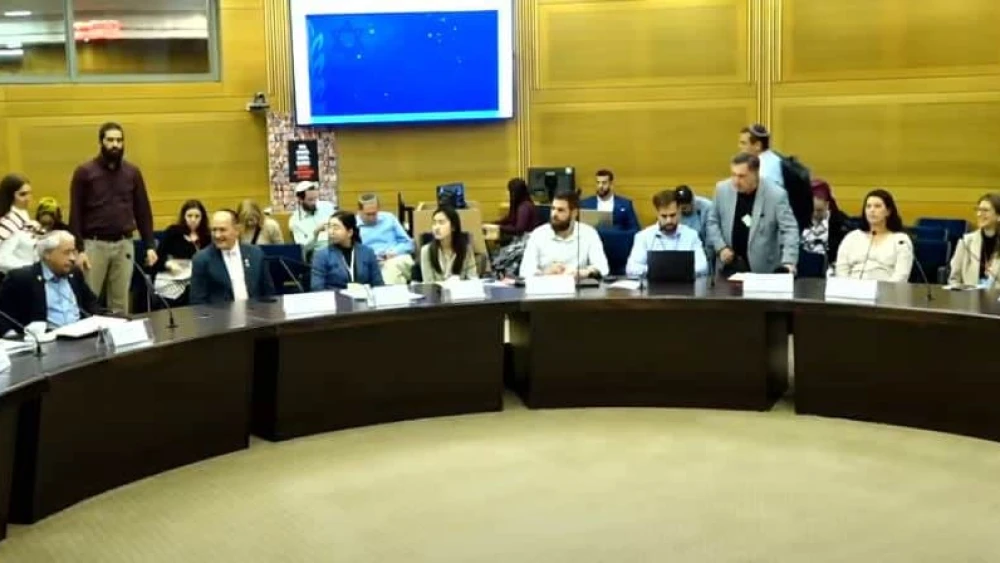
The Knesset Land of Israel Caucus, the largest lobby in Israel’s parliament, representing some 80 Knesset members, threw its weight behind U.S. President Donald Trump’s Gaza relocation plan during a special conference it hosted in the Knesset on Sunday.
The conference, titled, “The New Middle East: The Plan for Voluntary Migration from Gaza,” featured numerous speakers, both Knesset members and activists.
“It’s amazing how issues that would have sounded completely absurd a few years ago ... have today become the consensus,” said Israeli Finance Minister Bezalel Smotrich, chairman of the Religious Zionism Party. “We were thought of as crazy, delusional. It turns out that the crazy people are the knowledgeable realists,” he added.
“I was in the United States last week and they asked me on several occasions what I thought about President Trump’s plan. I told them… ‘It’s the only plan that is realistic for peace, for security. The only one—there is no other way,” Smotrich said.
Knesset Speaker Amir Ohana of the Likud Party said that the world had sadly become “accustomed” to the two-state paradigm as the only solution to the Arab-Israeli conflict.
He noted the idea had been tested with the 2005 disengagement, in which Israel evacuated some 8,000 Jews from the Gaza Strip and northern Samaria. Israel was rewarded with terrorism and thousands of rockets fired at its cities, culminating in the Oct. 7, 2023 Hamas massacre.
Likud MK Yuli Edelstein, one of the co-chairmen of the Land of Israel Caucus, and chairman of the Foreign Affairs and Defense Committee, agreed that “those who thought that the Oslo Accords would bring us a new Middle East were doomed to failure from the outset.”
Simcha Rothman of the Religious Zionism Party, another co-chairman of the caucus and who also serves as chairman of the Constitution, Law and Justice Committee, indicated that the two-state solution was dead, noting that 99 Knesset members voted against the establishment of a Palestinian state in February of last year “with a clear understanding that the path that the State of Israel has taken over the past years had been mistaken.”
Referring to Trump’s comments that the world was witnessing “a revolution of common sense,” Rothman said it is “now our duty to bring solutions based on common sense.”
He noted that countries that oppose voluntary migration from Gaza are in effect supporting Hamas’s military strategy, which calls for using civilians as human shields. A country that prevents Gaza’s civilians from leaving is a “collaborator” with Hamas’s war plans, he said.
MK Limor Son Har-Melech of the Otzma Yehudit Party, another Caucus co-chair, recalled that she had been evicted with her family from one of the northern Samaria communities evacuated during the 2005 disengagement. At the time, they were told it would bring peace and quiet. “We shouted that it is not what would happen,” she said.
“Instead of the prosperity that they promised us, we received a reign of terror. Instead of the economy that they promised, we received missile production and terror tunnels,” she continued.
It was time for Israel to stop trying to “manage” the problem, she said, and instead to “start dismantling it from the ground up.”
“The solution is no longer money poured into the reconstruction of Gaza after each [military] operation. The solution is not a temporary security zone or another round of localized bombardment. The real solution is to change the reality in Gaza through occupation and emigration of Gaza’s Arabs and Jewish settlement throughout Gaza,” she continued.
Gaza had a Jewish history dating back “thousands of years,” she said, noting that there were “flourishing” Jewish communities there less than two decades ago.
“The expulsion of the Jews from the Gaza Strip was a moral, security and national disaster,” she added.
“The Trump administration really gives us all the tools. All we have to do is reach out and want it,” she added.
Ido Norden, chairman of the Seniors Forum, a group comprising individuals who have formerly held high-level posts in the public and private spheres, presented a cost comparison between Trump’s plan and rebuilding Gaza with the population still in place.
“We looked at the alternative of rehabilitating the Gaza Strip with the residents remaining in place, and had the real costs of this alternative broken down by professionals. We saw that the cost of rebuilding waste infrastructure and building residential and employment spaces for the residents who remain is between $78 billion and $87 billion,” said Norden.
“And we are talking about a period of five to 10 years,” he added. “We’re talking of humanitarian aid of between $20 billion and $40 billion.”
Compared to that plan, costing in total between $98 billion to $127 billion, the total costs of Trump’s plan will be $30 billion to $40 billion, he said. That includes a $25,000 grant to every Gazan family that emigrates. Furthermore, if they emigrate to more developed countries, they will also receive help as refugees, he said.
Other conference participants included international legal scholar Eugene Kontorovich, who noted that there was nothing in international law opposing voluntary migration, and settlement activist Daniella Weiss, who called for establishing Jewish communities in the Gaza Strip.
Middle East scholar Mordechai Kedar noted that Qatar was an ideal relocation destination, as the country has thousands of residences and hotel rooms standing empty, that were built to host visitors to the 2022 World Cup.