In February, Dani Naveh, president and CEO of Development Corporation for Israel, better known as Israel Bonds, told JNS that efforts to boycott Israel aren’t hurting the U.S. broker dealer, which is the exclusive Israeli debt securities underwriter in the United States.
“Despite a disinformation campaign driven by antisemitism, the continued and growing inclusion of Israel Bonds in portfolios represents a tremendous success,” Naveh, a former Israeli cabinet minister, told JNS at the time. “Israel Bonds has long weathered attempts by the BDS movement and other anti-Israel campaigns to delegitimize this support.”
This month, he told JNS a similar thing. Municipal support for Israel Bonds is bipartisan, he said. “On the negative side of life, you can see these BDS campaigns targeting these officials following their decision to invest in Israel.”
He and his team pay attention to “aggressive” efforts in the United States to boycott the Jewish state.
“It should be an important part of the agenda for anyone who cares about Israel and the future of the Jewish community,” he told JNS. “There are probably around 35 national organizations behind it and many more local ones, which are very vocal. They target Israel Bonds, but at the end of the day their real agenda is the destruction of Israel.”
But although the campaign to boycott Israel annoys many people, “in terms of real impact on Israel Bonds sales or decisions by different comptrollers or treasurers, it has not made much of an impact,” Naveh said.
“In almost all these cases the BDS campaigns against us have failed,” he told JNS. “They try to strong-arm the treasurers and comptrollers.”
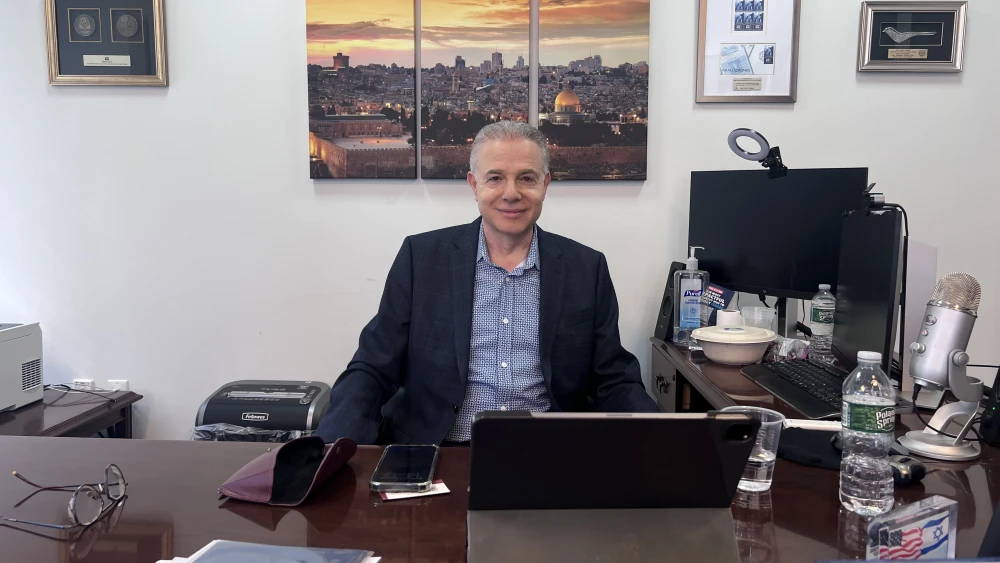
Naveh, who has served in his position for almost five years, spoke to JNS from his office in a midtown Manhattan commercial building, as Israel Bonds celebrates its 75th anniversary.
The annual income of Israel Bonds is nearly double what it was before Oct. 7, according to Naveh. “When I took office in 2022 it was about $1.3 billion a year,” he said.
There have been about $2.5 billion in annual investments in the bonds, half of which institutional investors like municipalities are driving, since 2023, according to Naveh. Since Oct. 7, Israel Bonds has brought in $8 billion worldwide, he added.

Palm Beach County, in Florida, is the largest investor. Mike Caruso, county comptroller, said on Jan. 6 that the county would add $350.5 million in investment, bringing the total to $1 billion. At the time, he stated that it was the “most significant investment in Israel Bonds of any investor in the world and provides the most significant returns of any investment option in the county’s portfolio.”
“Investment policy is not politics but purely a function of safety, liquidity and a market rate of return,” he added. “Israel Bonds are paying a higher rate than other allowable investment alternatives, including U.S. treasuries, and will provide a substantial return on investment for the people of Palm Beach County.”
The Israeli Finance Ministry sets rates of return on Israel Bonds twice monthly, and current rates range from 4.31% annually on investments starting at $5,000 for two years to 6.01% for those committing at least $1 million in a 15-year bond.
At press time, U.S. Treasury bonds paid in the low 4% range for terms lasting two to 10 years, and 5.08% for 30-year bonds.
Since its founding in 1951, after a proposal from former U.S. treasury secretary Henry Morgenthau to Israeli Prime Minister David Ben-Gurion, Israel Bonds has raised more than $57 billion.
What began as a philanthropic commitment by American Jews to support the developing infrastructure of the new State of Israel has become a serious investment by dozens of municipalities and other investors across the country.
Since Oct. 7, many more towns and cities have invested in Israel Bonds, according to Naveh.
“These local governments have a fiduciary duty to make sure they have a strong and steady return, which they have, investing in Israel Bonds,” he said. “At the same time, most of them have made that investment decision as part of their understanding that this is a great way to support the United States’ best ally.”
“Many have made statements about how proud they are to invest in Israel Bonds as part of their support for Israel,” he said.
Israel Bonds has never defaulted on a payment, he added.
Michael Frerichs, who has been Illinois state treasurer since 2015, has reportedly invested $100 million in Israel Bonds on behalf of the state, even though anti-Israel protesters reportedly defaced the Democrat’s house at 3 a.m. one morning, while his children were home sleeping.
That and other protests “really terrified his kids,” and have placed pressure on other elected officials, Naveh told JNS. “You see treasurers and comptrollers across the country facing that kind of aggressive campaign.”
“They have not caved in,” he said.
Speaking at an Israel Bonds event, Frerichs, who is not Jewish, “said very clearly that he’s going to stand on the right side of history,” Naveh said. “I really admire that because as an elected official, it’s not easy to be under such an aggressive campaign.”
An Illinois state law bars boycotting Israel. Eric Adams issued an executive order to that effect as New York City mayor, but Zohran Mamdani nixed that order as one of his first acts as mayor in January.
Naveh wants to see people “double down on our investment in Israel.”
“Show them that the Jewish community here in New York City increases their support for Israel in light of the anti-Zionist, anti-Israel positions,” he said.
Naveh declined to comment on an amendment to cut $3.3 billion in U.S. aid to Israel, which failed to pass but which drew only a minority of Democrats, who voted to keep funding Israel. “I can’t comment on any political questions,” he said.
Between 80% and 85% of the investments in Israel Bonds come from the United States, according to Naveh, who is in charge of global sales. About half of sales are to retail investors, including individual purchasers and Jewish Federations, he said.
“Since Oct. 7, we have raised so far more than $8 billion, which is a significant part of Israel’s foreign debt,” he told JNS. “We are very proud of being such an important part of Israel’s financial infrastructure.”
The money invested in Israel Bonds goes to Israel’s general operational budget, he said.
In 2023, Brad Lander, who was then New York City comptroller, let the Big Apple’s almost 50-year partial investment of its pension funds in Israel Bonds lapse. Lander, who recently won the Democratic primary against Rep. Dan Goldman (D-N.Y.) and who has accused Israel of “genocide,” had said prior to allowing the investment to lapse that he opposed efforts to boycott the Jewish state.
Mamdani, who has also accused Israel of “genocide” and who has said that he would have the Israeli prime minister arrested in New York City, has also said that he opposes investing in foreign countries’ sovereign debt. The Big Apple has the most Jews of any city outside Israel.
Mark Levine, New York City comptroller, who like Lander is Jewish, said during his campaign last year that he planned to explore reinvesting some of the city’s $310 billion in managed pension funds in Israel Bonds.
After seven months in office, Levine has yet to do so, a source with knowledge told JNS.
Levine’s office told JNS that the comptroller “has a fiduciary responsibility to maximize risk-adjusted returns for our pension members and beneficiaries.”
“As we have said before, these are complex investment matters—not political ones,” the office said. “We continue to use a rigorous review process to assess portfolio needs and work closely with our fellow trustees across each of our pension boards. Our approach is guided by our fiduciary responsibility to protect the long-term interests of our members and beneficiaries.”
Some $300 million reportedly remains invested in Israeli equities and a small amount in Israeli real estate investments. (JNS sought comment from the New York City comptroller’s office. Naveh declined to comment.)
In June, the Anti-Defamation League said that divesting from companies that conduct business with and in Israel could cause New York City taxpayers more than $37 billion in “potential forgone value” between 2025 and 2035.
“This research shows that divestment strategies guided by the BDS campaign can be bad fiscal policy, and we believe that they risk contributing to an environment where Jewish New Yorkers are already targeted and marginalized,” said ADL National Director and CEO Jonathan Greenblatt, in a statement accompanying the report.
Under Tom DiNapoli, New York state comptroller, the state has $360 million invested in Israel Bonds. DiNapoli won a decisive primary victory recently against candidates who said that they would divest from Israel.