Newsletter
Newsletter Support JNS

Likud sees boost in poll after Gantz’s departure

Meanwhile, the center-left bloc weakened, falling to 51 mandates from 53 in the last survey.

Benjamin Netanyahu
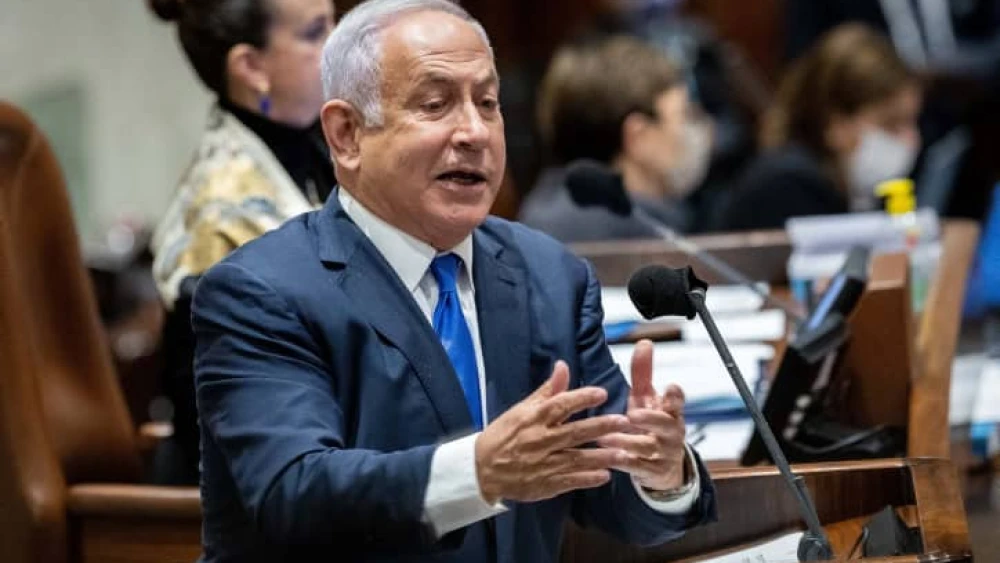
Then-opposition leader Benjamin Netanyahu addresses the Knesset, Feb. 28, 2022. Photo by Yonatan Sindel/Flash90.

A Direct Polls survey released on Monday by Israel’s Channel 14 shows that the Likud Party gained a slight tailwind following National Unity Party leader Benny Gantz’s announcement that he was quitting the emergency unity government.

If elections were held today, the Likud Party with Benjamin Netanyahu at its head would win a months-long high of 59 Knesset seats, up one from last week’s Direct Polls survey.

Meanwhile, the center-left bloc weakened, falling to 51 mandates from 53 in the last poll.

The survey asked which leader was best suited to serve as prime minister: Netanyahu or Gantz. Forty-seven percent of the respondents picked Netanyahu compared to 31% for Gantz. Twenty-two percent said neither was suitable.

According to the survey, the breakdown of mandates would be as follows:

Right-wing bloc:

Likud – 26
Shas – 10
Otzma Yehudit – 10
United Torah Judaism – 8
Religious Zionism – 5

Total: 59 mandates

Left-wing bloc:

National Unity – 17
Yesh Atid – 12
Israel Beiteinu – 13
Labor – 9

Total: 51 mandates

Arab parties:

Ra’am (United Arab List) – 6
Hadash-Ta’al – 4

While Democrats broadly oppose the strikes on Iran, about seven in ten Republicans approve, a new Pew report finds.
Stacy Skankey, of the Goldwater Institute, said that “taxpayers have a right to know what is being taught and how much a university is paying for it.”
A new Quinnipiac poll finds most voters also oppose U.S. military action against Iran and disapprove of U.S. President Donald Trump’s handling of the conflict, underscoring a sharp partisan divide.
“At a time when Israel is under siege, this is a very, very powerful night,” Ted Deutch, CEO of the AJC, told JNS.
“The increase in hateful acts across the city is absolutely abhorrent, and we have to do something about it,” stated Julie Menin, the council speaker.
“Many volunteers have never had the chance to meet a survivor in person, and hearing their stories firsthand makes the impact of their work tangible,” an organizer told JNS.