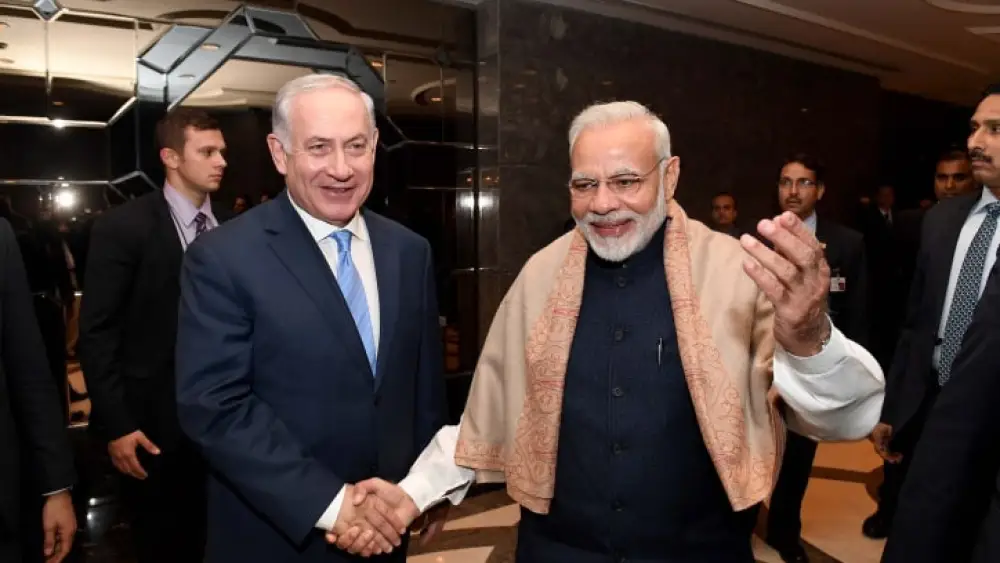
Israeli Prime Minister Benjamin Netanyahu and his Indian counterpart Narendra Modi spoke on Tuesday about the importance of securing freedom of navigation in the Bab-al-Mandab Strait, where Yemen’s Houthi terrorists have repeatedly carried out missile and drone attacks.
The two leaders agreed on the need to prevent the Iranian proxy from hampering international trade and thus harming the world economy. The Bab-al-Mandab Strait connects the Red Sea to the Gulf of Aden.
Freedom of navigation is an essential global need that must be ensured, Modi said.
Netanyahu thanked Modi for New Delhi’s support for Jerusalem’s “just war” to eliminate the Hamas terrorist organization.
They also discussed bringing workers from India to Israel. In the wake of Hamas’s Oct. 7 massacre of Israeli residents in communities facing the Gaza Strip, Israeli officials have expressed interest in replacing Arab workers from Judea, Samaria and the Gaza Strip, which some now consider a security threat.
In February, Netanyahu and Modi discussed ways to enhance bilateral relations by deepening cooperation in high-tech, economic matters and security.
Last year, India and Israel marked 30 years of full diplomatic relations. India gained independence from Great Britain in August 1947 and Israel did so in May 1948.