Steve Witkoff, U.S. special envoy to the Middle East, intends to hold meetings in the coming days about a ceasefire between Israel and Hamas in Gaza and a hostage release deal.
U.S. State Department spokeswoman Tammy Bruce told reporters at Tuesday’s press briefing that Witkoff will head this week to the “Gaza area” to continue with negotiations that can “hopefully” lead to a “ceasefire between Israel and Hamas.”
A State Department official later told JNS that Witkoff “will travel to Europe this week for meetings on a wide range of issues, including Gaza, and will continue pushing for a Gaza ceasefire and peace deal,” but would not confirm that Witkoff would continue on to the Mideast.
Axios later reported that Witkoff would hold talks with Israeli and Qatari officials in Rome on Thursday.
The meeting is slated to include discussions about a humanitarian corridor in Gaza, Bruce noted, amid growing reports of hunger in the Strip. Bruce would not confirm that the United States would negotiate to bring the United Nations into the fold in the opening of a humanitarian corridor.
The United Nations has been fiercely critical of the Gaza Humanitarian Foundation’s efforts, with the foundation publishing a letter on Tuesday urging the United Nations to cooperate on aid delivery going forward.
The Israeli government has pointed to hundreds of trucks that have undergone security screenings and are waiting for U.N. delivery, but have been sitting idle for extended periods.
“It’s always been the intention, obviously, to have as many sites as possible,” Bruce said of foundation distribution sites. “It’s been the difficulty of being in a war zone, and what you can do and what you can arrange.”
“The fact that we’ve had three sites up—and I think now it is nearly 85 million meals to date at the distribution centers that do exist—clearly, it’s not just a dynamic of wanting more distribution centers in a war zone,” Bruce said.
“Our goal is not to have a war zone, and the aid corridor that the secretary mentioned to me, so that multiple entities can deliver aid and whatever is needed in that region without being looted and hijacked by Hamas,” she said.
Bruce lamented the reported deaths of 30 people trying to access food from a United Nations convoy early this week, amid continued criticism and false reporting that the GHF sites, increasingly protected by the Israel Defense Forces, are becoming killing fields for aid seekers.
“I think no matter who has been trying to deliver food, they know historically and recently that there is going to be—and as long as Hamas still has its weapons and is still a player in that region, there is still going to be problems,” Bruce said.
She was dismissive of a statement released by 28 countries criticizing what they say are Israel’s humanitarian aid restrictions, and demanding an immediate ceasefire.
“We wonder why certain things have continued unabated, or at least in a kind of perpetual loop, because strongly worded letters don’t stop this madness,” Bruce said, asserting that intense U.S. diplomatic action will bring about an end to the war. “Strongly worded letters won’t stop Hamas. Strongly worded letters wouldn’t stop Iran.”
Bruce would not confirm reports that Tom Barrack, the State Department’s special envoy for Syria, would chair security talks between Israel and Syria.
“All parties have reached a cessation of hostilities. We are calling on the Syrian government to lead on the next steps and hold all perpetrators of violence accountable for their actions,” she said. “The United States government supports Syria’s national unity and a peaceful and inclusive resolution with its minority constituents.”
‘Everyone involved in atrocities would be held accountable’
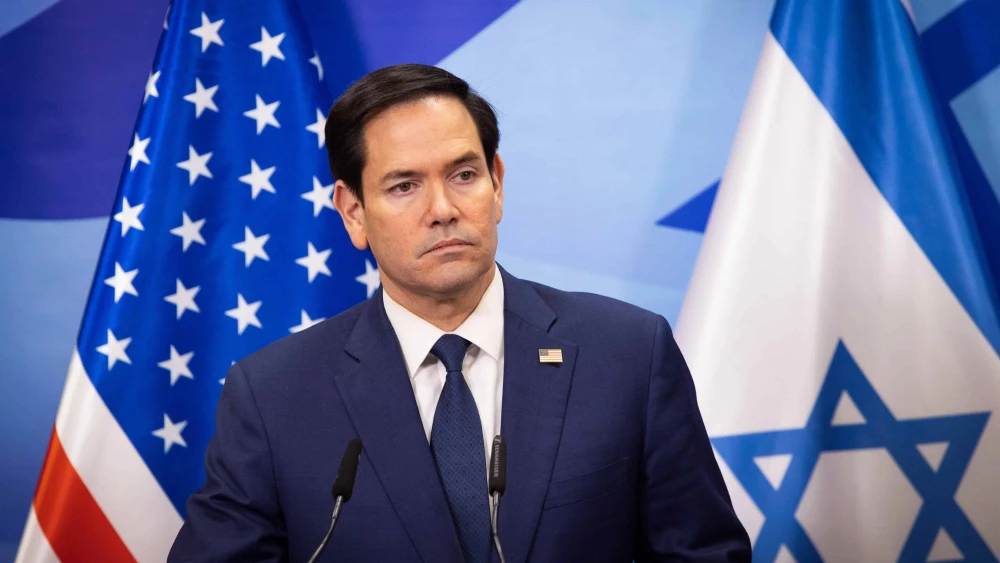
Marco Rubio, U.S. secretary of State and national security advisor, “expressed his optimism regarding the current situation,” according to Bruce, regarding Syria’s agreement to set up a boundary around Sweida, an area with a large Druze population in the country’s south where Bedouin tribes, viewed by the Israeli government as jihadists, have massacred swaths of the Druze community.
The Druze have deep cultural and historical ties to Israel, which is largely viewed as their protector, leading to Israeli strikes on jihadists, along with Syrian government and military targets after the Israeli government deemed that Syrian security forces were participating in the massacre—something Barrack refuses to confirm.
U.S. citizen Hosam Saraya and his family were executed in Sweida last week in an incident captured on video; Bruce would not confirm that Syrian government forces carried out the murders, as alleged.
She did allow that “everyone involved in the atrocities would be held accountable, and that could include people who also may be affiliated with the Syrian government.”
JNS asked Bruce whether Rubio had a preference among two competing bills in the U.S. House of Representatives to lift the Caesar Act sanctions on Syria. One calls for a full repeal, while the other, led by Rep. Mike Lawyer (R-N.Y.) and supported by some centrist Democrats, would allow Trump to permanently lift key sanctions on Syria in two years if Trump certifies that Damascus has met a set of conditions.
Lawler’s measure advanced out of the House Financial Services Committee on Tuesday. Critics of the bill say that Trump should be given wide latitude to lift the sanctions on his own. He can waive the Caesar Act sanctions every 180 days under current law.
The president has already lifted executive-imposed sanctions on Syria or has set the wheels in motion for what remains, though he cannot unilaterally lift congressionally imposed sanctions.
While Bruce would not discuss Rubio’s House preference, “he’s, of course, involved in every dynamic,” she said. “The sanctions have been lifted because we want Syria and its government to have a chance to become stable. It has been very clear what the requirements are. We know we have to work for it to become stable.”