Israeli Foreign Policy

“May it be a blessed year of realizing peace and stability in the region,” says Bahraini Foreign Minister Abdullatif al-Zayani after Israeli Foreign Minister Gabi Ashkenazi sends a holiday greeting.

Israeli Prime Minister Benjamin Netanyahu called it a “pivot of history” and “new dawn of peace.”

President of the American Zionist Movement Richard Heideman noted that the Abraham Accords bode well “for the future of Israel, Zionism and the Jewish people with all people.”
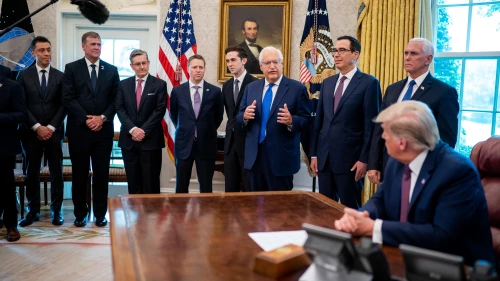
“The new peace agreements between Israel and the UAE, and Israel and Bahrain, are the product of a profound geopolitical shift that has taken place in the region over the past several years,” said Ilan Berman, senior vice president of the American Foreign Policy Council.
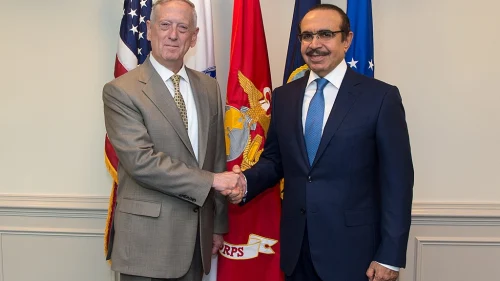
Rashid bin Abdullah Al Khalifa said that Iran is a “constant danger that harms our internal security.”

Other opposition groups came out against the deal, including the Bahrain Bar Association.

Will its new mission and its fundraising dollars, especially during a time of global uncertainty and rising anti-Semitism, detrimentally affect the Jewish people?

Mossad director Yossi Cohen: “A lot of very good people worked on this for a great many years. It didn’t start yesterday.”

Greek Prime Minister Kyriakos Mitsotakis calls the move “a positive first step,” but says sanctions are on the table if Ankara refuses to “return to the path of logic.”

Tehran says relations between Jerusalem and Manama “will remain in the historical memory of the oppressed and downtrodden people of Palestine and the world’s free nations forever.”

At the opening of the weekly Cabinet meeting on Sunday, Israeli Prime Minister Benjamin Netanyahu lauds Bahrain for following the UAE’s lead in normalizing ties with the Jewish state.

The sultanate lauds the “new strategic approach espoused by some Arab countries” as a step towards establishing peace “based on the termination of Israeli occupation of Palestinian territories.”