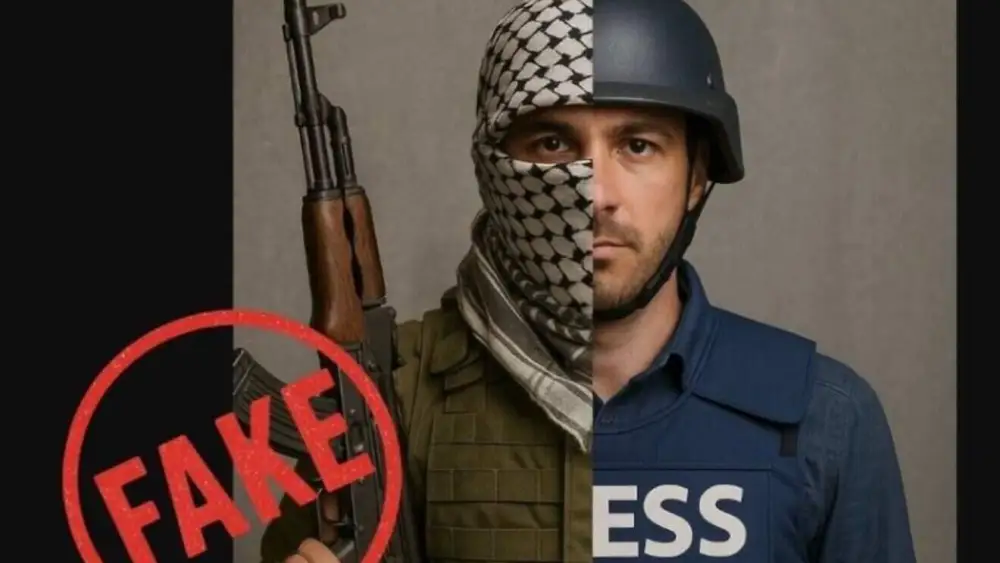
“Media Watch"—a new website set up by Israel’s Ministry of Diaspora Affairs and Combating Antisemitism—said the accusation that the IDF is killing hundreds of journalists in Gaza is false because many of the journalists aren’t journalists at all, but rather terrorists in disguise.
Diaspora Affairs Minister Amichai Chikli on Wednesday shared a report from the site documenting many of the purported journalists’ terror ties.
“We took a close look at who those so-called ‘journalists’ killed in Gaza really were. Results below,” tweeted Chikli.
He included a link to Media Watch, which says it uncovers journalists’ unsavory ties “so the public can see who is truly independent and who serves an agenda.”
The site has garnered attention, both positive and negative, with popular conservative commentator Mark Levin posting a link to the site on X.
However, the site came under cyberattack and was brought down on Wednesday night. Chikli’s staff told JNS that the site was hit by those upset by what the investigation had exposed.
“The very fact that the website established by the ministry has been suffering from incessant cyberattacks since its inception, which even led to the site being downed for a short time, is the perfect proof that the truth is very disturbing to Hamas and its supporters,” Chikli told JNS.
Fake journalistshttps://t.co/bYM0n1ukCq pic.twitter.com/vEBvsxsivI
— Mark R. Levin (@marklevinshow) September 2, 2025
Media Watch’s methodology involved combing through Facebook profiles of the deceased journalists and cross-analyzing their friend lists to identify any connections to recognized Hamas, or other terrorist, affiliates.
The site identified 48 journalists directly affiliated with a terrorist group or who had some link to terrorists.
“Just like the starvation campaign, when it is broken down into elements, you discover picture after picture, that these are complete lies, so too on the issue of ‘killing’ journalists,” Chikli told JNS, referring to the earlier, discredited claim that Israel was engaged in a systematic war of starvation against the Gazan population.
The “poster children” for that campaign, who appeared emaciated, all turned out to have pre-existing medical conditions. So, too, in the case of the putative “journalists,” the claims don’t stand up to closer inspection, he said.
“When you dive into the details and facts and go through journalist after journalist, you see that dozens of them were clear Hamas members, and some of them were also military operatives who took part in the atrocities of October 7,” Chikli said.
The new site is a work in progress and will be continually updated, said Hadas Maimon, executive director of strategic narrative and global communications for the ministry.
The ministry is building out the site to include categories, distinguishing between active terrorists, those who work for terrorist-supported news sites, and those who have other ties to terror, such as family members who belong to Hamas or Palestinian Islamic Jihad.
The site also includes a way for everyday people to report on “fake” journalists with terror ties. “We’re inviting everyone to provide information. We’ve added a ‘report’ button to the site. We invite people to share with us the information they have about journalists,” Maimon told JNS.
The ministry’s exposé comes on the heels of a campaign orchestrated by Reporters without Borders on Sunday that recruited hundreds of media outlets to simultaneously denounce Israel for purposefully targeting journalists in the Gaza Strip.
Reporters without Borders claims that Israel killed 220 journalists. It did not provide a list of names, but it did feature as the only example Anas al-Sharif, whom it identified as an Al Jazeera reporter.
Media Watch featured a section on al-Sharif.
Al-Sharif was targeted by Israel on Aug. 10 in a precision airstrike. The IDF had identified him as head of a Hamas cell, who guided rocket attacks against Israeli civilians and IDF troops. He only posed as a journalist.
“Intelligence and documents recovered in Gaza—including personnel rosters, training lists, phone directories and salary records—confirm his operational position within Hamas and his integration into the Al Jazeera network,” Israel’s Foreign Ministry posted to its embassy websites.
Israel released supporting documents, including a Hamas payroll list, providing “unequivocal proof of his Hamas military role and his deliberate use of journalism as a cover for terrorist activity,” according to the statement.
In July, the Committee to Protect Journalists (CPJ), a New York-based NGO that purports to “defend the right of journalists to report the news safely,” defended al-Sharif against what it called “smears” by Israel.
Even after Israel released the confirmatory documents that al-Sharif was on Hamas’s payroll, CPJ continued to identify him as a journalist.
CPJ, which has collaborated with Reporters without Borders, compiles lists of purported journalists killed by Israel.
The Diaspora Ministry’s Media Watch website said the CPJ’s work was the impetus for its research: “Following a publication by CPJ concerning the deaths of Palestinian journalists at the hands of Israel and the resulting questions about whether these incidents were justified, an investigation was launched to identify possible links between the deceased journalists and known Hamas affiliates.”
Media Watch’s research follows a similar investigation last year by U.K.-based journalist David Collier debunking the CPJ list, which he found was by and large a whitewashed Hamas list.
Collier told JNS on Sunday, “Over the past 22 months, far too many people wearing press jackets have been exposed as terrorists to take any claim about the targeting of journalists seriously. Which means those who still try to argue for their innocence are choosing to be deliberately blind to the truth.”
At the time of Collier’s report in January 2024, the Hamas list of ‘journalists killed’ numbered 107 people—a remarkable figure, surpassing the number of journalists killed in World War II and the Vietnam War.
The CPJ list numbered about 60 to 70 journalists at the time of Collier’s report. All the names on it came from the Hamas list, Collier discovered.
Collier was able to identify 93% of the 107 people listed through their social media accounts. He found that 35 of the 70 (50%) on the CPJ list worked for proscribed terrorist groups. About 19 (27%) weren’t journalists at all.
Seventy-nine percent endorsed terrorism and the killing of innocents. For Collier, the most egregious example was Hassuna Salim, who worked for Hamas-affiliated Quds News Network, and posted on a Telegram channel on Oct. 7, 2023, at 6:36 a.m., the time of the Hamas invasion of Israel, a directive from Palestinian Islamic Jihad calling for everyone to pick up a gun and fight.
“Messages such as these sent 100s of armed ‘civilians’ across into Israel to help Hamas rape and murder,” Collier’s report noted.
Others celebrated terrorist attacks against Israelis over a period of years. Duaa Sharaf, who worked for Hamas-affiliated Radio Al-Aqsa, posted to social media on April 7, 2022, after a mass shooting in Tel Aviv, “Kill them. May Allah punish them with your hands, and humiliate them, and help you against them, and heal the hearts of a believing nation.”
“Hit Tel Aviv. Hit it,” wrote Assem Kamal Moussa, a journalist with news site Palestine Now, of the same attack. On May 2, 2023, he posted a picture of Hamas rockets launched at Israel: “And you are on your way to transfer the occupier’s life to the sanctuaries of hell.”
Collier described CPJ’s research as “sloppy,” “consistently amateurish” and “significantly compromised,” noting that all the information he worked from was publicly available. “This was the real letdown with the CPJ,” he said. “Why the hell didn’t they do that work? How could they not bother to check anybody on social media?”