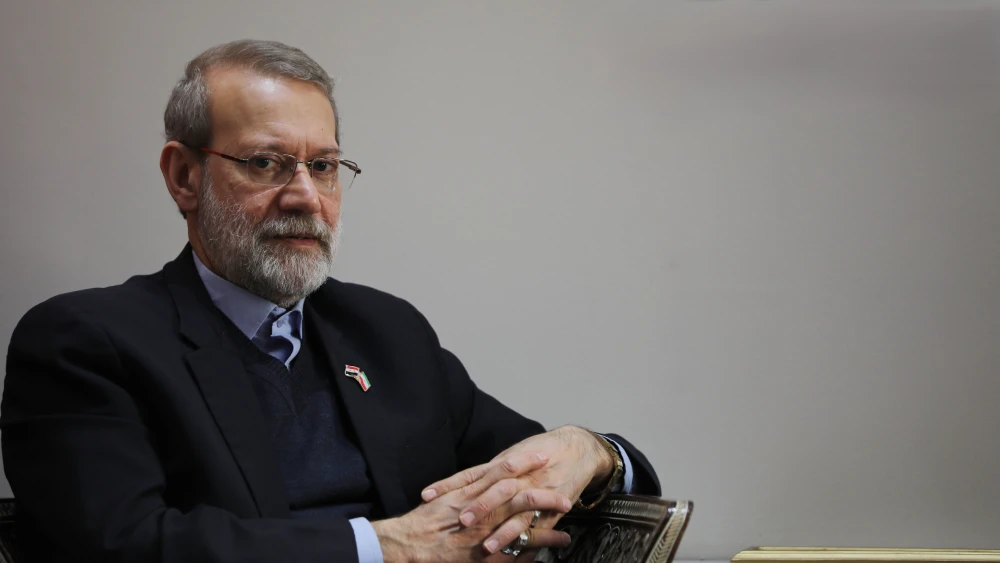

Ali Larijani, the 67-year-old former head of Iran’s Supreme National Security Council, died a terrorist’s death last week. For much of his career, however, he lived as a diplomat, and was feted as one by regional and Western nations alike.
Back in 2007, Larijani addressed the annual Munich Security Conference in Germany. Arriving in the city off the back of a Holocaust-denial conference hosted by the regime in Tehran, Larijani no doubt got a tremendous kick out of telling an audience in Germany, of all places, that it was an “open question” as to whether the Nazi slaughter of 6 million Jews had occurred. He did much the same two years later at Munich in 2009, telling one questioner that Iran’s leaders did not share European “sensitivities” or “perspectives” when it came to querying the veracity of the extermination program.
He would have likely done so again in 2011 had his earlier denialist statements not resulted in a ban on his attendance—a classic example of a European state realizing far too late that to stop the horse from bolting, the stable door would need to be shut first.
In the various high-level roles he held on behalf of the Islamic Republic, chief nuclear negotiator among them, Larijani never lost sight of the regime’s core goal of eliminating the State of Israel. Now that he has himself been eliminated—the latest in a long line of terrorists and terror enablers from Gaza to Lebanon to Iran to have been felled by an Israeli strike since the Oct. 7, 2023 pogrom—the question remains as to whether Iran can continue to be the world’s primary state sponsor of anti-Zionist ideology, assuming that the regime survives the current U.S.-Israeli onslaught in truncated form.
Iran took on that position following the collapse of the Soviet Union and its allied communist states from 1989 onwards. During the Cold War, Soviet anti-Zionism, a central plank of Moscow’s foreign policy, morphed into what I call “antizionism”—a toxic ideology that has never been as strong or as visible as today, nearly four decades after the demise of the USSR. What was being opposed was not Zionism as the vast majority of Jews understood the term, but a defamatory caricature that drew heavily on older antisemitic tropes.
This expressed itself in two principal ways: violence and propaganda.
The Soviets backed the Arab side in the regional wars of 1967 and 1973. They supported various left-wing terrorist groups in Western countries, led by such figures as the Venezuelan militant Ilyich Ramírez Sánchez (also known as “Carlos”), a KGB and East German Stasi asset who operated on behalf of the Popular Front for the Liberation of Palestine. And they sponsored a slew of propaganda initiatives, in the form of pamphlets with titles like “Beware: Zionism,” as well as U.N. General Assembly resolutions, among them the infamous equation of Zionism with racism approved by the world body in 1975.
Iran adopted an even more radical approach. The 1990s are remembered as a quieter time in the Middle East, mainly because Israel and the PLO were immersed in negotiations for much of that decade. Still, Iran executed deadly attacks against Israeli and Jewish targets, including the Israeli Embassy in Buenos Aires in 1992; the AMIA Jewish Center in Buenos Aires in 1994; and, one day after the AMIA bombing, the destruction of a Panamanian civilian airliner in which all of its 21 passengers, over half of whom were Jewish, were killed.
As with the Soviets, the violence was matched by an outpouring of propaganda. Much of this sought to undermine the truth of the Holocaust, which the Iranians depicted as a fabrication designed to provide a colonial entity with a moral shield. Key regime figures, among them the recently eliminated Supreme Leader Ayatollah Ali Khamenei and former President Akbar Hashemi Rafsanjani, dismissed the Shoah as “Zionist propaganda” and ranted about “the false slogan of the murder of millions of Jews.”
This set the stage for subsequent President Mahmoud Ahmadinejad’s later projects. In addition to the 2006 conference in Tehran, which drew speakers from die-hard neo-Nazi circles, leftist anti-imperialist groups and even followers of the anti-Zionist Haredi sect Neturei Karta, there was also a 2016 competition inviting cartoons that crudely mocked the Holocaust. In this way, Iran was able to mobilize a global cohort of malcontents who gave the world a glimpse of the kind of obscene messaging that flooded social media after the Oct. 7 massacre.
Whereas in the last century, hatred of Jews was cultivated and promoted by states like tsarist Russia, Nazi Germany, the Soviet Union, and later on, various Arab countries, in this one, the animosity is more of a horizontal phenomenon, spread across social media and civil society political campaigns by individuals and NGOs. Anti-Zionism is now essentially a cult with various branches, bringing together such ostensibly disparate figures as New York City’s Islamist mayor, Zohran Mamdani, far-left advocacy groups like Code Pink and neo-traditionalist antisemites like the podcast host Tucker Carlson, all of whom agree on core themes: the Jewish connection to Israel is fabricated, Israel has committed and is committing genocide, Israelis are not a nation but a collection of interlopers.
Even so, we should not play down the importance of state participation in a situation like this one. Over decades, Iran proved itself adept at fertilizing the lies that reside at the heart of anti-Zionist ideology, turning them into common-sense notions among adherents.
Thanks in large part to the Soviet Union and Iran, mere critics of Israel—that is, those whose voiced disapproval of the Jewish state is proportionate and directed at its actions, rather than its very existence—are a dying breed. Fealty to totalitarian entities like the Islamic Republic goes hand in hand with the desire to expunge Israel from the society of states (which is, by the way, why it’s pointless to ask keffiyeh-clad demonstrators why they are unmoved by human-rights emergencies elsewhere in the world, because for them, it’s not about human rights to begin with).
Moreover, antagonism toward Israel grounded in Holocaust denial and distortion is not a luxury that the Islamic Republic indulges in only when its leaders are feeling secure. Rather, it is integral to the nature of the regime, however strong or weak it happens to be. Thanks to Israel, powerful deniers like Khamenei and Larijani are dead. But the open sewer from which they emerged continues to reek.