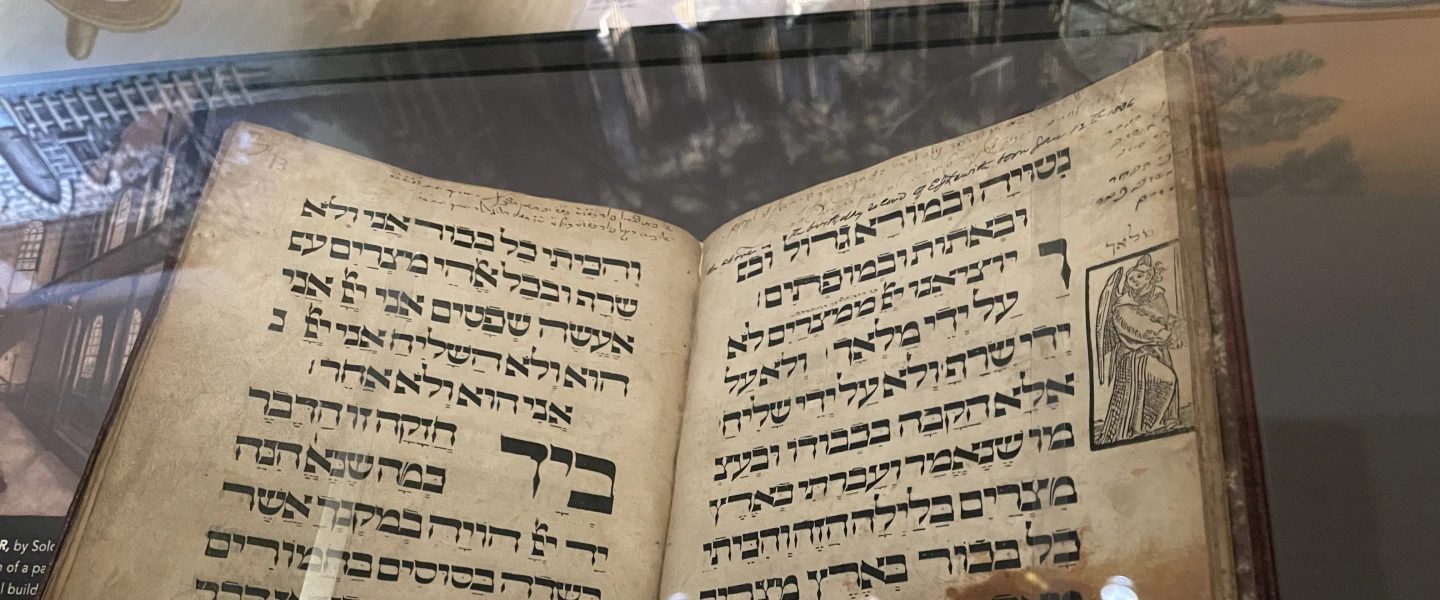
When Edward J. Lewith emigrated to Charleston, S.C., from Europe in the late 19th century, he brought with him a copy of the Prague Haggadah, printed by Gershom Cohen in 1526.
“It was clearly a cherished family treasure,” Jesse Abelman, curator of Hebraica and Judaica at the Museum of the Bible in Washington, D.C., told JNS. “They recorded family births and deaths for three generations in it in both English and Yiddish.”
Lewith, whose wife, Nena Lewith, corresponded with President Teddy Roosevelt in 1902, passed it down to relatives and in 1947, the family donated the Haggadah to Kahal Kadosh Beth Elohim, the synagogue in Charleston, which is one of the nation’s oldest and where Lewith family members were active leaders.
In so doing, they connected “the Haggadah to the history of American Jews, in addition to its own storied history as one of the most significant editions of one of the most popular Jewish books ever printed,” Abelman told JNS.
The 1526 Prague Haggadah, a copy of which Kestenbaum and Company sold for $120,000 in April 2009, was “the first complete illuminated Haggadah to be printed by Jews,” according to the Israel Museum, which owns a copy, a gift of John D. Herring and family. (John and his twin brother Paul built up an important collection.)
“Some of its woodcut illustrations were inspired by Christian sources,” the Israel Museum states. “Others originated in earlier Haggadot that had been written and illustrated by hand.”
Abelman told JNS that “first of all, it’s genuinely beautiful with gorgeous type and distinctive woodcuts.”

“It may be the first, and is certainly among the first, printed illustrated Haggadot, and its illustrations created the mold from which Haggadot would be illustrated for years to come,” he said. “It is a paradigmatic print Haggadah, from the early days of printing, and its influence is still imprinted on Haggadot being published today.”
JNS asked if the Bible Museum curator figured it would still be studied and cherished half a millennium from now.
“I hesitate to predict what will be in 500 years,” Ableman said. “I think I can confidently say that as long as people are talking about the history of the Haggadah, and they have access to the Prague Haggadah of 1526, they will be talking about it.”
“It’s foundational to the development of the book,” he said.
As the Prague Haggadah celebrates its 500th birthday, Abelman thinks the particular volume that the Lewith family preserved, which is now in the museum’s collection, has timely things to say.
“The Haggadah tells us that in every generation, we must see ourselves as if we participated in the Exodus. We must put ourselves in the story of the Haggadah,” he told JNS. “The Lewith family did this in a very literal sense, recording their family milestones on the very page where God’s personal action brought the Israelites out of Egypt, ‘Not by the hand of an angel. Not by the hand of a seraph. Not by the hands of an agent, but the Holy One, in His glory and by Himself.’”
“I think there’s something powerful in the way that the Lewiths did this on the page, inscribing themselves in pen on parchment into the eternal narrative,” he said. “It speaks to the present, I think, not in any direct way, but as a reminder that the present and the past are always tied together. A 3,000-year-old story, a 500-year-old book, a birth 150 years ago and our lives today, all present on the same page.”
Sharon Liberman Mintz, curator of Jewish art at the Library of the Jewish Theological Seminary and international senior Judaica specialist at Sotheby’s New York, told JNS that the 1526 Haggadah “is one of the most exciting books that I have ever had the pleasure to turn the pages of.”

The Prague Haggadah, which is the “first complete illustrated printed Haggadah,” marks “a pivotal moment in the development of the text used by millions of Jews around the world at the Seder,” she said.
Liberman Mintz noted that several pages from an earlier Haggadah, printed around 1510 in Istanbul, were found in the Cairo Genizah, but no complete surviving volume of that Haggadah is known.
“The Prague Haggadah is profusely illustrated with woodcuts commissioned by the printers who wished to enliven the text, but these images were not merely decorative,” she said. “They functioned pedagogically, guiding participants through the ritual and reinforcing memory.”
With the invention of the printing press and early print technology, the costs of making a beautiful text decreased dramatically, according to Liberman Mintz. That also “enabled a broader audience to engage with the Haggadah, both visually and textually,” she said.
“This important Haggadah reflects the vibrant Jewish printing culture of early 16th-century Prague, one of the most important centers of Hebrew printing in Ashkenaz,” she told JNS. “It stands at the intersection of Jewish and Christian artistic traditions and is a fascinating witness to cultural exchange, as well as to the ways Jewish printers and patrons shaped the visual language within the possibilities of print.”
Marc Michael Epstein, professor of religion and visual culture and director of Jewish studies at Vassar College and author of several books on medieval Haggadot, told JNS that the Prague Haggadah is the first place that the motif of the hare hunt appears in print. “In that iteration, the hares are being driven into a net,” he said. “Just eight years later, in Augsburg in 1534, the second printed Haggadah to feature this image appears, and something has shifted: the hares have escaped.”
Often, dogs chase hares in Haggadah depictions, even though hares are not kosher and there isn’t an immediate connection to the Exodus story.
“What are we to make of this?” Epstein said. “There are moments in which the net feels as if it is closing around us. Moments in which the darkness is not merely felt but must be named, and yet it is worth remembering that we have passed through such moments before, and emerged, as the hares of Augsburg remind us, on the other side.”

“The Augsburg Haggadah offers a corrective to the more somber vision of its Prague predecessor, articulating in images what the Haggadah itself declares,” he told JNS, “that ’though more than one has risen against us to put an end to us, the Holy One has saved us from their hand.’”
When Kestenbaum, a New York City auction house, sold a copy of the Prague Haggadah in 2009, it called the book the “most celebrated printed book in the history of Hebrew printing.”
“The magnificent Prague Haggadah served as a prototype for all future illustrated Haggadahs for centuries,” it said.
It added that only five complete paper copies of the Prague Haggaadah are recorded—at Oxford’s Bodleian Library, Copenhagen’s Royal Library, New York’s Jewish Theological Seminary, Jerusalem’s Schocken Library and the Klagsbald Collection in Paris. The book that Kestenbaum was auctioning came from the estate of a Swiss family, it said.
“This magnificent work, with its superb borders, poised lettering, stately initials, marginal cuts and decorations and its assured balance, is among the most distinguished productions of the 16th-century press,” the celebrated historian Cecil Roth wrote of the book in 1965.
“The beauty of the work lies above all in the superb disposition of the type and the exquisite balance of the pages,” he added. “Words cannot convey the full beauty of this work—every page of which justifies a long, detailed and affectionate description.”
The Haggadah has more than 50 woodcut illustrations in it, including knights in armor, angels and Jews observing the holiday. The evil son is depicted as a soldier with a sword and ax, and on a page alongside text about nakedness, a semi-nude woman is illustrated. Another illustration depicts the Midrashic story, in which Pharaoh’s advisers tell him that he must bathe in Jewish infant blood to cure his leprosy.
Abelman told JNS that whenever the Bible Museum has displayed the Prague Haggadah owned by the Lewiths, it has been well-received.
“The significance of the printing combined with the personal connection to the Lewith family is compelling to people,” he said. “I hope it helps them better understand the place of the Haggadah in Jewish history as well as Jews’ place in American history.”