Newsletter
Newsletter Support JNS

Israeli scientists ID coronavirus proteins that harm blood vessels

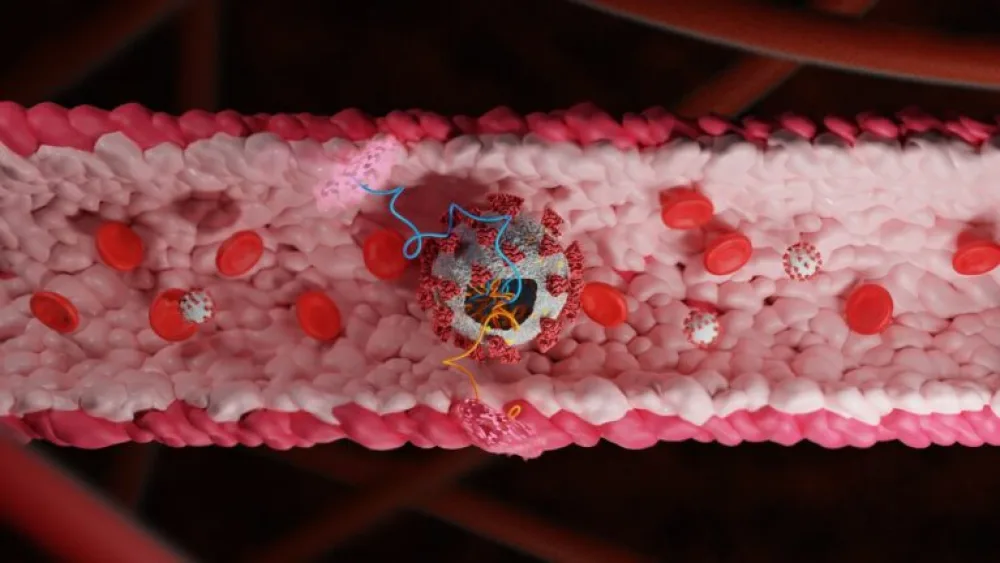
While COVID-19 is primarily thought of as a respiratory disease, patients are up to three times more likely to suffer a stroke or heart attack, says Tel Aviv University researchers.

COVID-19 in a blood vessel. Image courtesy of Tel Aviv University.

A team of Israeli experts has solved the mystery of which proteins in the SARS-CoV-2 virus are responsible for causing the severe vascular damage seen in coronavirus patients.

The novel coronavirus is made up of 29 proteins. Five of those proteins were identified as damaging to blood vessels in a study led by Tel Aviv University researchers Ben Maoz (biomedical engineering and neuroscience), Professor Uri Ashery (life sciences and neuroscience) and Professor Roded Sharan (computer science).

“We see a very high incidence of vascular disease and blood clotting, for example, stroke and heart attack, among COVID-19 patients,” said Maoz.

“We tend to think of COVID as primarily a respiratory disease, but the truth is that coronavirus patients are up to three times more likely to have a stroke or heart attack,” he explained.

“All the evidence shows that the virus severely damages the blood vessels or the endothelial cells that line the blood vessels. We wanted to find out which proteins in the virus are responsible for this type of damage.”
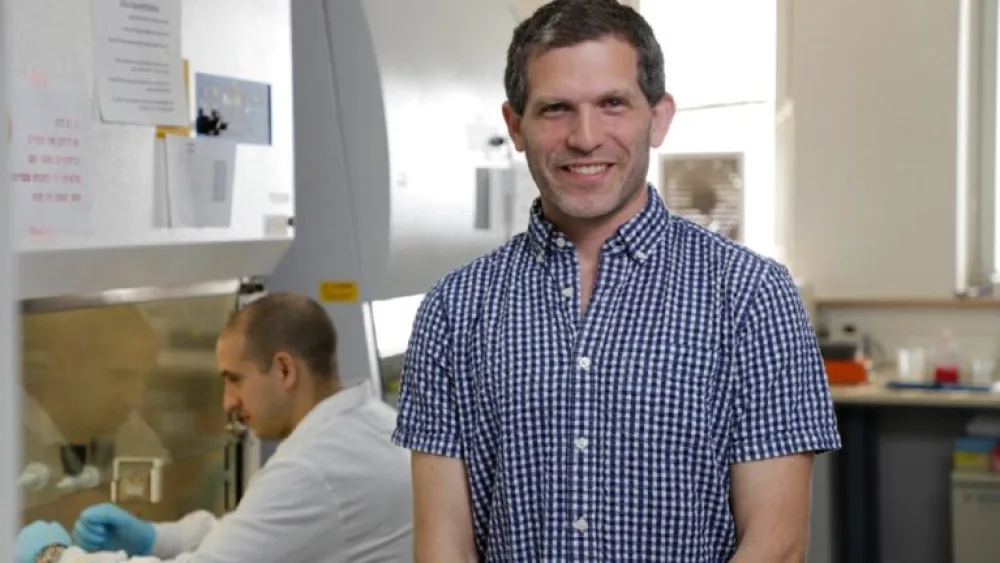
Dr. Ben Maoz of Tel Aviv University. Photo courtesy of Tel Aviv University
Researcher Ben Maoz of Tel Aviv University. Photo courtesy of Tel Aviv University.

Also participating in the study were Rossana Rauti, Yael Bardoogo and Meishar Shahoah of Tel Aviv University and Professor Yaakov Nahmias of the Institute of Life Sciences at the Hebrew University. The results were published in the journal eLife.

“Our research could help find targets for a drug that will be used to stop the virus’s activity, or at least minimize damage to blood vessels” in COVID-19 patients, said Maoz.

This article was first published by Israel21c.

“A soldier is missing from the tank,” a handwritten report appears at 6:40 a.m. on June 25, 2006, more than an hour after the abduction.
Israeli forces later killed six Hezbollah terrorists in separate engagements as troops continued operations inside the Security Zone.
The Israeli airline said it would review its decision next week following an assessment of the situation.
The Israeli leader said the Jewish state turned the table on its enemies after Oct. 7, breaking through “the barrier of fear.”
The newly released State Archives trace the Israeli response from the Air France hijacking to the successful hostage rescue in Uganda.
Panelists at the JNS Summit argued that Israel must expand its domestic military capabilities while continuing strategic cooperation with the United States.
Benny Gantz, JNS editor-in-chief Jonathan S. Tobin, Gilad Erdan, Mosab Hassan Yousef, Nissim Black and leading voices in security, diplomacy, media, law and Jewish communal affairs headline the summit’s third day in Jerusalem.