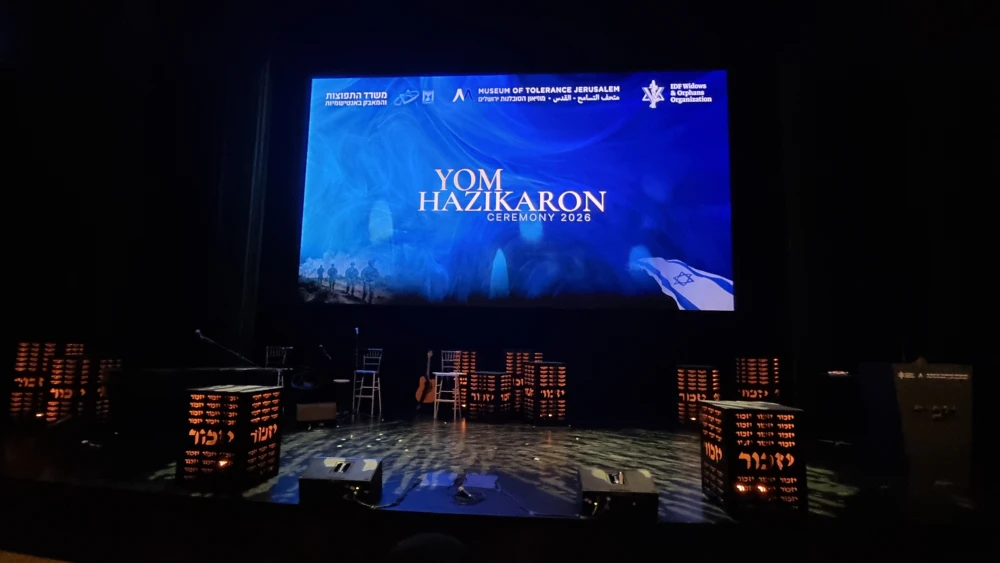
As the piercing siren sounded across Israel at 8 p.m. on Monday night, April 20, the country came to a standstill, marking the start of Yom Hazikaron, Israel’s Memorial Day for fallen soldiers and victims of terror.
For many English-speaking immigrants to Israel, however, participation in this deeply rooted national moment can be complicated by language barriers that create distance from communal mourning. For the third consecutive year, an English-language Yom Hazikaron ceremony at Jerusalem’s Museum of Tolerance sought to close that gap, offering not only translation but a sense of belonging.
Organized by the IDF Widows and Orphans Organization (IDFWO), with support from Israel’s Ministry of Diaspora Affairs and Combating Antisemitism, the ceremony created a shared space in which grief, memory and resilience could be fully understood and deeply felt.
This year, Israelis commemorated 174 fallen soldiers and 79 victims of terror lost in the past year alone, joining the enduring national memory of 25,650 people killed in defense of the State of Israel and in terrorist attacks in Israel and around the world. The military bereavement circle now includes more than 59,500 family members.
The weight of the past year hung palpably over the evening. The trauma of the Oct. 7, 2023, Hamas-led attacks, along with ongoing military operations, has drawn Israelis and Jewish communities worldwide closer to the raw reality of loss.
Former Mossad director Yossi Cohen, president of the International Friends Association of the IDF Widows and Orphans Organization, delivered opening remarks emphasizing the emotional resonance of the national moment.
“The siren that has just faded still echoes in all of our hearts,” Cohen said. “The absolute silence that envelops the entire nation for one long minute is a silence we all too well know—it is the silence that remains in the house after they are gone.”
Speaking not only as a former intelligence chief but also as someone personally touched by loss, Cohen framed bereavement as a pillar of national strength.
“I do not see just bereavement,” he said. “I see the backbone of Israel.”
Throughout the evening, stories of personal loss were woven into a collective narrative of remembrance and resilience.

Families share their stories
Among the families highlighted was that of Sgt. Maj. (res.) Yossi Hershkovitz, 44, principal of the ORT Pelech High School in Jerusalem, who was killed in battle in northern Gaza on Nov. 10. His children, Be’eri, Shira and Tal lit a memorial torch and recited Yizkor, transforming private grief into a public act of remembrance.
Music underscored the emotional ceremony. Singer Yonatan Razel performed “Gam Ki Elech,” (Though I Walk), a song composed under fire in Gaza, alongside members of the Hershkovitz family, embodying the evening’s central theme of moving forward while carrying the weight of memory.
Eitan Amsalem of the Museum of Tolerance reflected on the meaning of silence itself.
“Silence bears more weight than words,” he said, noting how dreams, possibilities and futures are lost with each life cut short.
One of the most poignant moments featured Kimi Alush, the widow of Daniel Alush, who was killed in a helicopter crash during a rescue mission in Gaza in September 2024. Sitting alone on a dark stage illuminated by a single lamp, she read a letter to her sons describing the enduring reality of grief.
“You’re never really okay,” she said, while emphasizing her determination not to be crushed by a loss she never chose.
Her story echoed a generational legacy of bereavement: her mother, Ankie Spitzer, lost her husband Andre Spitzer in the 1972 Munich Olympics massacre.
Chava Zenilman, widowed with three young children, described choosing growth over despair after the death of her husband Ari in Gaza in December 2023. Shortly before he fell, the couple named their infant daughter Maayan Nechama—“a spring of comfort.”
“We choose to grow, to develop together,” she said. “We will win.”
The ceremony also featured testimony from Orit Mark and Keren Emuna Kalmanson. Mark, who was 16 when her father, Miki Mark, was killed in a 2016 terror attack, has since lost five close family members over eight years to terror and war.
“Everyone calls them heroes,” she said. “I just want them alive.”
Among those attending was former Knesset member Shulamit “Shuli” Mualem-Rafaeli, who became an IDF widow in 1997 when her husband Moshe was killed in a helicopter disaster that claimed the lives of 73 soldiers. She later became a leading advocate for bereaved families and worked to ensure that IDF widows who remarry continue to receive their pensions.
“IDFWO not only supported me,” she told JNS. “It helped raise my two young daughters.”
Rabbi Dr. Benji Levy, CEO of SHARE and a key figure in producing the ceremony, emphasized the collective responsibility carried by those in attendance.
“We enter this ceremony as individuals,” he said, “but we must leave as a collective witness—carrying forward the legacy of the incredible heroes left behind.”
Founded in 1991, the IDF Widows and Orphans Organization supports bereaved families throughout their lives. The English-language ceremony demonstrates that support extends beyond financial or logistical assistance, creating spaces in which memory is accessible and grief is shared.
As the evening concluded with a memorial montage of fallen soldiers, the message was clear: Yizkor is not only about looking back. It is about sustaining a shared commitment and striving to be worthy of the memory of those who are no longer here.
In a country bound together by loss, the ceremony ensured that language would not be a barrier to belonging.