When people hear the name Oberson in Israel, many think of fashion.
For decades, Gideon Oberson and his family helped shape Israeli couture, dressing generations of women and building one of the country’s most recognizable design brands. His daughter, Dana Oberson, inherited the creative gene but chose a different medium.
Instead of fabrics, she works with stone. Instead of runways, she designs homes, hotels and public spaces that draw inspiration from Israel’s landscapes, history and layered identities.
With the publication of her new monograph, House of Oberson: A Design Legacy, Israeli architect Dana Oberson invites readers into a world where architecture is about more than buildings.
“Israel has beautiful sites,” Oberson told JNS during a recent Zoom interview. “I wanted to share them with the world at the highest level possible.”
Published by Rizzoli, the internationally renowned publisher known for its architecture and design titles, the book showcases more than two decades of work by the founder of Herzliya-based Oberson Architects.
For Oberson, design is a way of sharing place, identity and the relationship between people and their surroundings. Her projects range from luxury private homes to hospitality developments. All draw heavily on Israel’s landscapes, history and diverse communities, creating spaces that feel rooted in their environment rather than imposed upon it.

A family legacy of design
Design has been part of Oberson’s life from the beginning. She grew up in a family where creativity was woven into everyday life.
Her parents, whose families knew each other before fleeing to Italy during turbulent times in Europe, married young and built their lives around design and fashion. After arriving in Israel, they began making dresses at home.
Yet Oberson did not ultimately follow her father’s path.
After serving in the Israel Defense Forces, she studied graphic design at the Bezalel Academy of Arts and Design. There, she discovered architecture’s unique ability to operate across multiple dimensions and scales.
“What fascinated me was the possibility of more than one dimension and the change of scale,” she said. “One day you can be designing a chair, and the next you can be working on an entire building.”
That flexibility continues to shape her approach. While fashion influenced her appreciation for aesthetics and detail, architecture offered an opportunity to create experiences and environments that people inhabit every day.
“Design has no borders,” she said. “It is always crossing boundaries.”
Inspired by landscape and history
That philosophy is evident throughout her work. Oberson rejects short-lived trends in favor of timeless designs shaped by climate, landscape and local context.
Rather than beginning with a preconceived style, she studies the site, the sun, the topography, the views and the people who will ultimately live there.
“I dislike trends,” she said. “Every home should be different.”

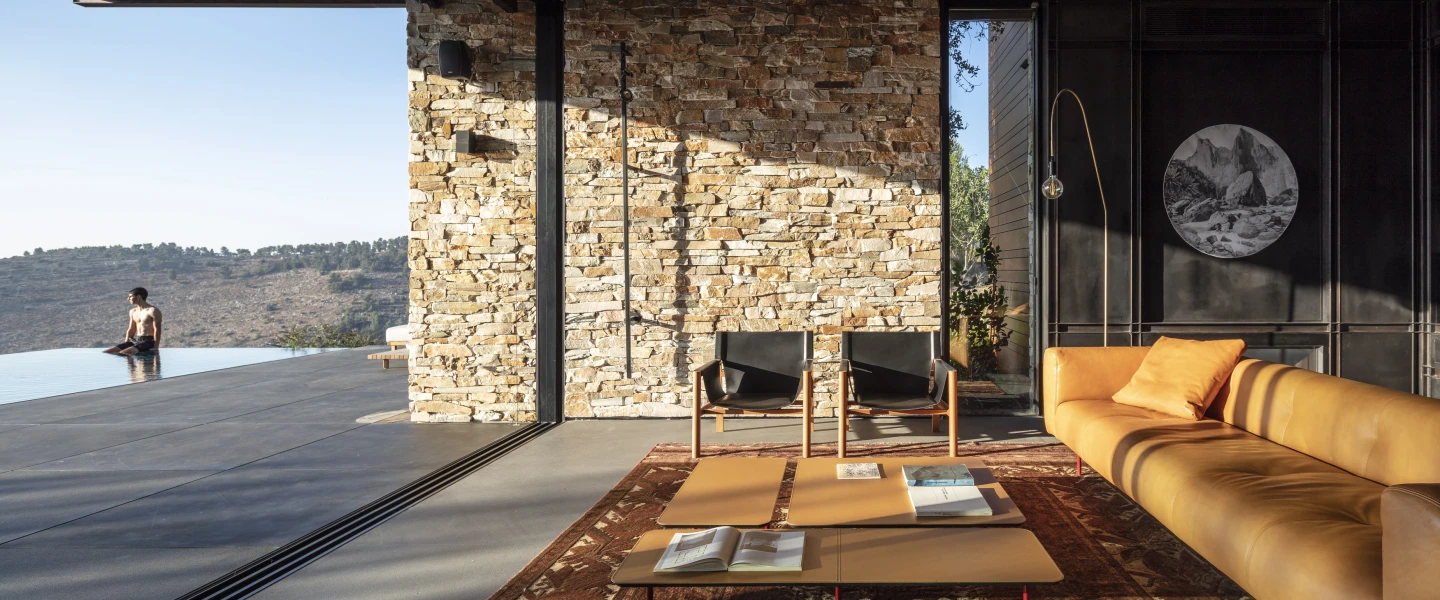
One project featured prominently in the book is a contemporary stone villa in the hills of Neve Ilan, in the heart of the Judean Hills. Built on a sloping site overlooking forested hills and distant views toward the Mediterranean, the home uses locally sourced Jerusalem stone to create a dialogue between past and present.
For Oberson, the challenge was not simply to build a house but to create a home connected to its surroundings and history while meeting contemporary needs.
The project also reflects a broader theme running through her work: architecture’s role in places where multiple histories and communities intersect.
Rather than imposing a universal design language, she seeks to create buildings that belong to their location.
That approach extends even to large-scale developments. Oberson is currently involved in a project of approximately 300 homes, each individually designed with distinct landscaping and architectural elements.
“Each home must have its own personality,” she said.
Creating spaces that belong
As one of Israel’s leading architects, Oberson has navigated a profession traditionally dominated by men. She often finds herself the only woman in the room.
“Israel is still a male-dominated country,” she observed, noting the imbalance visible in many sectors, including politics.
Yet she views her perspective as an advantage rather than an obstacle.
“I’m blonde, but stupid I am not,” she recalled telling one boardroom full of skeptical colleagues, a remark that quickly commanded attention.
Today, her firm is recognized internationally for projects that blend minimalist aesthetics with Mediterranean influences, natural materials and a strong sense of place. The new monograph documents that evolution while offering a broader reflection on contemporary Israeli architecture.
Ultimately, Oberson hopes readers come away with a deeper appreciation for the landscapes and stories embedded in the built environment.
Her dream project? A budgetless one in a beautiful place—overlooking the sea, in the barren desert or in the snow.
More than luxury, however, the dream represents creative freedom: a chance to design slowly, intentionally and without compromise.
For Oberson, architecture at its best is not about creating landmarks. It is about creating spaces that belong.
“It’s not about building a house,” she said. “It’s about creating a home.”