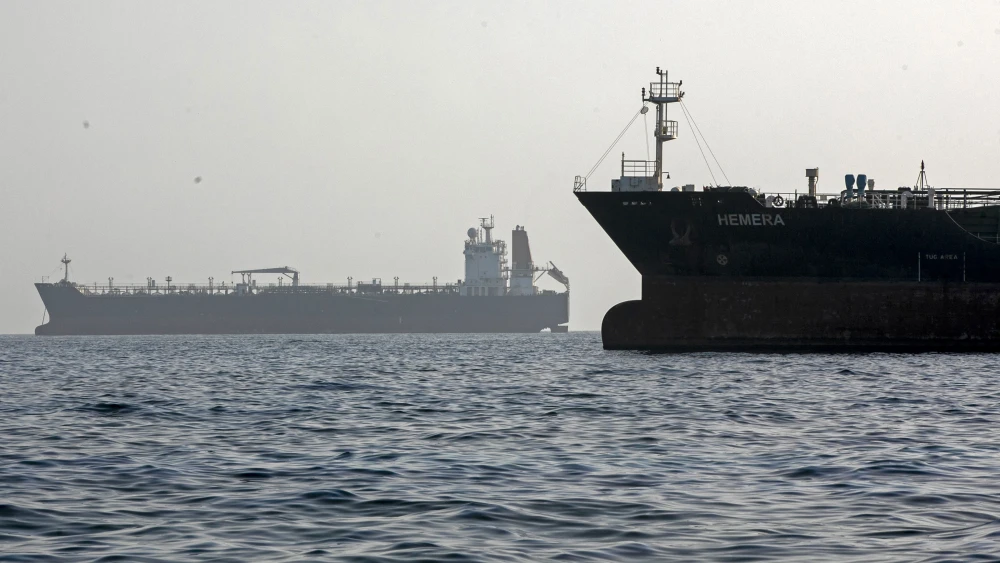
U.S. forces on Friday intercepted several Iranian ballistic missiles and drones launched by Iran toward its Gulf neighbors and the Strait of Hormuz, the U.S. Central Command said.
In total, the Islamic Republic fired seven ballistic missiles toward Kuwait and Bahrain, hours after CENTCOM downed four Iranian one-way attack drones that were launched toward the strait, the statement read.
CENTCOM described the drones as posing “an immediate threat to regional maritime traffic.”
In response, U.S. forces struck Iranian coastal surveillance radar sites in Geruk, east of the strait, and on Qeshm Island in the northern part of the chokepoint as a defensive measure, the statement continued.
“Initial assessments indicate six of the missiles launched by Iran were intercepted and a seventh did not reach its intended target,” CENTCOM said.
No injuries to U.S. service men and women were reported.
The statement added that Iranian claims of damaging U.S. 5th fleet headquarters in Bahrain “are false.”
— U.S. Central Command (@CENTCOM) June 6, 2026
Meanwhile, U.S. President Donald Trump sat down on Friday for an interview with Kristen Welker of NBC News’ “Meet the Press,” in which he said that one reason Tehran is not rushing to reach an agreement with Washington to end the conflict is that it “has been getting away with whatever [it] wanted” for 47 years, since the 1979 Islamic Revolution.
He added that the Iranians are “strong, they are proud; there are things they never thought they’d be doing that they’re going to have to do ..., they’ve got no choice. And it takes a little while.”
The war against Iran “should’ve been done long ago. This should’ve been done by other presidents or other countries,” Trump continued.
He said he decided to act because Tehran was twice close to having a nuclear weapon, adding that the 2015 Joint Comprehensive Plan of Action was “tantamount to giving them a nuclear weapon.”
The American leader said that it was for this reason he terminated the agreement in 2018, which would have expired in any case and paved the way for Iran to obtain a nuclear bomb.
"There are things they never thought they'd be doing that they're going to have to do... You're talking about 47 years of getting away with whatever they wanted," says @POTUS on Iran talks.
— Rapid Response 47 (@RapidResponse47) June 5, 2026
"This should've been done long ago. This should've been done by other presidents or other… pic.twitter.com/tcWI6TL7op
Trump further stated that most of Iran’s manufacturing sites for missiles and drones have been destroyed during “Operation Epic Fury,” but the Iranians still have some 21-22% of their stockpile of ballistic missiles intact.
The full interview will air on Sunday.
Witkoff, Kushner meet with nuclear experts in Tennessee
Trump’s special envoys Steve Witkoff and Jared Kushner meanwhile paid a visit to Tennessee to consult with a team of nuclear experts at the Oak Ridge National Laboratory, Axios reported on Friday.
The meeting on Thursday could mean that negotiations with Iran are reaching the final hurdle, after which Tehran’s nuclear project will become the focal point of future talks.
“This meeting in Oak Ridge doesn’t mean that a deal is going to happen, but it is a sign that the negotiations are in a very serious phase and that there is a good chance to get it done and we want to be prepared,” Axios cited a U.S. official as saying under conditions of anonymity.
A team of some 100 experts was recently formed should a Memorandum of Understanding soon be finalized, the report read.
The report further said that an agreement to extend the truce for 60 days has been already reached, but that Trump had asked for two amendments, one of which stipulates a 60-day deadline for Iran to down-blend its enriched uranium material, a process that dilutes the purity levels into a safer, more usable form.
However, the Iranian regime requested to extend the deadline to 90 days, two sources were cited as saying.
The second point of contention reportedly involves Iran’s frozen financial assets, with the Trump administration conditioning their release on the Islamic Republic’s gradual proof of compliance and Tehran demanding an immediate release with no strings attached, per Axios.