


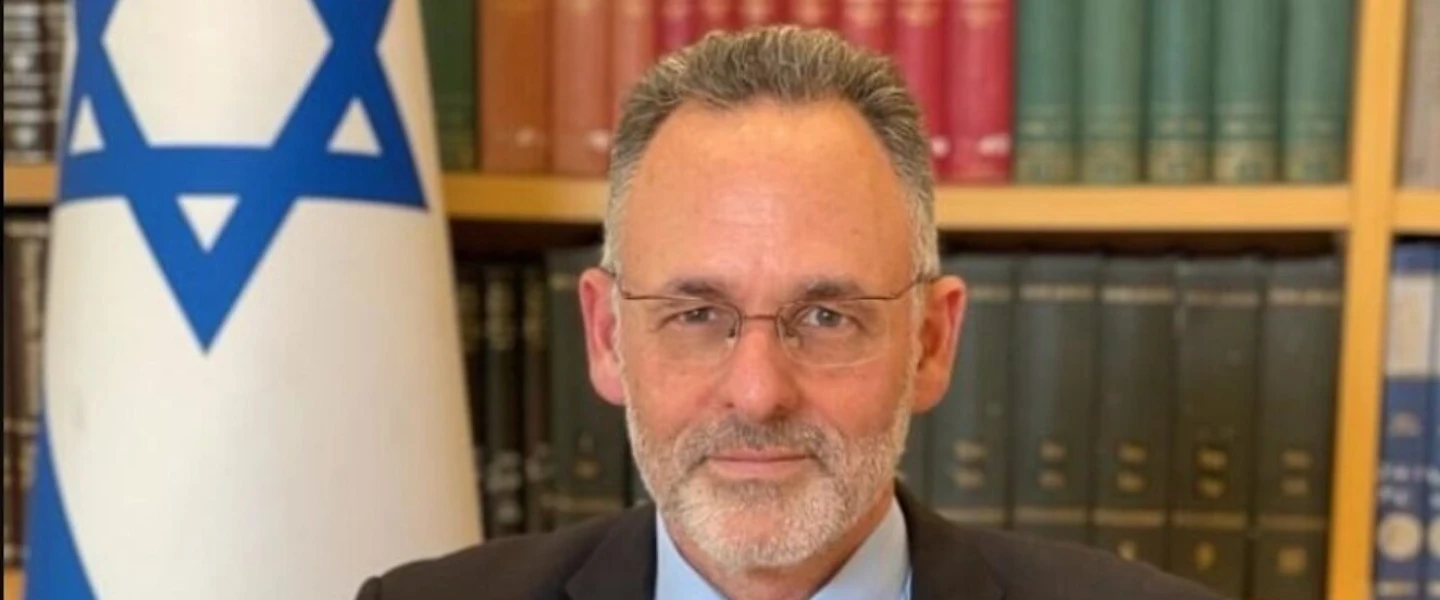
OTTAWA, Canada—There is a connection between sustained, sharp criticism of Israel by the Canadian government and a rise in antisemitic incidents fueled by extremists, Israel’s Ambassador to Canada Iddo Moed told JNS on Tuesday. He stressed, however, that he was not accusing the Canadian government itself of Jew-hatred.
“I don’t blame the government for antisemitism in any way, shape or form. I don’t think this government is antisemitic, but I do think that continued criticism of Israel, along with neglecting to voice support in principle for the relationship, has an impact on antisemitism,” said Moed.
“There are 400,000 Jewish people in Canada; it is the fourth-largest diaspora in the world. That link is very special, so it is impossible to think about the bilateral relations without appreciating the value that the Canadian Jewish community brings into that,” he said.
Referring to Prime Minister Mark Carney’s remarks at Holy Blossom Temple in Toronto on June 1, Moed welcomed the acknowledgment of antisemitism as a national problem.
“I think it was important that he spoke out against antisemitism and acknowledged that there is a crisis of antisemitism in Canada. I don’t think it was acknowledged by this government before,” said Moed.
“I read reactions from Jewish organizations who feel that more needs to be done, and they need to see action being implemented and legislation being enforced. I follow that. I have mentioned to the Canadian government repeatedly our continued concern about the rising antisemitism in Canada,” he added.
According to Moed, the most significant turning point in Israel-Canada relations came in March 2024, when Ottawa suspended export permits for controlled items destined for Israel.
“It was a kind of blanket policy that was announced at that time, and it included components of the Iron Dome and other defensive equipment for Israel—no arms, because we don’t buy any arms from Canada,” said Moed.
“To me, it signified that Canada was not going to support Israel in its defense in an existential war against Iran and all its proxies at a time when we still were not sure whether Iran would attack directly, which it did. ... I felt this was the time of need, where Israel was really looking to its friends, and that’s when the Canadian government announced that the export permits were suspended,” he continued.
The policy was not publicly described as an embargo until the 2025 election campaign, when Canadian Prime Minister Mark Carney referred to it as such. Moed also addressed the tendency of candidates who supported initiatives such as Vote Palestine, a grassroots campaign to boycott prospective lawmakers who do not support the Palestinians.
“I see a very clear line between that and getting elected. Those candidates used the campaign of Vote Palestine to get more votes. This is part of the political system. Unfortunately, sometimes the policies vis-à-vis Israel are at least partially based on domestic electoral considerations, but this is not unique to Canada,” said Moed.
A different standard
Speaking about Canada’s condemnation of Israel’s treatment of activists who attempted to reach Gaza by boat in May in what many viewed as a publicity stunt, Moed said Jerusalem has grown accustomed to being held to a different standard.
“Those people are provocateurs. When they walk out of the airport, you see them walking, when in fact they are supposed to have a broken tailbone or a twisted ankle. You have to take that into consideration before you come to any country and blame them for something that cannot really be substantiated,” the ambassador said.
Countries, he added, should exercise caution before accepting such accusations, particularly when they come from activists who have been involved in promoting blood libels against Israel for years.
Circling back to the issue of rising antisemitism, Moed said it poses a real threat not only to Jews but also to society, tolerance and mutual respect. The strain of antisemitism that has plagued Canada in the aftermath of the Hamas-led Oct. 7, 2023, massacres, he argued, can be linked in part to foreign actors and to organizations listed as terrorist entities in Canada.
“Prime Minister Carney mentioned in his speech immigration and preventing hate from being imported to Canada, so this is something he likely alluded to himself,” Moed said.
Moed emphasized that there is no contradiction between respecting freedom of speech and ensuring the security of all citizens.
“It is based on agreeing that we disagree sometimes, but agreeing that we respect each other as human beings with different opinions. Our society should be based on those values. ‘Love thy neighbor as thyself,’ that’s the basis for everything,” he said.
“Young people who are frustrated and feel that part of their frustration should be expressed against Jews for some obscure reason should understand that expressing hate is bad for society; it is bad for them and for their future,” he added.
Education and law enforcement are both essential, Moed said, in a world where the freedoms that used to be enjoyed by all the same way are changing.
When a policeman didn’t do anything
“When a young girl thinks five times whether she should wear her Star of David out because she may be attacked, her freedom of expression is limited, and that should not be the case. When a five-year-old Canadian boy is called a baby killer, it should not be allowed as well,” he continued.
“When hateful things were yelled at that boy, there was a policeman nearby and he didn’t do anything, either because he did not know what law was being broken, because he did not hear, or because he did not care. Who knows. Our society is changing and we all need to be more proactive and reach out to one another to strengthen each other,” he added.
Moed said authorities should work to mitigate and prevent threats through stronger enforcement of existing laws, emphasizing that many measures can be implemented through simple steps. He added that society must be more vigilant than in the past.
Most important, the embassy aims to demonstrate to Canada’s Jewish community that it stands with them.
“Israel is here together with the Jewish community to support it, think together and voice concerns vis-à-vis the government whenever it is appropriate for us to do. We use any possible venue to raise it because I think this is part of my duty. Just as the Jewish community was concerned with what happened in Israel since Oct. 7, such outpouring of support, solidarity and concern is not one-sided,” he said.
Asked how safe it is to be Jewish in Canada, Moed said Canadian Jews themselves are best positioned to answer.
“I hear every day stories about ‘Plan B.’ Plan B means people leaving, preparing to leave, thinking about leaving, looking for another location to live, whether it is the United States or Israel. ... I hear it every day, and I didn’t hear it as often a year ago, not two years ago, and definitely not when I came here in August 2023,” said Moed.
“Therefore I think more Jewish people feel that Canada is less safe for them today than it was before Oct. 7. I see the rise of the levels of antisemitism. According to B’nai Brith, it is almost 20 incidents a day; it happens almost every hour. It’s mind boggling. It is a crisis, as Prime Minister Carney admitted.
“I will reiterate our willingness to support whatever the Canadian government wants to do to mitigate this threat,” the ambassador said.



